


It should have been over sooner


.jpg)
.jpg)
.jpg)
Reading Time: 5min | Tue. 07.07.26. | 09:47
It has long been clear that the greatest player in Portugal's history has been holding the team back for quite some time, but Roberto Martinez either failed to see it or simply refused to see
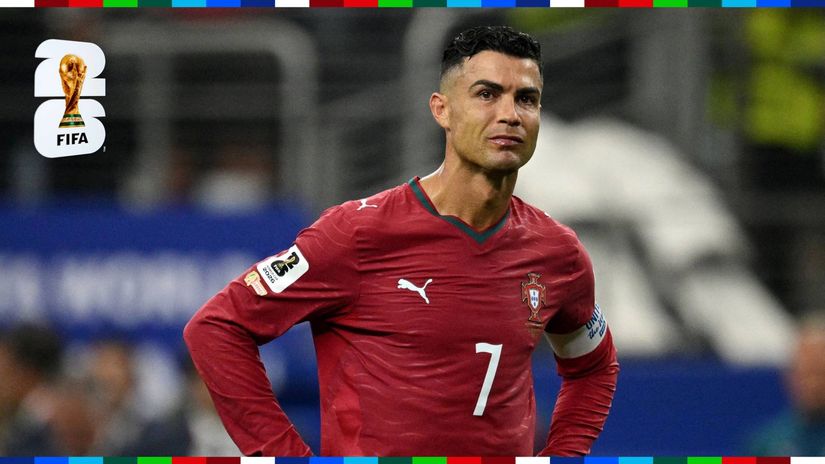
Cristiano Ronaldo stood motionless when the final whistle blew against Spain, hands planted on his hips, tears welling in his eyes as he gazed into the distance. In that instant, the reality finally sank in: his pursuit of World Cup glory had come to an end.
Many believed that chapter should have closed four years earlier, when Portugal were eliminated by Morocco in Qatar. Instead, Ronaldo was granted one last appearance on football’s biggest stage. Yet fairytale endings are rare in elite sport.
Cristiano Ronaldo fights back tears after Portugal's elimination in what could be his final World Cup pic.twitter.com/Dvs3mdEhCp
— Vidol (@imVidol) July 6, 2026
Against Spain, the Portuguese captain looked exactly what time has made him — a 41-year-old icon whose brilliance can no longer overcome the limits of age. He fought until the very end, chasing the one prize that had always escaped him, but determination alone was never going to be enough.
His involvement told the story. Ronaldo managed just 19 touches throughout the match. By comparison, Spain striker Mikel Oyarzabal, who recorded the fewest touches among the other starters, had 35. Ronaldo was largely absent from the contest, with the game often unfolding around him rather than through him. A player once capable of deciding the biggest occasions almost single-handedly had become little more than a spectator, watching the action instead of shaping it.
>1 - Cristiano Ronaldo in the knockout stages of the World Cup:
— OptaJoe (@OptaJoe) July 7, 2026
741 minutes
10 matches
1 goal (penalty)
0 assist
Epilogue. pic.twitter.com/XKCQVSZQ3l
That performance was hardly unexpected considering the rest of his tournament. When Ronaldo shouted, “I’m back, I’m back!” into the television cameras after Portugal's win over Uzbekistan in Houston, the declaration felt more emotional than convincing.
Anyone judging beyond the goals against modest opposition could see that this was no longer the devastating Ronaldo of old — the relentless forward who routinely produced extraordinary moments and carried teams through impossible situations. As the score remained level against Spain and Portugal searched desperately for inspiration, many assumed his number would appear on the substitution board.
Instead, others made way. Pedro Neto departed, followed by Vitinha, Joao Felix and later Joao Cancelo. Ronaldo stayed on. Despite being the oldest player on the field by a considerable margin, he remained until the final whistle.
Roberto Martinez never seriously considered taking him off. Unlike Fernando Santos, who had shown the courage to bench Ronaldo during the previous World Cup, Martinez consistently chose to build around him.
The one exception came against Croatia, but even that substitution required little bravery. Portugal were losing control in midfield, and Goncalo Ramos had already entered the match in search of an equaliser, which eventually came from Ronaldo's penalty. Sacrificing a striker for Ruben Neves restored balance rather than signalling any shift in hierarchy.
🥺🚨 Zinadine Zidane on Cristiano Ronaldo crying after the full time whistle:
— The Touchfine | 𝐓 (@TouchfineX_) July 6, 2026
🗣️ “I felt hurt seeing him cry after the final whistle. You could see it wasn’t about him anymore, it was about his country. What kind of man loves his nation more than himself to the extent he played… pic.twitter.com/Jr3mhOsli6
Ironically, it was Ramos who once again delivered when Portugal needed him most. “When you need a late goal, you can call Goncalo Ramos,” the striker remarked after the match.
Yet Martinez rarely seemed willing to make that call if it meant replacing Ronaldo.
Some will inevitably ask whether Ronaldo himself should have spared his coach that dilemma. It is a legitimate debate. His achievements for Portugal remain unmatched: 146 goals in 233 international appearances, five Ballon d'Or awards and a place among football's immortals. None of that changes because of one disappointing World Cup, nor should it.
His legacy also remains secure despite suggestions that extending his international career may have slightly clouded its final chapter. History will remember the extraordinary rivalry he shared with Lionel Messi, not the fact he managed only seven touches after halftime against Spain. Even so, there is a difference between preserving a legacy and acknowledging present reality.
It is difficult to avoid the conclusion that this tournament increasingly became a personal mission for Ronaldo rather than one that truly served Portugal's ambitions.
He secured more records, becoming the first player to score in six different World Cups and finally finding his first goal in the knockout rounds. He also surpassed Eusebio as Portugal's leading World Cup scorer. Impressive milestones, certainly, but they ultimately did little to improve Portugal's chances of lifting the trophy.
🚨 Roberto Martinez on Christiano Ronaldo:
— DREN!! (@City_Dren) July 6, 2026
Reporter:🎙️
Why do some people always criticize your judgement on playing Ronaldo throughout the 90th minute of the game?
Roberto:🎙️
It is there job to criticize and it is my job to decide. Christiano Ronaldo was never the problem,… pic.twitter.com/EHyG9Ved7l
Ordinarily, those tactical decisions would reflect directly on Martinez, but his departure means the scrutiny will now fall on others. Ronaldo's role will be part of the discussion, although Portugal's failure cannot be pinned solely on one player.
Too many key figures failed to reach their usual standards. Bruno Fernandes, so influential throughout the Premier League season, never truly imposed himself on the tournament. Vitinha, outstanding for Paris Saint-Germain and regarded as one of the world's finest midfielders, looked unusually subdued, perhaps worn down physically.
Collectively, Portugal lacked rhythm and cohesion. They struggled against DR Congo, escaped defeat against Colombia, and required both Ramos' impact from the bench and a VAR decision to edge past Croatia.
🚨🏆 Cristiano Ronaldo: “I’ve won Euro 2016 and for me it has same dimension as the World Cup”.
— Fabrizio Romano (@FabrizioRomano) July 6, 2026
“That remains forever. Tomorrow is a new day, and we go”. pic.twitter.com/Dk9XIsHaiY
Ronaldo himself appeared prepared for the end. The day before facing Spain, he spent nearly half an hour speaking with reporters, dismissing critics before thanking them for providing motivation. He insisted he had already accepted that his life and career would remain complete regardless of how this World Cup ended.
After Portugal's elimination, as journalists crowded around him one final time in a World Cup mixed zone, he repeated the same message.
“For me, the biggest title the national team won was the European Championship in 2016. I sincerely think it had the same significance as the World Cup,” Ronaldo said. “So for this reason I repeat, I have a clear conscience and I gave it my all — that’s it. Tomorrow will be a new day and life goes on.”