



Kenneth Muguna: On a Path of Proving Doubters Wrong



Reading Time: 7min | Fri. 22.01.21. | 14:07
Kenneth Muguna's rise to the National Team was littered with numerous struggles as he started in the lower leagues of Kisumu where he turned out for various youth clubs before joining Palos.
Modern football is on a constant path of adding new dimensions into the game with the sport evolving after a few years as most coaches lay emphasis on the number 10 role and playmakers.
Playmakers around the globe are the real estate of football with coaches forking out millions to lay their hands on the precious talents who almost guarantee goals and success to a team.
In the last decade, teams around the world have forked out almost £700 million on playmakers who make the top five most expensive players.
The precedent was set when Paris Saint Germain (PSG) broke the bank to rope in Neymar from Barcelona with the French money bags also adding Kylian Mbappe into their books, with Phillipe Coutinho, Antoine Griezmann rounding up the top five of the most expensive playmakers.
Back at home, Kenneth Muguna has been billed as the best playmaker in the country and has even managed to dislodge Eric Johanna from the position at Harambee Stars despite the latter playing regularly in Europe.
His rise to the National Team was littered with numerous struggles as he started in the lower leagues of Kisumu where he turned out for various youth clubs before joining Palos.
Take it back where it all began⚽️#MatchDay pic.twitter.com/nAY2ztf8uW
— Kenneth Muguna Mugambi (@KennethMuguna10) January 18, 2021
From dividing opinions after becoming the youngest ever player to win the Kenyan Premier League (KPL) Most Valuable Player (MVP) award at the tender age of 20 to being one of the first names that roll out in the Harambee Stars starting line up.
The lanky midfielder’s journey started on January 6, 1996, where he was born in a family of four in the lakeside city of Kisumu that has been famed for producing some top talents in the country that have gone ahead to put Kenya into the global map. Muguna enrolled at the Kondele Primary School, an area known for its beehive of activities that has an ugly past after it was a hotspot for violence following the 2007 post-election violence that led to the death of hundreds in the city.
It is at the school where he developed his passion for football but just like any aspiring footballer who prefers the education route, he found it a challenge in balancing his playtime and studies with teachers in the school laying emphasis on education. This left him with little time to play and he made up for that as he would spend most of his time at home chasing balls made out of polythene bags and knitted together with sisal ropes every evening and during weekends.
To further sharpen his skills in the game, Muguna joined Urusi Academy in Kisumu which has also produced notable players in the league such as the current Tusker FC full-back Wellington Ochieng. His move was also influenced by his school not having a strong football team as he once admitted that they were eliminated from the provisional level as they only had four actively playing footballers.
After progressing through the ranks of the pre-teenage sides, Muguna opted for a more challenging chapter in his early football career as he moved to Real Kisumu in 2007.
“I was initially an offensive midfielder before shifting to the central midfield while playing for Urusi, an academy in Kisumu which had a senior team too. I only played for U-10, U-12 and U-14 sides after which I left to join Real Kisumu FC Academy,” said Muguna in an interview with the Star.
The switch in position was just what Muguna needed as he steadily graduated among the youth ranks winning various accolades at various junior levels from Under 12 through to Under 18 and was recognized as an MVP in successive years.
The individual honors further fueled his desire to pursue football as a career as back in 2010 he finally put pen to paper to join his first professional side, Kisumu Youth Olympic Club. This was the same year that he sat for the Kenya Certificate of Primary Education (KCPE) exams Nyabondo High School where he instantly gained fame due to his prowess on the field that earned the school bragging rights in Nyakach.
The coaches at Urusi and Kisumu Youth Olympic Club did a good job as Muguna was recruited straight into the school team while still a Form One and so impressed was the school administration with his performances that he was appointed the games captain while still in his first year.
His outstanding efforts on the pitch inspired the school to the zonal finals twice, the district finals twice, before he eventually almost single-handedly steered his team to the provincials after an 8-year absence.
The performances for his school, however, had to be shared as he was forced to balance between his school team and Kisumu Youth who plied their trade in the FKF Provincial league, where they gained promotion to the Nationwide (now known as National Super League).
In 2015, Muguna attracted interest from Kisumu based Palos FC (now defunct) who were also in the Nationwide and had an outstanding debut season notching 11 goals and laid eight assists.
The late Western Stima coach Henry Omino had been following closely on Muguna’s performances and petitioned the club to sign the budding midfielder who was a cut above the rest in the second-tier league.
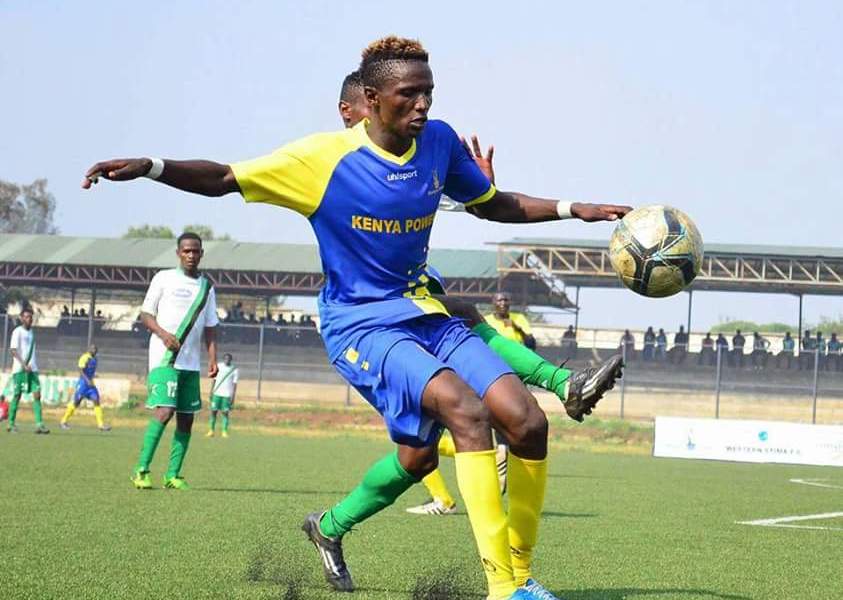 Kenneth Muguna turning out for Western Stima FC.
Despite not having a fruitful season in front of goal after making the switch to Stima, his performances in the middle of the pack won hearts as he completed 2229 minutes of football in 28 matches, netting four goals and earning five yellow cards.
Muguna’s performances did not go unnoticed as he was awarded the Most Valuable Player (MVP) in 2016 by a three-pronged judging panel of coaches, team captains, and journalists, a decision which sparked a backlash from fans across the country.
The award was taken home by Muguna after fending off strong opposition from Eric ‘Marcelo’ Ouma of Gor Mahia, Humphrey Mieno and the 2016 Golden Boot winner John Makwatta.
After clinching the award, Muguna credited Omino who handed him the KPL debut and also opened the door to bigger clubs who were after his signature.
“My gratitude goes to my club and especially, coach Henry Omino, who has been a father figure to all of us at the club.
”If an opportunity comes to move, then I have to consider critically before making my move. My next move has to be to a bigger club, either here or abroad,” said Muguna.
A big-money move to Gor Mahia followed for Muguna as his star continued to rise as he had a perfect relationship with Brazilian coach Ze Maria who had convinced him to make the move to K’Ogalo.
His debut season for Gor Mahia finally brought some silverware to cap his superb performances since turning out for Kisumu Youth as his three goals and nine assists aided the club to their unprecedented 16th title.
Behind the scenes, Ze Maria had quit the club after he failed to secure a salary increment and soon joined Albanian side KF Tirana with Dylan Kerr replacing him.
Muguna would soon reunite with the Brazilian tactician in Tirana after handing in a transfer request, a situation which left Kerr fuming with rage having lost his lynchpin ahead of the 2018 season and the CAF Champions League qualifiers.
Just like a number of Kenyans who have signed for Tirana, Muguna’s stint was punctuated with controversy after he and Musa left the Scandinavian country after lasting for only a season as they unceremoniously terminated their contracts over a pay dispute.
Muguna, however, chose to pick positives after his troublesome stint at Tirana that has seen Musa Mohamed and Francis Kahata suffer the same fate at the club.
“I learnt a lot, the lessons go beyond my football life. That is a different set up by all standards, including culture and style of playing. Being away from home teaches you lessons that you cannot get locally with all due respect to local clubs.
“I hope the experiences make me a better person and player as I return home,” said Muguna in an interview with Citizen.
 Kenneth Muguna displaying his 2016 Most Valuable Player (MVP) gong.
 Muguna’s return to Gor Mahia inspired even better performances from the midfielder as the club managed to rewrite history becoming the first club from Kenya to qualify for the CAF Confederations Cup quarter-finals where they lost to Moroccan side RS Berkane.
The midfielder has already won two league titles since his return to Gor Mahia and was handed the captain’s armband following the departure of Harun Shakava to Zambian side Nkana FC in 2019.
“I am not under pressure at all because this is something that I am used to. I have always assumed leadership roles in all the clubs that I have played for, though this is the first time I have the armband,” added Muguna.
For the National Team colors, Muguna received his first call-up to the national team in 2016 but had to wait till 2019 to net his first foal as he came to Kenya’s rescue against Uganda, scoring a goal that drew the teams level as they battled to a 1-1 draw in a friendly match played at Kasarani Stadium.
He provided two assists in the 2-1 win over Zambia and started in the 2-1 loss to Comoros back in November 2020.
At the age of 24 Muguna has a number of years left in his career if he manages to stay at the top of his game and injury free to prove doubters who had questions about him winning the MVP back in 2016.