


TACTICAL ANALYSIS: Understanding Ghana’s 2026 FIFA World Cup Setup


Reading Time: 4min | Sun. 07.06.26. | 08:50
Despite tactical volatility and federation instability, Ghana possesses individual components capable of a deep World Cup run
There is something deeply poetic about the Black Stars and the World Cup Finals. In 2010, they carried the entire African continent on their shoulders until that fateful winter day when Luis Suárez’s infamous handball denied Dominic Adiyiah’s goal-bound header.
In an instant, Suárez became public enemy number one across Africa. Yet, this team was always meant for a grander purpose. Conceived by Africa’s greatest pan-Africanist, Kwame Nkrumah, the Black Stars were created to represent black independence and excellence, named after Marcus Garvey’s Black Star Line shipping company. That pioneering 1960s side even played glamorous exhibition matches against Real Madrid and West Germany.
Download our MozzartSport App For More News
Fast forward to 2026, and Ghana is preparing to face Panama, Croatia, and their former colonizers, England, in the World Cup group stage. No African nation has qualified for more World Cups in the 21st century than Ghana (2006, 2010, 2014, 2022, and 2026).
From their stunning Round of 16 debut in Germany to the heartbreaking quarterfinal run in South Africa, the World Cup is a tournament Ghana has made their own.
Ghana's World Cup Pedigree:
2006: Round of 16 (Debuted by beating Czech Republic & USA)
2010: Quarterfinals (Heartbreak vs Uruguay; matching Africa's best)
2014 & 2022: Group Stage exits despite highly competitive displays
2026: 5th appearance, navigating a grueling CAF qualification
Yet, the current reality paints a stark contrast. Ghana enters this tournament arguably at their lowest point in modern history.
.jpg)
Ranked 73rd globally and a lowly 14th in CAF, they suffer from back-to-back group stage exits at the Africa Cup of Nations (AFCON) and a humiliating failure to even qualify for the most recent edition in Morocco - dumped out by a displaced Sudan side coached by Kwesi Appiah.
Behind the scenes, the Ghana Football Association (GFA) has been a mess. Following a humbling 5-1 friendly defeat to Austria and a loss to Germany in March, the GFA made the decision to sack head coach Otto Addo on the literal eve of the tournament.
Enter Carlos Queiroz. The veteran Mozambican-born tactician, famously the tactical genius alongside Sir Alex Ferguson, brings a renewed energy and a pragmatic approach suited to get the best from a team on its knees.
Under Queiroz, Ghana will primarily set up in a fluid 3-4-2-1 system, which can seamlessly adapt into a 4-2-3-1 depending on available personnel. The core principle of their attacking play is direct, aggressive verticality.
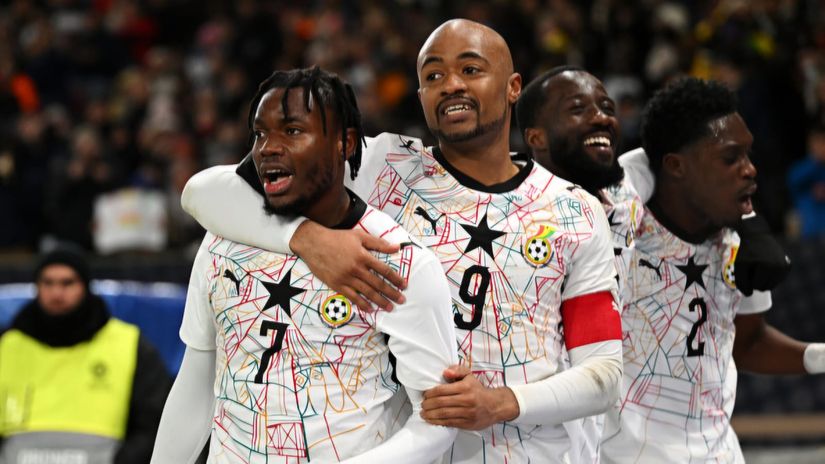
When building from deep, the Black Stars waste little time. They routinely hit direct, long balls from the goalkeeper targeting the veteran Jordan Ayew. Ayew acts as the physical focal point, tasked with winning aerial duels and bringing explosive secondary runners like Abdul Fatawu into the game.
Once possession is established in the opposition half, the primary objective is to create isolated 1v1 situations for their creative wingers/inverted #10s.
The width is strictly provided by aggressively overlapping wingbacks or fullbacks. Ghana relies heavily on sweeping switches of play, changing the attacking point rapidly to catch the opposition's defensive block sliding out of position.
Once the wide areas are unlocked, Ghana floods the penalty box, relying on a high volume of dangerous crosses.
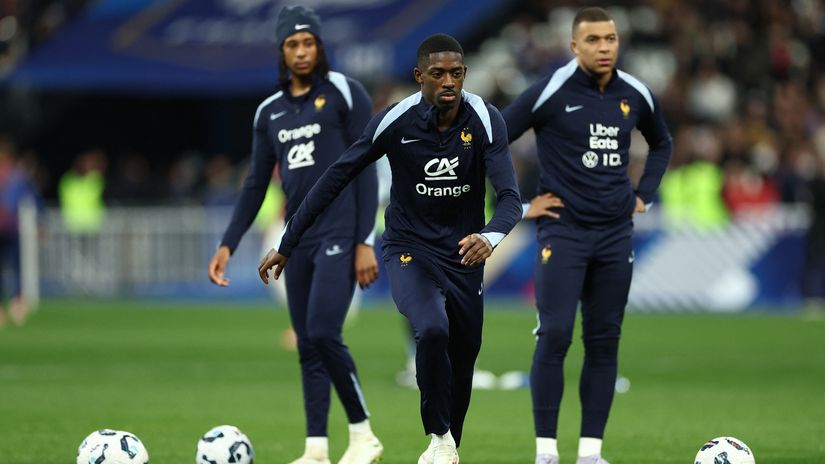
Players like Antoine Semenyo and Jordan Ayew are crucial here; their dribbling, final-pass creativity, and precise delivery drive the attack.
Furthermore, set-plays are an absolute lifeline for this side. With Ayew pulling the strings, a staggering 64% of Ghana's recent goal contributions have come via set-pieces, with 28% of their total goals scored directly from dead-ball scenarios.
Out of possession, Ghana’s system alters drastically into a 4-1-4-1 man-oriented mid-block, which frequently shifts into a classic 4-4-2 or an aggressive 5-2-3 high press.
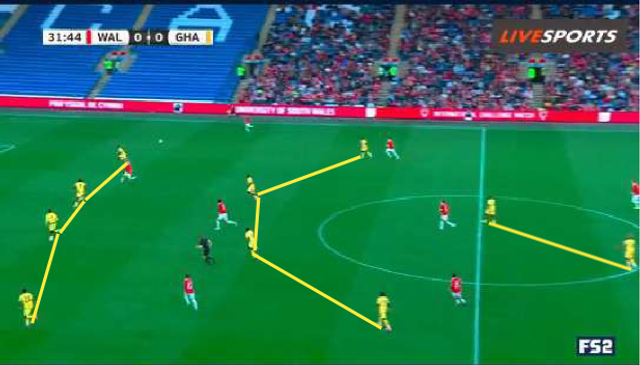
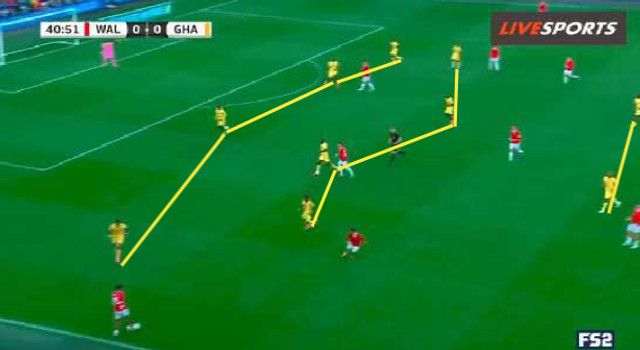
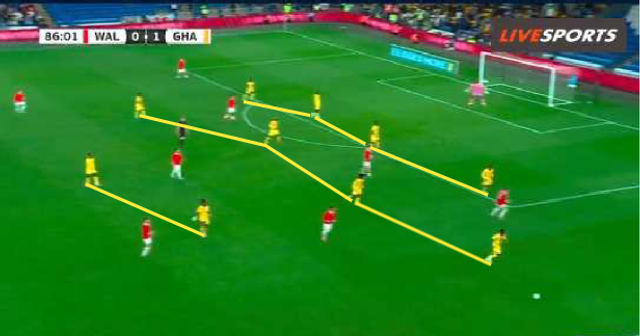
Queiroz will look to squeeze the pitch, using the front three to hunt down opposition central defenders while demanding that at least one central midfielder steps up high to deny the opposing playmaker any time or space.
While the front three are highly effective at pinning opposition build-ups, the aggressive jumping of the central midfielders leaves massive structural voids behind them.
Because the rest of the defensive line prioritizes maintaining depth, an enormous chasm frequently opens up in the center of the pitch. Elite teams can exploit this lack of central midfield protection. When opponents exchange quick, vertical passes and interchange positions fluidly, Ghana's man-oriented press unravels, leaving them highly susceptible to third-man combination plays.
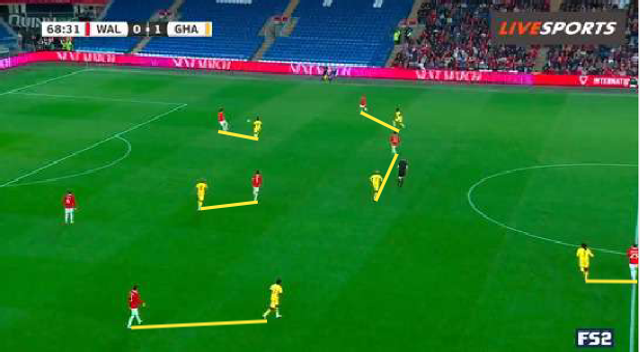
Furthermore, because the wingbacks and fullbacks press so aggressively, their blind sides are highly vulnerable. Fast, transitional teams can easily exploit the depth behind Ghana's wide defenders, targeting the large structural gaps that appear when the team is caught between a high press and a retreating backline.
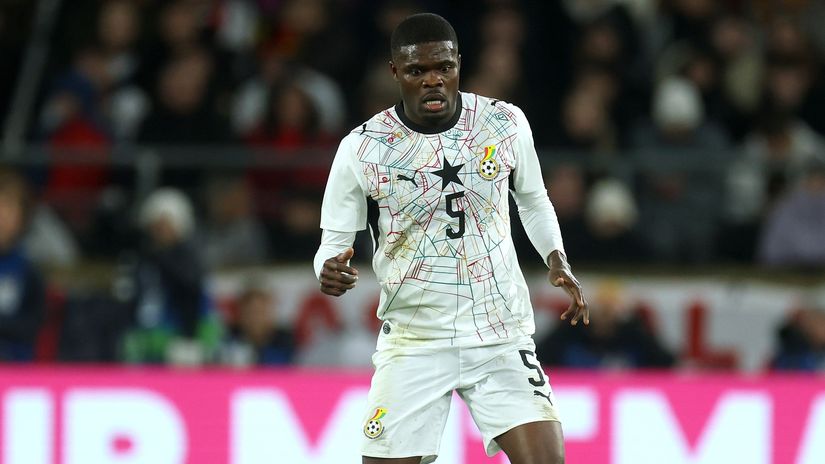
Despite tactical volatility and federation instability, Ghana possesses individual components capable of a deep World Cup run.
● Jordan Ayew: The undisputed talisman. His role as the direct outlet, set-piece specialist, and spatial creator makes him indispensable to Queiroz's structural survival.
● Antoine Semenyo: Providing the necessary elite-level dynamism, Semenyo’s power in 1v1 isolations and his ability to convert final passes will dictate how effectively Ghana capitalizes on transitions.
● Abdul Fatawu: The young winger offers raw pace and verticality, making him the perfect beneficiary of Ayew's aerial knockdowns and sudden switches of play.
If Carlos Queiroz can successfully mask the central defensive chasms out of possession and weaponize their lethal set-pieces, the Black Stars might just summon the pan-African spirit of 2010, defy the chaos of their own federation, and dance their iconic kakalika dance on the global stage once again.