


TACTICAL ANALYSIS: How Al Hilal Neutralized Tusker’s dynamic rotations in CECAFA Kagame Cup triumph





.jpg)
Reading Time: 4min | Mon. 27.07.26. | 22:28
This CECAFA Kagame Cup encounter showcased the balance between tactical structure and execution. Tusker played constructive football, using inverted full-backs and third-man combinations to generate high-quality chances
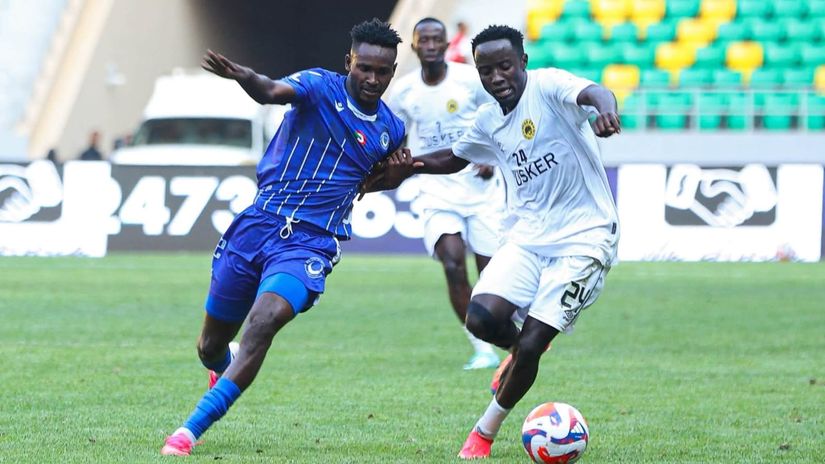
Al Hilal secured a 2–0 victory over Tusker FC in a high-stakes CECAFA Kagame Cup 2026 clash defined by contrasting build-up philosophies, dynamic positional rotations, and lethal transitional efficiency. While Tusker displayed fluid structural adaptability, Al Hilal’s superior exploitation of wide channels and late-game transitional moments ultimately decided the outcome.
Download Our MozzartSport App For More News
Al Hilal deployed a 4-2-3-1 starting shape under new manager Guy Bukasa. Mohammed Mustafa started in goal behind a defensive line featuring right-back Awad Yaser, left-back Kamaradini Mamudu, and central defenders Altayeb Abdelrazig and Babe Diarra.
The midfield featured double pivots Aprocious Petrus and Haman Mandjan, anchoring behind advanced playmaker Godwin Frimpong.
Yasir Mozamil provided width on the right wing, Sunday Damilare occupied the left flank, and Emmanuel Flomo spearheaded the attack as the primary striker.
Tusker lined up in a base 4-4-2 formation. Brandon Obiero was protected by a back four of Eugene Ikutwa, Collins Ochieng, Thomas Teka, and Aboud Omar.

Fabian Adikiny paired with Chrispine Erambo in central midfield, flanked by Yakeen Mutheheli on the right and Stephen Etyang on the left. In attack, Ian Simiyu operated just behind Victor Mbaoma.
As Tusker advanced into possession, Mbaoma often dropped into a deeper withdrawn role while Simiyu remained high to pin Al Hilal’s central defenders.
Al Hilal initiated build-up phases through an asymmetric, bait-and-press structure.
They formed a 3-2 base shape in deep possession: goalkeeper Mustafa stepped between the central defenders to form a back three, while left-back Kamaradini inverted alongside pivot Petrus. Right-back Yaser pushed high up the flank.
This setup deliberately lured Tusker’s initial two-man pressing line of Mbaoma and Simiyu.
Tusker countered by deploying a compact 4-4-2 mid-to-high block, jumping forward with four players to match Al Hilal’s numerical advantage. Simiyu executed curved runs toward goalkeeper Mustafa to direct play onto one side.
Early on, Tusker successfully neutralized Al Hilal’s extra man. Mustafa struggled under direct pressure, leading to rushed long balls, misplaced passes, and unforced turnovers.
Despite early build-up friction, Al Hilal continually generated threat through their right flank overload. When right-winger Mozamil received the ball, high-positioning right-back Yaser overlapped, creating dilemmas for Tusker’s left-sided defenders.
Mozamil frequently inverted into the half-space or attacked the box directly, providing numerical superiority to attack incoming crosses.
Tusker responded with fluid build-up rotations of their own, setting up in a 4-2 base structure designed to form passing triangles as they advanced to attacks:
- Central defenders opened wide while right-back Ikutwa inverted into central midfield alongside Adikiny.
- Right-winger Yakeen dropped deep into the vacated right-back space.
- Midfielder Erambo pushed between the lines as the un-marked free man.
- A dropping striker pulled his marker out of position, allowing third-man combinations out wide to release the arriving full-back for crosses into the box.
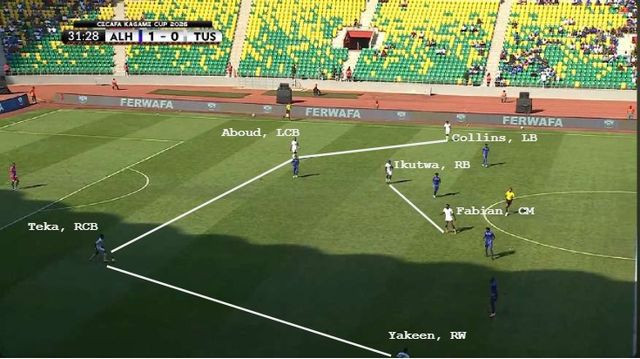
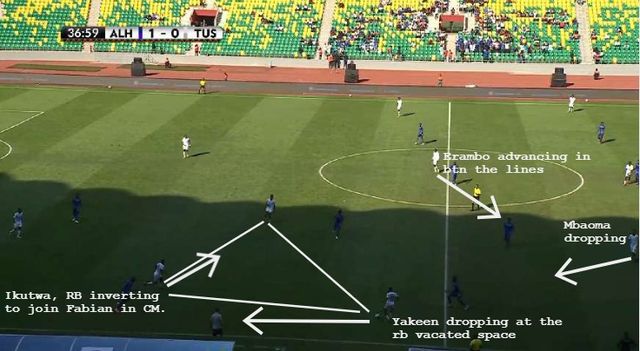
Tusker’s fluid positional shifts created significant defensive trade-offs.
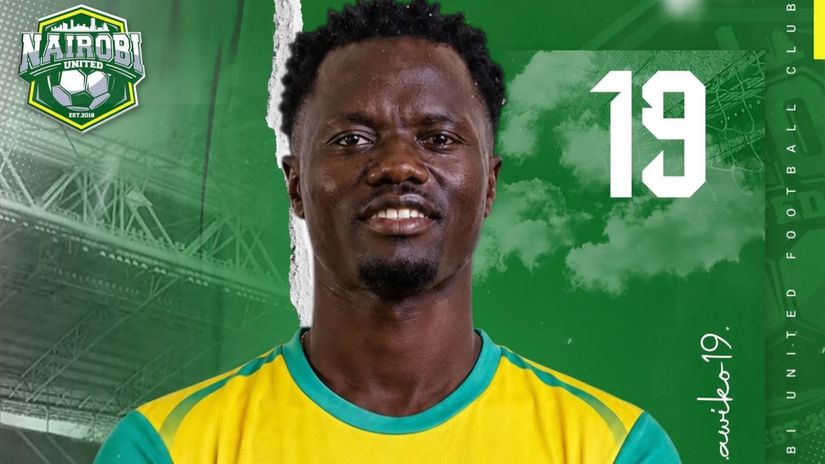
As right-back Ikutwa inverted, winger Etyang was forced into deep recovery tracking to contain Yaser's high positioning.
This converted Tusker’s defensive shape from a 4-4-2 into a temporary 5-3-2 block out of possession.
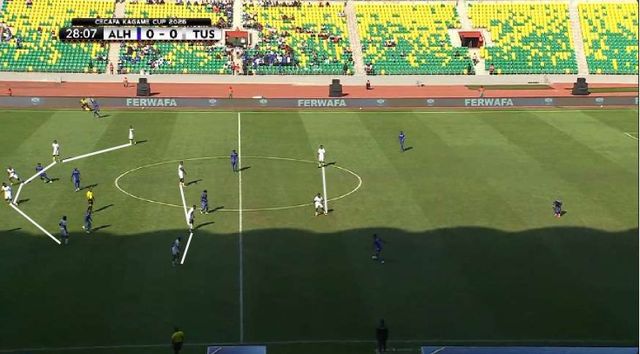
By the 25th minute, Al Hilal shifted from direct vertical passes to short, intricate combinations to bypass Tusker’s mid-block. In the 29th minute, a central mispass by Tusker was intercepted by Al Hilal. Although Mozamil’s initial shot was saved, Al Hilal maintained their structure to immediately recycle possession.
Left-winger Damilare collected the second ball and set up inverted left-back Kamaradini, whose deflected strike from outside the box broke the deadlock to make it 1-0.
Despite controlling prolonged periods of the first half, Tusker were punished for minor spatial misalignments in transition, a couple of miss-passes and incomplete finishing in the final third.
Both managers made strategic interventions at half-time. Guy Bukasa replaced Mandjan with Rawa in midfield and introduced Akire Temple for Damilare. Akire took over the right wing, pushing Mozamil to the left flank.
Julien Mette’s Tusker responded with a quadruple substitution, bringing on John Otieno, December Kisakah, Aboubacar Doumbia, and Warsama to maintain high-intensity pressing.
In the second half, Tusker pushed their defensive line higher, attempting to funnel Al Hilal toward the touchlines to trap them in wide areas.
This aggressive posture yielded set-piece opportunities, with Aboud Omar testing Mustafa from distance, while late substitute Steven Omondi forced corner saves from header opportunities.
However, Tusker’s high defensive line and wanting rest defense left them vulnerable to quick vertical transitions. Al Hilal sat in a mid-block, absorbing pressure before releasing rapid counter-attacks through Akire and Mozamil.
As Tusker pushed forward for a late equalizer, Al Hilal exploited the vacant transitional spaces. In the 94th minute, Akire isolated Aboud on the right flank and delivered a cut-back to the edge of the penalty area.
Unmarked substituted midfielder Salim Adams struck a long-range shot into the bottom corner, finalizing a 2-0 win.
This CECAFA Kagame Cup encounter showcased the balance between tactical structure and execution. Tusker played constructive football, using inverted full-backs and third-man combinations to generate high-quality chances.
However, their inability to capitalize in the final third - combined with defensive vulnerability during wide transitions - cost them the match.
Al Hilal demonstrated elite game management. After surviving early pressing problems, Guy Bukasa’s side adapted through intelligent rest-defence, wide overloads, and high-efficiency counter-attacks to earn a decisive 2-0 victory.