


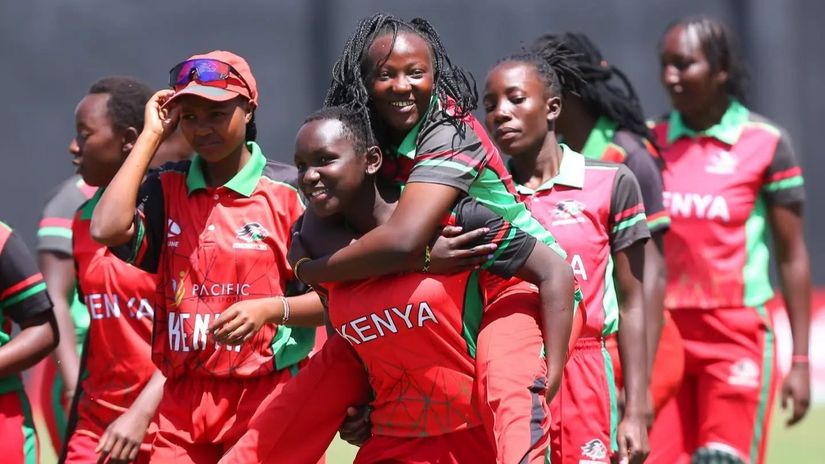
Inside Cricket Kenya's plan to grow and deepen talent pool in women's league









Reading Time: 4min | Sat. 27.06.26. | 14:42
The programs form part of the long-term strategy to create a sustainable pathway for female cricketers, while increasing competitiveness of the national teams
Kenya's women cricketers are set for a busy second half of the year as Cricket Kenya rolls out a series of development programs aimed at expanding the talent pool, strengthening domestic competition, and positioning the country to meet International Cricket Council (ICC) requirements.
Download our Mozzart Sport app for more news
The initiatives, outlined by Cricket Kenya Women's Director Charity Wambui, include an Under-19 half-term tournament currently underway, preparations for the ICC Under-19 Women's World Cup Qualifiers in Uganda at the end of August, and the launch of a functional women's league that will see matches played every weekend.
The programs form part of Cricket Kenya's long-term strategy to create a sustainable pathway for female cricketers, while increasing the competitiveness of the national teams.
According to Wambui, consistent domestic competition has been one of the missing pieces in the growth of women's cricket in Kenya.
"If we play every weekend, coaches are able to assess what their players are giving," she said. "This will not only help us widen and deepen the pool of talent we have, but it will also open doors for us to develop more talent. If players know that every weekend there is a game somewhere, even those who are new to cricket will develop an interest in the sport."
The introduction of a regular league also addresses one of the concerns Wambui raised shortly after assuming office in April; the lack of a consistent domestic competition for women.
Rather than staging tournaments only in preparation for international assignments, Cricket Kenya intends to establish a year-round calendar that provides players with continuous match exposure.

Regular competition, she believes, will not only improve individual player development but also give national team selectors a wider pool of players to choose from.
"We want to have the headache of selecting the national team," said Wambui. "What I mean is that we want to have so many polished and talented players, that it becomes difficult to decide who makes the final squad. That can only happen when we have a large pool of players competing regularly."
Beyond player development, Wambui believes a structured competition calendar will make women's cricket more attractive to commercial partners.

"It is difficult to attract sponsors when these plans remain on paper," she explained. "When you approach a sponsor, they want to know when you are playing and how often you are playing. If we have a calendar where the women are playing every Saturday, then sponsors are assured of visibility because there will be cricket taking place every weekend."
The inaugural league will feature eight teams split between Nairobi and Nakuru, with four teams in each centre.
Players have been pooled from neighbouring counties to ensure the competition is both competitive and sustainable. Nakuru will host players drawn from counties such as Kisii, Vihiga, Kakamega and Homa Bay, while Nairobi-based teams will include players from surrounding counties including Kajiado and Murang'a.
Wambui said the two centres were selected because they already possess the infrastructure required to host quality cricket.

"Nairobi and Nakuru are among Kenya's major cricketing centres, alongside Mombasa," she said. "They have both grass wickets and astroturf facilities, which are the main playing surfaces required for cricket. They also have a large pool of talent, making it easier to bring together players from surrounding counties."
The expanded competition is also expected to help Cricket Kenya satisfy ICC participation requirements.
According to Wambui, ICC regulations require member nations to maintain a minimum number of functional women's hardball teams to remain eligible for certain international competitions.
"ICC requires us to have around six functional women's hardball teams," she explained. "With this program, we will have eight teams. Four in Nakuru and four in Nairobi which means we are comfortably above that threshold."
Alongside the domestic league, Cricket Kenya is also investing in youth development through the ongoing Under-19 half-term tournament.
The competition serves as preparation for Kenya's Under-19 women's team ahead of the ICC Under-19 Women's World Cup Qualifiers scheduled for Uganda at the end of August.
While the immediate objective is qualification, the tournament also provides selectors with an opportunity to identify emerging talent capable of progressing through the national pathway. For Wambui, however, the broader objective extends beyond a single tournament or qualification campaign.
She wants to see more girls taking up cricket across the country and eventually feeding into competitive domestic leagues and national teams.

"These programmes fit into Cricket Kenya's long-term vision because we simply want more girls and more women playing the game," she said.
The latest initiatives build on Cricket Kenya's renewed focus on women's cricket following the election of the federation's new leadership in April.
If successfully implemented, they could mark a significant step towards addressing some of the longstanding challenges that have hindered the women's game, including inconsistent competition, limited player pathways and a narrow talent base.
With an Under-19 international campaign on the horizon and a league set to provide regular competition, Cricket Kenya hopes the foundations being laid now will not only produce stronger national teams but also create a more vibrant and sustainable future for women's cricket in the country.