



Cricket Kenya's blueprint to grow women's game after years of neglect



.jpg)





Reading Time: 6min | Tue. 26.05.26. | 22:00
Unlike the men’s game, which benefits from relatively more organized structures and fixtures, women cricketers have often endured long breaks between competitions. Domestic leagues have either been inconsistent or entirely absent, making player development difficult.
When the new leadership of Cricket Kenya was elected on Sunday, 19 April, one of the appointments that quietly carried significant weight for the future of the sport was that of Charity Wambui as Women’s Director.
For years, women’s cricket in Kenya has existed in flashes, moments of brilliance interrupted by long periods of inconsistency, underfunding, and limited visibility.
Download our Mozzart Sport app for more news
Despite producing talented players and competing commendably on the continental stage, the women’s game has often struggled to maintain momentum due to structural and financial challenges.
Now, Wambui believes the time has come to reposition women’s cricket from the periphery of the game to the centre of Kenya’s cricket future.

“My biggest achievement would be ensuring women’s cricket becomes part of the bigger picture in Kenya,” said Wambui in an interview with Mozzart Sport.
“When cricket is mentioned in this country, I do not want people to think only about men’s cricket first. I want women’s cricket to also be recognised equally.”
That ambition comes at a critical time for the women’s game globally and locally.
Over the past decade, women’s cricket has experienced unprecedented growth worldwide, fueled by ICC investment, professional leagues, and increased broadcast exposure.
In Africa, countries like Zimbabwe, Uganda, and Namibia have made significant strides in strengthening their women’s structures and international competitiveness.
Kenya, however, has struggled to keep pace despite possessing a rich cricket history.
The Kenya women’s national cricket team has enjoyed notable moments over the years, including winning the 2009 Africa Women’s Championships and producing standout talents such as Queentor Abel, Esther Wachira, and Sarah Bhakita.
The team also impressed during the 2023 ICC Women’s T20 World Cup Africa Division Two Qualifier campaign, where they reached the finals after an unbeaten run in the group stages.

Yet behind those performances lies a recurring challenge that Wambui repeatedly returns to: funding.
“Development and money go hand in hand,” she said. “You cannot separate the two. When development is on your right, money is on your left. Sometimes both are on the same side.”
According to Wambui, years of controlled funding have significantly affected the growth of women’s cricket in Kenya, limiting opportunities for regular competition, international exposure, and player development.
“We are not where we are supposed to be, but we are also not far from where we should be,” she explained.
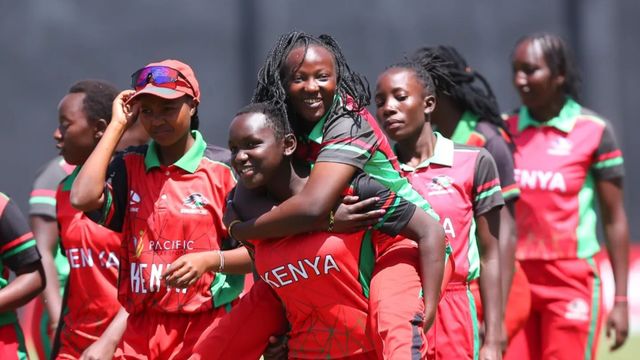
“What really helps a team is more playtime. If we get the finances, we will be able to organise more friendlies and more matches, and that exposure will help us understand exactly where we stand competitively.”
That lack of regular play has arguably been one of the biggest obstacles facing women’s cricket in Kenya.
Unlike the men’s game, which benefits from relatively more organised structures and fixtures, women cricketers have often endured long breaks between competitions. Domestic leagues have either been inconsistent or entirely absent, making player development difficult.
Wambui says changing that is among her top priorities.
“One of my main agendas and visions is to ensure that we have a women’s league running all year long,” she said. “Not just when preparing for competitions, but consistently throughout the year.”
Her vision involves establishing structured regional league systems across various parts of the country, including Nairobi, Rift Valley, Western Kenya, and the Coast region.
Rather than focusing only on individual counties, Wambui says the administration is looking at regional blocks to maximise participation.
“If we say Nakuru on its own, they can sustain themselves, but if we say maybe a county like Kericho on its own, it may struggle,” she explained. “That is why we prefer grouping them into blocks so that we get as many girls benefiting as possible.”
.jpg)
The proposed league structures would also target multiple age groups, from Under-16 and Under-19 competitions to open women’s leagues, creating a more sustainable development pathway for girls.
Such pathways have historically been one of the missing links in Kenya women’s cricket.
While school cricket has produced several talented players over the years, many girls slip through the system after finishing school due to limited opportunities to continue playing competitively.
To address that gap, Wambui says Cricket Kenya is already working on plans to establish high-performance centres across the country.
“We are looking into establishing high-performance centres in different regions. We have already identified areas such as Western Kenya, Rift Valley, Nairobi, and possibly the Coast region.”
The centres, she says, will cater to both men and women while specifically ensuring girls’ cricket development is integrated into the broader national setup.
“These high-performance centres will not only cater for men but also women and girls because everyone in those regions will benefit,” she said.
The emphasis on development structures comes at a time when women’s cricket is increasingly becoming a viable professional pathway globally. Kenyan players are slowly beginning to attract opportunities abroad, something Wambui believes demonstrates the untapped potential within the country.
Congratulations to Women's Under-19 Cricket Team 🇰🇪
— Moraa Times (@MoraaTimes) March 17, 2026
Last week the team competed in the ICC Under-19 Women's T20 World Cup Africa Division 2 Qualifier held in Entebbe, Uganda.🇺🇬
Kenya faced Mozambique, 🇲🇿 Cameroon, 🇨🇲 Sierra Leone, 🇸🇱 and Malawi 🇲🇼 in the round-robin tournament… pic.twitter.com/RThLgyKbwb
“Currently, we already have two players who have gone to play club cricket in the UK,” she said. “Imagine how many more opportunities these girls could get if women’s cricket received more exposure and storytelling.”
Visibility, according to Wambui, may ultimately prove just as important as funding.
Despite the growth of women’s sports globally, women’s cricket in Kenya continues to receive minimal media coverage compared to football, athletics, rugby, and even men’s cricket. That lack of visibility has made attracting sponsors increasingly difficult.
“Sponsors are not always willing to invest where visibility is still limited; this is actually the backbone of everything. People need to know that women’s cricket exists in Kenya and that the players are performing well.”

Wambui also pointed to accountability challenges within sports administration generally as another factor that sometimes discourages investment in women’s sports.
Still, she remains optimistic that the current leadership can reposition the women’s game and build sustainable structures around it.
Part of that optimism stems from her belief that Kenya already possesses the technical quality needed to compete with Africa’s stronger cricketing nations.
“We actually do not need major technical or structural improvements; what we need is more playtime.”
She believes regular fixtures against stronger opponents such as South Africa, Nigeria, and other leading African nations would significantly improve Kenya’s competitiveness.
“We need a calendar that includes tours and fixtures against stronger teams. Playing against stronger opposition regularly will help us grow and become a stronger team ourselves.”
For now, however, the reality remains that women’s cricket in Kenya still faces an uphill battle for recognition, investment, and consistency.
But with a renewed push for year-round leagues, grassroots structures, high-performance centres, and increased visibility, Wambui hopes the next four years can lay the foundation for long-term growth.
From community sessions to national success 🇰🇪
— East Africa Character Development Trust (@EACDT1) March 15, 2026
Congratulations to the Kenya Women's Under-19 Cricket Team for winning the tournament and earning promotion to Division 1.
We are proud that 98% of the players are beneficiaries of our programme.
Dreams are becoming reality. pic.twitter.com/T2IK5sN3tc
And if her vision succeeds, Kenya women’s cricket may finally begin moving from occasional promise to sustained progress.