


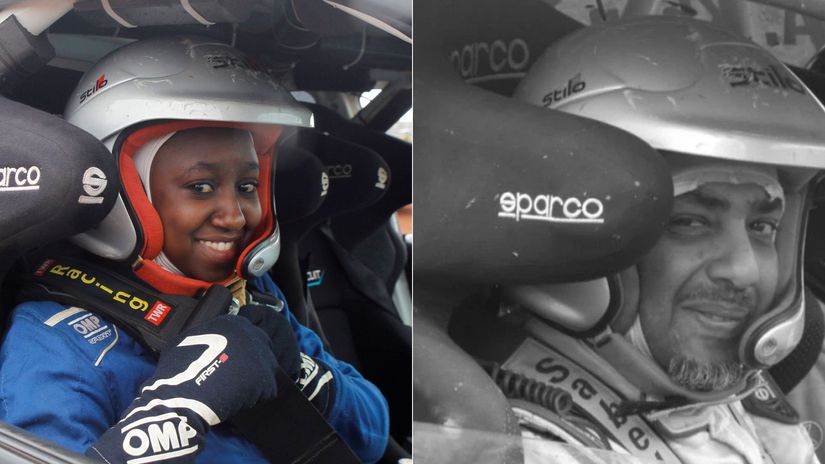
Rally driver Maxine Wahome acquitted by court over boyfriend's death








.jpg)
Reading Time: 4min | Tue. 28.07.26. | 16:01
The prosecution had called 29 witnesses in an effort to prove that Wahome was responsible for the injuries that led to Khan’s death
Rally driver Maxine Wahome has been acquitted of the murder of her late boyfriend, Assad Khan, after the High Court ruled that the prosecution failed to establish a prima facie case linking her to his death.
Download our Mozzart Sport app for more news
In a ruling delivered on Tuesday, 28 July, Justice Lilian Mutende found that the Directorate of Public Prosecutions (DPP) had not presented sufficient evidence to warrant placing Wahome on her defence, effectively bringing the high-profile case to an end.
“In totality, having considered all the evidence before the court, the case presented by the prosecution has failed to establish a prima facie case warranting that the accused person be placed on her defence,” Justice Mutende ruled.

The prosecution had called 29 witnesses in an effort to prove that Wahome was responsible for the injuries that led to Khan’s death. However, the court found that the evidence did not sufficiently connect the rally driver to the fatal injuries.
The State’s case largely relied on circumstantial evidence, arguing that Wahome and Khan were the only two people inside the house when the altercation occurred. The judge, however, held that the circumstances did not exclusively point to Wahome as the person who inflicted the injuries.
Witnesses who responded to the incident testified that they heard a commotion and Khan instructing Wahome to leave the house, but none witnessed how he sustained the injuries.
Evidence from the crime scene further weakened the prosecution’s case. A crime scene officer testified that bloodstains were found on stairs leading to the rear balcony and on broken glass from a door.
The broken glass was identified as the only object at the scene capable of causing the injuries, while other recovered items, including a penknife and a piece of metal, had no bloodstains.
Investigators also found no significant disturbance in the bedroom, and no blood was detected on other items examined at the scene.
Wahome consistently maintained her innocence, telling investigators that Khan attempted to assault her after an argument, forcing her to lock herself on the balcony. According to her account, Khan broke the glass door while trying to gain access after failing to open it.
Although the prosecution challenged her version of events, the investigating officer admitted there was no conclusive evidence proving that Wahome caused Khan’s injuries.
Medical evidence also introduced alternative possibilities. A doctor testified that some of Khan’s injuries could have resulted from a fall down the stairs, while the defence questioned whether medical complications during treatment contributed to his eventual death.
Previous court proceedings heard that Khan suffered significant blood loss before developing complications while receiving treatment.
Justice Mutende also considered evidence regarding the couple’s relationship, including WhatsApp messages exchanged before the incident. The messages showed Khan repeatedly contacting Wahome while she was out socialising, asking about her whereabouts and why she was not answering his calls.
Witnesses further testified about alleged conflict in the relationship, with one describing Khan as having previously been violent towards women he dated.

The prosecution also questioned Wahome’s conduct after the incident, including her failure to visit Khan in hospital or attend his burial. However, the judge ruled that such behaviour, on its own, could not establish criminal responsibility.
“There is the question of fear or discomfort, which was brought up since, from the outset, the accused was a suspect, and she was adamant about it,” Justice Mutende observed.
The judge emphasised that circumstantial evidence can only sustain a conviction if it excludes all reasonable alternative explanations, concluding that the prosecution had failed to meet that legal threshold.
Following the ruling, Wahome’s lawyer, Steve Kimathi, welcomed the acquittal and criticised the decision to prosecute his client.
“I am extremely pleased with the Court’s decision to acquit Maxine. This is a case that should never have been brought before the courts in the first place, yet the Office of the Director of Public Prosecutions chose to pursue it.
Today’s judgment is a vindication of my client’s innocence and, most importantly, it has cleared her name. I welcome the Court’s decision and am grateful that justice has prevailed,” Kimathi said.
.jpg)
He added that the defence team is considering legal action over the manner in which Wahome was arrested, publicly paraded and charged.
Wahome had been charged following the death of Khan, who was pronounced dead on December 18, 2022, while undergoing treatment in Nairobi after sustaining injuries during an alleged domestic incident.