


.jpg)
Eriksen collapse brought back harrowing memories, says Muamba
.jpg)
Reading Time: 5min | Sun. 13.06.21. | 15:28
Other members of the football world who are familiar with the situation expressed their views
Fabrice Muamba has spoken about how watching Christian Eriksen receive life-saving treatment at Euro 2020 brought back emotional memories of his own cardiac arrest as a doctor warned the Dane was unlikely to play again.
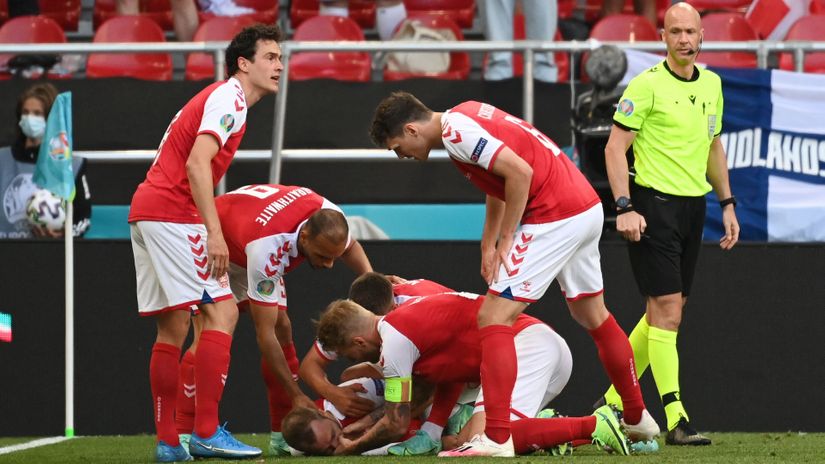
Eriksen received CPR as his distraught teammates formed a circle around him to shield the stricken player from the view of 16,000 stunned fans in Copenhagen on Saturday.
Muamba, the former Bolton midfielder who collapsed after suffering a cardiac arrest during a televised FA Cup game in 2012.
"To watch it from that distance and not knowing the expectation of what was going to happen -- it's scary," he told the BBC.
"It's credit to the medical staff that they've come in and they did an amazing job on Christian."
Please God
— fabrice muamba (@fmuamba6) June 12, 2021
Muamba said he was impressed by how Eriksen's teammates had surrounded him to "protect the whole situation".
"It just brought back emotion that you've literally put down there for a long time that you don't want to re-live," he said.
"To see it on the other side, when it happened I asked my missus 'how did you even cope knowing this has happened to me'?
"I'm hoping that things turn out to be OK for him. I really, really, really hope he comes through."
A sports cardiologist who previously worked with Eriksen at Tottenham said the midfielder, now at Inter Milan, was unlikely to play again.
"Clearly something went terribly wrong," Sanjay Sharma, professor of sports cardiology at St George's, University of London, told the Press Association agency.
"But they managed to get him back. The question is what happened? And why did it happen?
"This guy had normal tests all the way up to 2019 so how do you explain this cardiac arrest?"
Sharma, who chairs the Football Association's expert cardiac consensus group, said there were multiple reasons a cardiac arrest could have happened, such as high temperatures or an unidentified condition.
But he said reports after the match that Eriksen, 29, was awake in hospital were "a very good sign".
"I'm very pleased," he said. "The fact he's stable and awake, his outlook is going to be very good. I don't know whether he'll ever play football again.
"Without putting it too bluntly, he died today, albeit for a few minutes, but he did die and would the medical professional allow him to die again? The answer is no."
.jpg)
Dr Scott Murray, a leading NHS consultant cardiologist specialising in prevention of heart problems, claims Italy pride themselves on their record of preventing cardiac arrests in football - so the Danish player's problems will likely spell the end of his time in Serie A.
'It probably is (the end of his career) for him. The Italians stop people participating in sport if they are found to have a significant cardiac abnormality, it's in law.
'He will require a heart echo-cardiogram to see what's happening to his heart muscle. He will also need a cardiac MRI scan - a detailed scan of his heart muscle to see whether there's any scarring.
.jpg)
'I think this is going to create an enormous amount of awareness - if you can get rapid medical assistance, you can save lives.
'In the public, everyone must learn how to do CPR, how to refer to medical services, everyone must know where the nearest defibrillator is.
'We've seen this in high-profile cases such as Fabrice Muamba and also people who are less fortunate like someone from my hometown - Phil O'Donnell - who died on the pitch.
.jpg)
'He will need extensive investigation and probably a special pacemaker called a defibrilator which monitors every heartbeat and is about to tell you when the heart is about to do this again. If it does, the defibrilator can shock the heart internally.'
'They've been doing that for a long time, beyond 20 years and they've reduced the death rates from cardiac arrests in sport from beyond 3 per cent down to below one per cent.'
.jpg)
'He will require an ECG - a 12-lead electro cardiogram which measures the electrical activity in the heart to see what is going on,' the NHS doctor claimed. 'That can give various indicators into why this may have happened.
One of many who weren't lucky enough to escape death in situations similar to this was Cameroonian Marc-Vivien Foé, former Man City, West ham United and Lyon footballer.
In the 2003, during Cameroon vs Colombia match, in the 72nd minute of the match Foé collapsed in the centre circle with no other players near him.
After attempts to resuscitate him on the pitch, he was stretchered off the field, where he received mouth-to-mouth resuscitation and oxygen. Medics spent 45 minutes attempting to restart his heart, and although he was still alive upon arrival at the stadium's medical centre, he died shortly afterwards.
The Marc-Vivien Foe tragedy may well have inadvertently saved the lives of others - Muamba, Eriksen and others. pic.twitter.com/TbETIG49Xc
— Andrew Raeburn (@andrew_raeburn) June 12, 2021
The first autopsy did not determine an exact cause of death, but a second autopsy concluded that Foé's death was heart-related as it discovered evidence of hypertrophic cardiomyopathy, a hereditary condition known to increase the risk of sudden death during physical exercise.
Former Tottenham player and manager Glenn Hoddle, who suffered a cardiac arrest while working for TV in 2018 reacted via twitter.
Thank God Christian is ok ????. And to those who did the CPR, it’s simple you saved his life as I know so well . Godbless you Simon D. for what you did for me loving every minute of my Extra Time ! Stay strong Christian ????.
— Glenn Hoddle (@GlennHoddle) June 12, 2021
Bosnian keeper Asmir Begovic has criticised football's authorities for ignoring the health of players after Eriksen collapsed.
Former Chelsea goalie believes the jam-packed post-Covid schedule has left many players 'worn out' as he slammed football authorities for not addressing the problem and protecting the health of players.
The health and wellbeing of players has long been ignored. Shoving more and more games in more condensed periods will only lead to bigger health issues for players. Let hope the people in power will take notice at some point.
— Asmir Begovic (@asmir1) June 12, 2021
© Agence France-Presse/DailyMail