


PLAYER ANALYSIS: Key qualities England-based defender will add to Harambee Stars


.jpg)



Reading Time: 4min | Wed. 18.03.26. | 19:07
For long Harambee Stars has been in need of a midfield conductor, one who can play those long switches of play but still protect the defense on transitions. If his performance against Swansea is anything to go by, Kenya may have jusy found it's guy
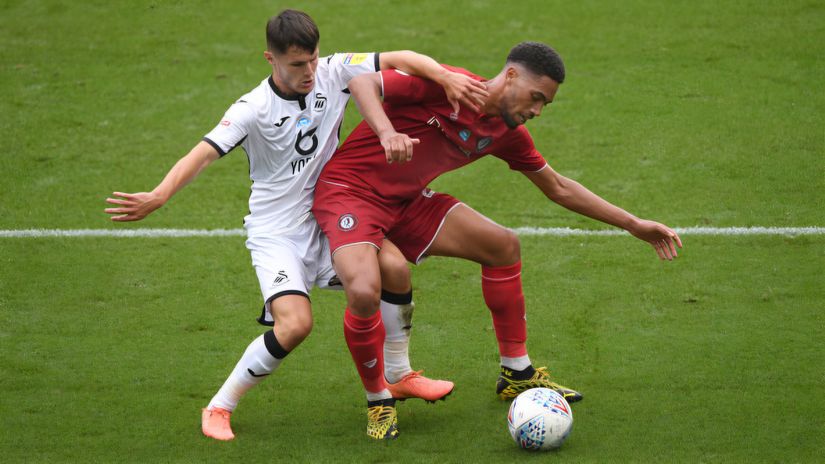
Harambee Stars call up, Zak Vyner played the full 90 minutes as Wrexham secured a 2-0 win over Swansea last Friday.
Operating at CDM/CM in a 3-5-2 system alongside Lewis O’Brien, just ahead of the backline, he balanced defensive solidity with progressive play.
His impact was subtle yet vital - like a hinge in a door, often unnoticed but crucial to the team’s structure.
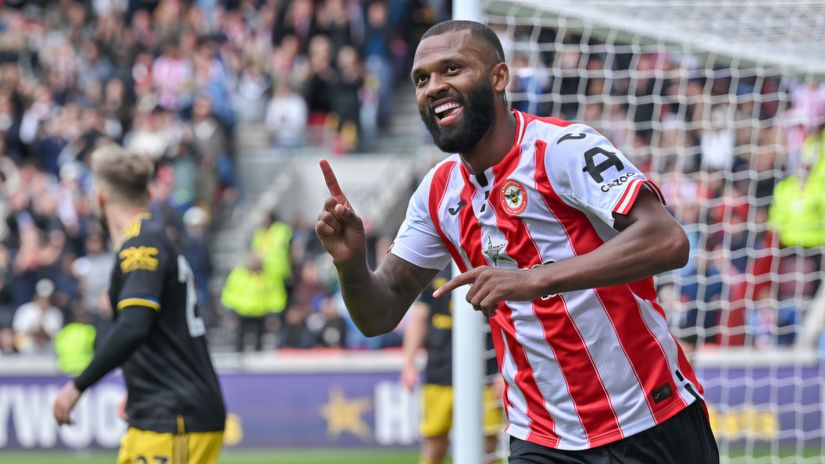
From the opening stages, Vyner’s positional awareness stood out. Playing as the deeper presence in midfield, he constantly scanned his surroundings, checking his shoulders before receiving the ball.
This habit of scanning allowed him to anticipate pressure and adjust his positioning off the ball.
In many ways, his movement resembled a chess player thinking several moves ahead, positioning himself not just for the current phase but for the next transition as well.
The heatmap from the match illustrates how active he was across the central corridor, covering both sides of the pitch and maintaining a central anchor point in Wrexham’s shape.
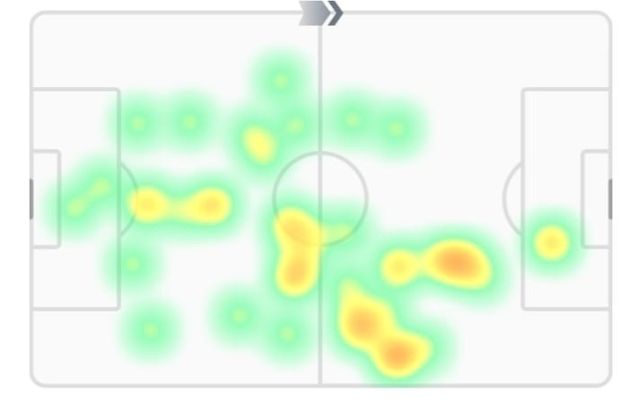
Operating in the double pivot with O’Brien, Vyner’s primary responsibility was balance.
While O’Brien occasionally pushed higher to support attacks, Vyner remained the shield in front of the defence.
This discipline ensured Wrexham always had a protective layer in front of the back three.

His ability to read developing attacks was evident as he frequently stepped in to disrupt Swansea’s build-up before it gathered momentum.
Rather than diving recklessly into challenges, he relied on timing and positioning to cut passing lanes or force opponents into wider areas where Wrexham could trap them.
Statistically, his defensive contribution might not jump off the page at first glance, but context tells a deeper story.
Vyner recorded three clearances, one interception, and three recoveries while also winning his aerial duel.
He was dribbled past only once during the match, highlighting how difficult it was for Swansea to bypass him centrally.
These moments often came through sharp recovery sprints, where he tracked runners and neutralized danger right at the source.
His tackling approach is calculated rather than aggressive - preferring containment and pressure over reckless lunges.
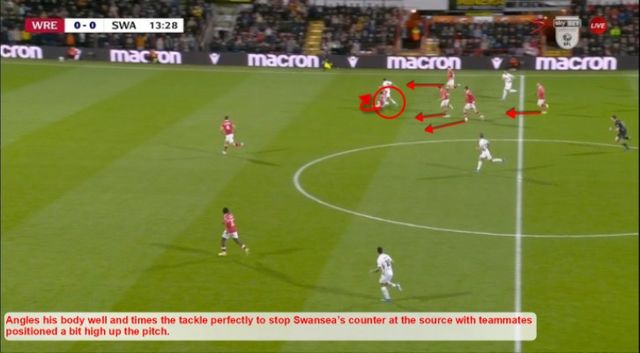
Vyner’s work rate was another defining feature of his performance.
In a midfield two within a 3-5-2 system, the central players must cover enormous ground, particularly when wing-backs push high.
Vyner embraced this responsibility, constantly shuttling laterally to cover spaces left by advancing teammates.

Out of possession, he acted as the team’s defensive metronome, ensuring the midfield line stayed compact and organized.
On the ball, Vyner demonstrated impressive composure and efficiency.
Completing 24 of his 32 passes for a 75 percent accuracy rate, he kept the tempo ticking without overcomplicating possession.
His decision-making was quick and purposeful - often using one-touch passes or short combinations to progress the ball through midfield.
His two-footed ability makes him particularly effective when under pressure, as he could pivot and distribute using either foot.
A key aspect of Vyner’s distribution was his range.
He completed both of his attempted long passes, frequently switching play to the flanks.
On several occasions, he spread the ball toward the right side to release Issa Kabore in space, allowing Wrexham to stretch Swansea’s defensive block.
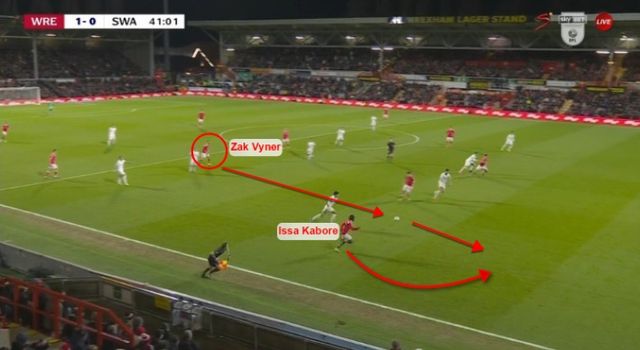
These diagonal passes functioned like opening a curtain - suddenly revealing wide spaces for the wing-backs to exploit.
His influence was also evident in the attacking phase.
In the 25th minute, Vyner played a role in orchestrating the buildup that eventually led to Nathan Broadhead scoring.
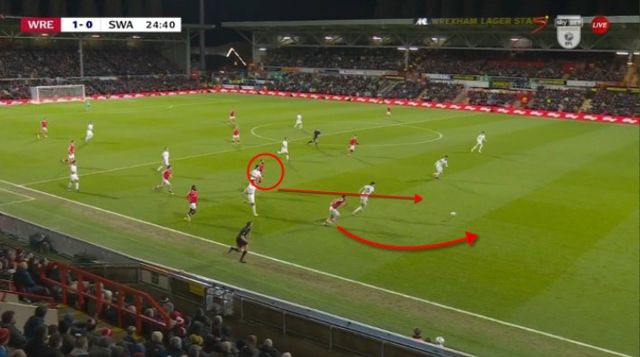
Recognizing space between the lines, he surged forward to add numbers in attack, briefly transforming from a holding midfielder into a supporting runner.

This ability to time forward movements gave Wrexham an extra layer of unpredictability.
Out of possession, Vyner adopted a proactive pressing approach.
Rather than sitting deep and waiting, he often stepped forward aggressively to engage Swansea’s organizing midfielder high up the pitch.
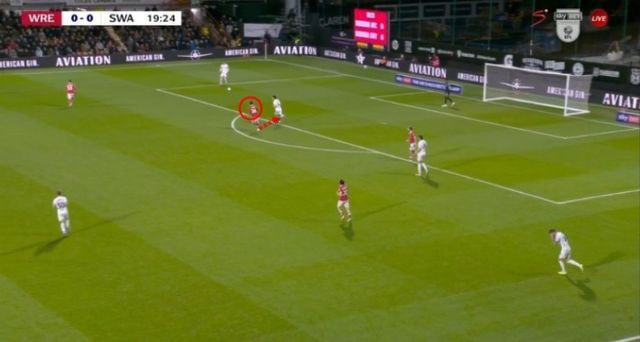
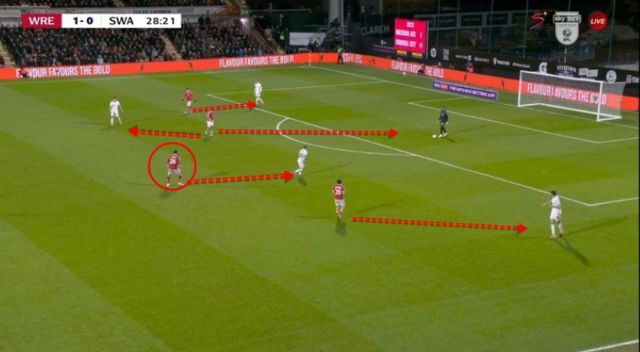
His body orientation when pressing is particularly intelligent - angling his approach to force the opponent wide, where the touchline acted as an additional defender.
This front-footed pressing style pushed Swansea backward and disrupted their rhythm.
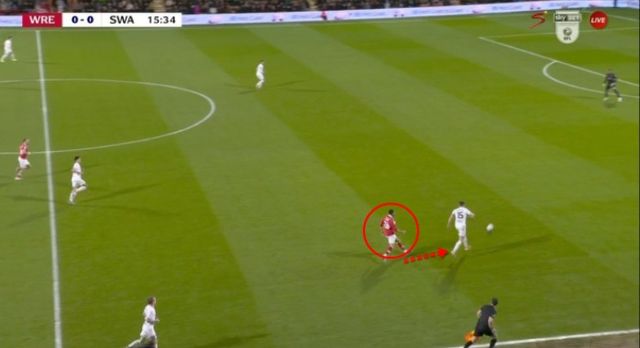
However, this aggressive engagement occasionally left small pockets behind him.
When Vyner stepped high to press, Swansea sometimes attempted quick combinations through the vacated midfield space.
These moments highlight a minor area for growth: balancing proactive pressing with positional security.

With improved coordination from the midfield line, this vulnerability can easily be minimized.
Despite recording modest attacking numbers - just one shot off target and an expected goals value of 0.02 - Vyner’s role was never about statistics.
His job was structural.
Like the foundation of a building, he ensured everything above him remained stable.
Ultimately, Zak Vyner’s performance was a display of intelligent midfield play.
With strong positional discipline, efficient distribution, and tireless work rate, he served as Wrexham’s tactical anchor, giving the team stability in both defensive and attacking phases.
Performances like this may not always dominate the highlights, but his influence on the team’s structure is clear.
With his recent national team call-up, his versatility to operate in both defense and midfield could prove crucial for Harambee Stars.