


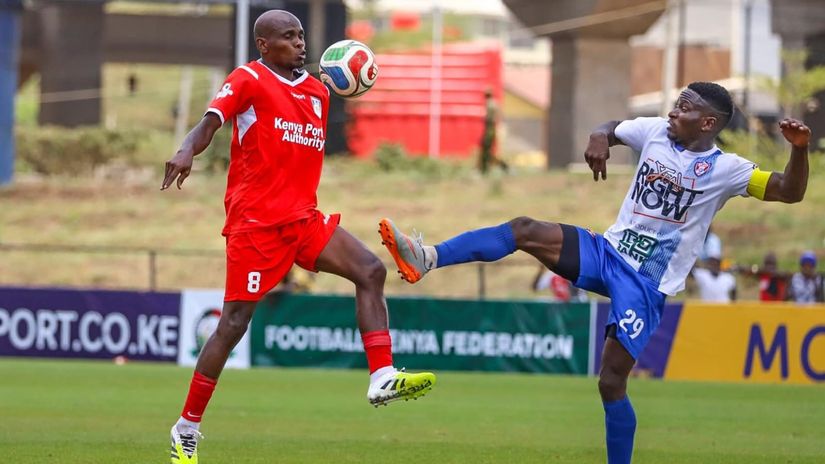
TACTICAL ANALYSIS: How Bandari made light work of Githurai All Stars in Mozart Bet Cup




.jpg)

Reading Time: 6min | Mon. 09.02.26. | 19:08
Bandari consistently exposed Githurai’s structural risks, punished errors in build-up, and leveraged superiority in wide zones.
From the opening minutes, this Mozzart Bet Cup contest quickly revealed itself as a test of structure versus ambition.
Githurai All Stars entered with a proactive game plan built around transitions, wing switches, and aggressive pressing triggers, but Bandari FC turned the match into an exercise in control, exploitation, and efficiency.
Follow our WhatsApp channel for more news
The 3-0 scoreline was not the product of isolated moments or individual brilliance alone; it was the outcome of a coherent tactical approach that consistently exposed Githurai’s structural risks, punished errors in build-up, and leveraged superiority in wide zones.
This analysis explains how Bandari’s pressing, build-up adaptability, and wide dominance systematically broke the game open, while Githurai struggled to reconcile their attacking intent with defensive stability.
Githurai All Stars began in a 4-2-3-1, with Kenan Otieno in goal behind a back four of Ochieng Ojiem, Derick Wekesa, Kennedy Ndegwa, and Brian Oyando.
Stephen Angulu and David Wonders formed a double pivot, tasked with screening and progression, while Moise Nkurunziza operated between the lines as the advanced midfielder.
Shivachi Erick and Danson Mariga held width on the right and left, respectively, with Edwin Nganga leading the line.
In possession, this shape aimed to stretch Bandari horizontally, using switches of play and striker drop-offs to access space between the lines.
Out of possession, however, it morphed into a 4-4-2, with Moise Nkuruniza stepping out to engage Bandari’s deep midfielder.

Bandari, by contrast, set up in a 4-1-2-3 that offered both defensive security and attacking flexibility. James Omusinde guarded the goal, with Joseph Onyango and Erickson Mulu as fullbacks, flanking centre-backs Shariff Majabe and Andrew Juma.
Said Tsuma anchored midfield as the single pivot, while Betrand Konfor and Geoffrey Ojunga played higher as interior midfielders.
Darius Msagha and William Wadri provided width, with Frank Ouya acting as the reference point up front.
In possession, Bandari’s shape often resembled a 3-2-5, with Tsuma dropping and fullbacks advancing. Out of possession, it became an aggressive mid-to-high block designed to suffocate build-up.
Githurai’s primary defensive scheme revolved around a zonal 4-4-2 mid-block, with pressing triggers activated on lateral passes, especially when the ball was played wide.
The intention was to funnel Bandari into predictable wide areas and spring pressing traps. However, the block lacked compactness vertically, particularly between midfield and defense.
This spacing became the core tactical problem Bandari sought to test. Every time a midfielder stepped out to press Tsuma or a dropping centre-back, space opened behind him, weakening the block’s integrity and exposing the backline to direct runs and switches.
Bandari’s build-up was adaptive rather than rigid. Against Githurai’s first line of pressure, Tsuma frequently dropped between or alongside the centre-backs, creating a numerical advantage.
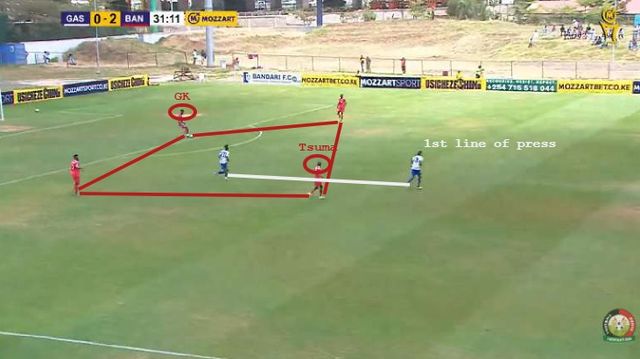
The goalkeeper also stepped in as an extra outfielder during deeper phases, stretching Githurai’s press and forcing indecision. This caused a clear dilemma: press higher and risk being bypassed, or sit off and concede territory.
On the right, rotations were particularly effective. Msagha held width high and wide, pinning the left-back, while Onyango overlapped aggressively.
Inside them, Ojunga and later Wadri drifted into half-spaces, creating overloads that Githurai struggled to track. The effect was consistent progression into advanced zones with minimal resistance.

The first goal in the 15th minute encapsulated Bandari’s pressing edge.
A poorly judged back pass during Githurai’s build-up invited pressure, and Bandari pounced immediately. Ouya capitalised on the turnover after being set up by Wadri, finishing decisively with the goalkeeper off his line.
Cause: aggressive, coordinated high press. Effect: forced error in a vulnerable zone. Outcome: early control of the game.
The second goal stemmed from wide exploitation. Msagha again drove down the right, delivering a cross that bypassed Githurai’s shifting block and found Wadri arriving on the far side.
The goal was not accidental; it was the logical outcome of repeated right-sided overloads and slow defensive shifting across the box.
The third goal, late on, further reinforced the pattern. With Githurai pushing higher and losing compactness, Bandari attacked the channels behind the defense.
Emoni’s timed run exploited the space left by an aggressive backline, converting another right-sided delivery by Hamisi Mwaphalu into a goal.
Bandari consistently accessed the right half-space and wide channels, areas that became high-value zones throughout the match.
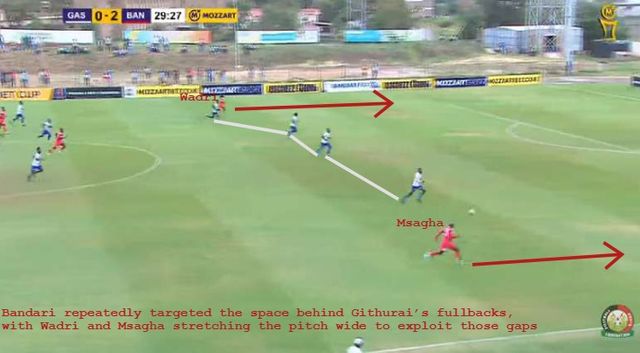
These spaces were available because Githurai’s midfield line was often dragged out by Tsuma’s positioning and interior rotations, while the fullbacks were pinned by wide attackers.
Zone 14 was less directly targeted, but the threat of central access forced defenders to collapse inward, opening lanes for switches and crosses.
Githurai, on the other hand, relied heavily on speculative long-range shots and early crosses, a sign of difficulty accessing central zones.
Their inability to establish a sustained occupation between the lines limited the quality of their chances.
Bandari’s pressing system was built on clear triggers: poor touches, back passes, and central receptions with closed body orientation.
.jpg)
The pressing shape resembled a 4-3-3, with Ouya leading and wingers curving runs to block central lanes. This forced play wide or long, aligning perfectly with Bandari’s aerial and positional strengths.
Behind the press, the rest-defence was well organised. Tsuma remained deep, often forming a back three with the centre-backs, ensuring numerical superiority against transitions.
When possession was lost, immediate counterpressure delayed Githurai’s breaks, allowing the block to reset and nullify counterattacks.
In the second half, Githurai attempted to increase attacking output through substitutions and positional reshuffles, pushing wingers higher and committing more bodies forward.
While this improved ball circulation briefly, it also increased risk. Bandari responded by controlling tempo, using Tsuma and Wadri deeper to dictate rhythm and draw pressure before exploiting space behind.
Bandari’s substitutions injected fresh energy without altering structure, maintaining pressing intensity and wide dominance.
The penalty incident and subsequent save did little to change momentum, as Bandari continued to manage the game with maturity.
Defensively, Bandari maintained a compact mid-block when required, with clear stepping triggers when passes entered midfield zones.
The backline held a disciplined line, recovering quickly into shape and limiting central penetration. Githurai were often forced sideways, then backwards, before eventually resorting to hopeful deliveries.

This performance was a clear demonstration of how quality, structure, clarity, and discipline translate into dominance.
Bandari combined aggressive pressing with intelligent build-up and ruthless exploitation of wide areas, turning Githurai’s transitional ambitions into vulnerabilities.
The gap in quality and depth between the two sides - accentuated by Bandari’s top-tier experience - was evident throughout.
Bandari’s superior squad profile allowed them to execute their game plan with composure, punish errors decisively, and manage every phase with tactical maturity.
For Githurai AllStars, the match underlined the challenge of matching that level, highlighting the need to better balance attacking ambition with structural security.
Ultimately, this was more than a victory; it was a clear tactical statement shaped by quality, control, and inevitability