



TACTICAL ANALYSIS: How Morocco's military side knocked CAF Champions League holders out




.jpg)



Reading Time: 5min | Mon. 23.03.26. | 12:56
FAR Rabat’s progression was the result of a well-executed tactical plan built on defensive compactness, transitional efficiency, and adaptability
Pyramids’ elimination from the CAF Champions League at the hands of FAR Rabat was not simply a story of moments.
It was one defined by contrasting structures, defensive discipline and superior exploitation of key tactical phases.
Across this second leg, FAR Rabat demonstrated a clearer strategic identity, culminating in a decisive away performance that sealed a 3-2 aggregate victory after a 2-1 win.
While Pyramids controlled phases of possession and territory, their inability to consistently break down a compact and reactive opponent ultimately proved costly.
Follow Our WhatsApp Channel For More News
From the outset, both sides established clear base structures, with starting line-ups providing insight into their intended game plans.
Pyramids lined up in a 4-4-2 system.
Ahmed El Shenawy started in goal, protected by a back four of Mohamed Chibi at right-back, Hamed Hamdan at left-back, and a central defensive pairing of Sami Ahmed and Mahmoud Marei.
In midfield, Mohanoud Lasheen and Youssef Obama formed the central partnership, flanked by Mostafa Zalaka on the right and El Sayed Ahmed on the left.
Nasser Maher operated in a withdrawn role just behind striker Fiston Mayele, effectively creating a flexible attacking structure with a 4-4-2 out of possession and a 4-2-3-1 in possession.
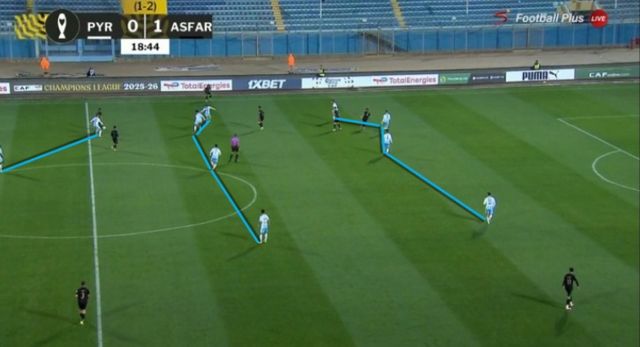
FAR Rabat, on the other hand, adopted a more fluid 3-4-3/4-3-3 hybrid with a 4-4-2 out of possession shape earlier on
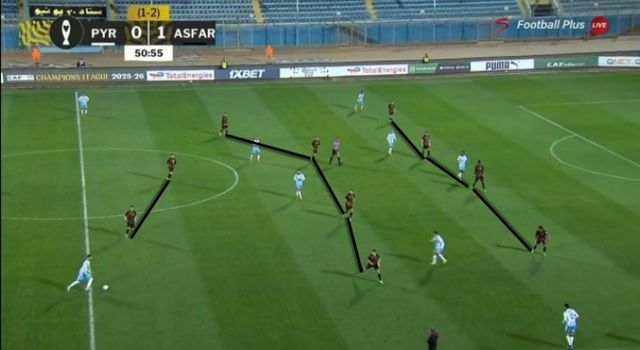
Ahmed Tagnaouti started in goal, with a defensive line that included Anas Bach, Marouane Louadni, Fallou Mendy, and To Carneiro - shifting between a back three and back four depending on the phase.

In midfield, Mohamed Hrimat and Zineddine Derrag operated as the deeper pairing, while Abdelfettah Hadraf played in an advanced playmaking role.
The front line consisted of Reda Slim on the right wing, Ahmed Hammoudan on the left, and Youssef El Fahli as the central striker, though rotations often saw El Fahli drift into wider areas to exploit space.
In possession, Pyramids attempted to construct attacks through controlled circulation across the backline and midfield.
Their approach relied heavily on vertical passes targeting the runs in behind from Mayele and Maher.
However, FAR Rabat’s defensive discipline limited the effectiveness of these movements.
The backline maintained strong positional awareness, while midfielders tracked runners effectively, ensuring that central passing lanes remained congested.
Although Pyramids produced moments of intricate passing, particularly in the first half, these sequences rarely translated into high-quality chances due to the opponent’s structural control.
FAR Rabat’s attacking approach was more direct and transition-oriented.
Their opening goal in the seventh minute highlighted this clearly.
.jpg)
A well-timed run in behind by Youssef El Fahli exploited space beyond the defensive line, meeting a lofted pass from Hadraf before setting up Reda Slim for a composed finish.
This sequence reflected a broader pattern: quick vertical progression combined with intelligent off-ball movement.
Rather than relying on sustained possession, FAR Rabat focused on exploiting transitional moments and defensive gaps left by Pyramids’ advancing shape.
The spatial battle further underlined the contrast between the two sides.
Pyramids struggled to access central attacking zones due to FAR Rabat’s compact structure.
As a result, they were often forced into wide areas, relying on crosses and set-pieces to generate chances.
While this approach did create opportunities - most notably through dangerous free-kick deliveries - it also reduced the overall efficiency of their attacks.

FAR Rabat, in contrast, effectively utilized wide channels during transitions, advancing quickly through the flanks before attacking the spaces left open in Pyramids’ defensive structure.
Pressing dynamics also played a significant role.
Pyramids attempted to apply high pressure at various points, particularly during FAR Rabat’s deeper build-up phases.
However, this press lacked consistent coordination, allowing FAR Rabat to either play through it or bypass it entirely with direct distribution.
Long goal kicks aimed at contestable areas became a key strategy, enabling FAR Rabat to win second balls and initiate attacks higher up the pitch.
Additionally, their counterpressing ensured that Pyramids were frequently dispossessed in midfield, preventing sustained attacking sequences.
A crucial yet often overlooked aspect of the game was FAR Rabat’s rest-defence.
Even when committing players forward, they maintained a solid defensive structure behind the ball.
This limited Pyramids’ ability to exploit transitions and forced them into slower, more predictable build-up patterns.
In contrast, Pyramids occasionally left themselves exposed when pushing numbers forward, creating opportunities for FAR Rabat to counterattack into open spaces.
The second half saw a shift in tempo and tactical emphasis.
Pyramids increased the speed of their ball circulation, using quicker passing and positional rotations to destabilize FAR Rabat’s defensive block.
This led to improved access into the final third, as the defensive structure was tested more rigorously.
However, the increased tempo also resulted in a higher frequency of misplaced passes, particularly in midfield, which FAR Rabat capitalized on to launch quick transitions.
FAR Rabat extended their lead through a set-piece in the 54th minute, with Rabie Hrimat converting a well-delivered corner with a powerful header.
This goal highlighted their effectiveness in dead-ball situations, adding another dimension to their attacking threat.
Even beyond the goal, their set-pieces continued to pose problems, including an effort that struck the post shortly afterward.

Pyramids responded with attacking substitutions, introducing Mostafa Fathy and Odeh to add width and creativity.
This adjustment shifted their approach toward more direct attacking, with early crosses into the box targeting Mayele and Maher.
Their goal in the 62nd minute came from such a scenario, as Mayele timed his movement between defenders to convert a delivery into the net.
This moment injected momentum into Pyramids’ play, as they began to push FAR Rabat deeper into their own half.
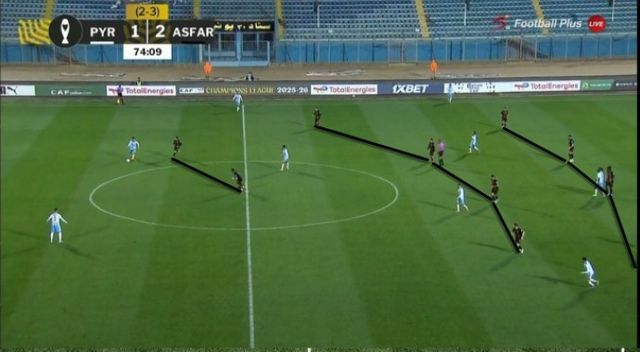
Recognizing the changing dynamics, FAR Rabat adapted by retreating into a deeper defensive structure.
They transitioned into a 5-4-1 shape, and at times even a 6-3-1, prioritizing protection of the penalty area.
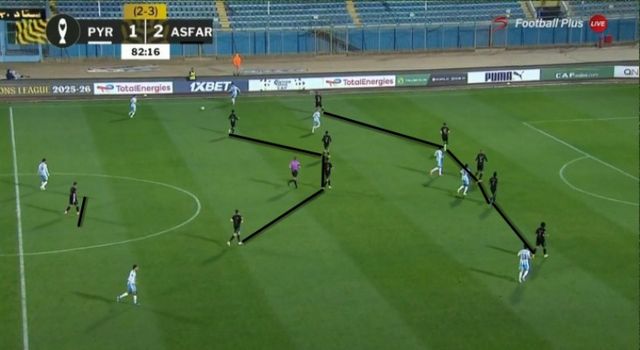
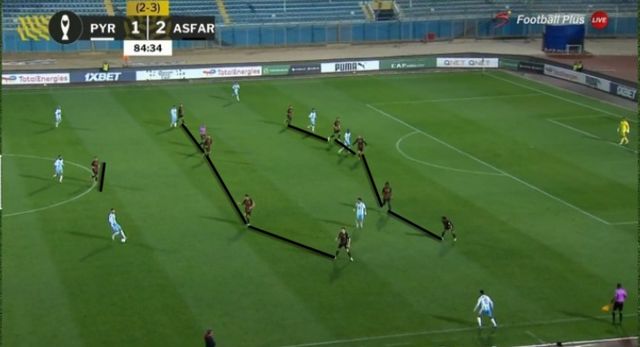
The introduction of an additional centre-back further reinforced their defensive solidity, ensuring numerical superiority against crosses and aerial threats.
This shift reflected a clear understanding of game state, sacrificing attacking presence in favor of defensive control.
Despite sustained pressure in the closing stages, Pyramids were unable to find an equalizer.

Their attacks became increasingly predictable, relying heavily on wide deliveries and lacking central penetration.
FAR Rabat’s disciplined defensive organization, combined with effective clearance of crosses and strong positional awareness, allowed them to withstand the pressure.
Occasional counterattacks provided further relief and disrupted Pyramids’ rhythm.
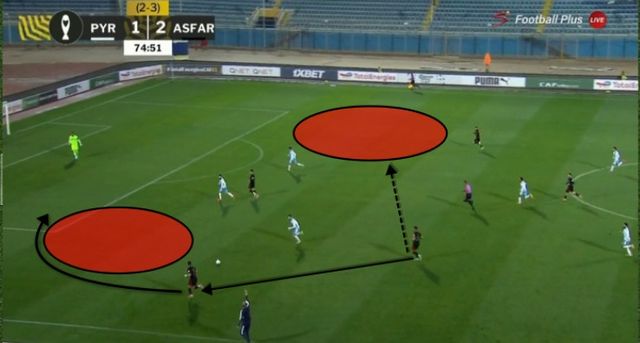
In conclusion, FAR Rabat’s progression was the result of a well-executed tactical plan built on defensive compactness, transitional efficiency, and adaptability.
Their ability to neutralize Pyramids’ strengths while exploiting key weaknesses proved decisive across both legs.
While Pyramids demonstrated control in possession and moments of attacking quality, they lacked the structural variation required to break down an organized and disciplined opponent.
Ultimately, FAR Rabat’s clarity of approach and execution in decisive moments secured their place in the next round.