



TACTICAL ANALYSIS: How Sundowns outsmarted FAR’s relentless pressing to win Champions League


.jpg)



Reading Time: 6min | Tue. 26.05.26. | 13:07
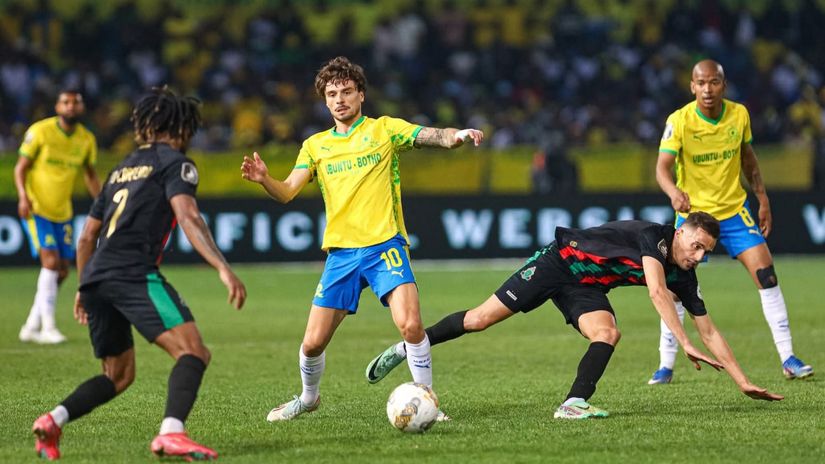
The hosts did not want to give Sundowns any breathing space, closing in whenever they were out of possession and limiting the available spaces
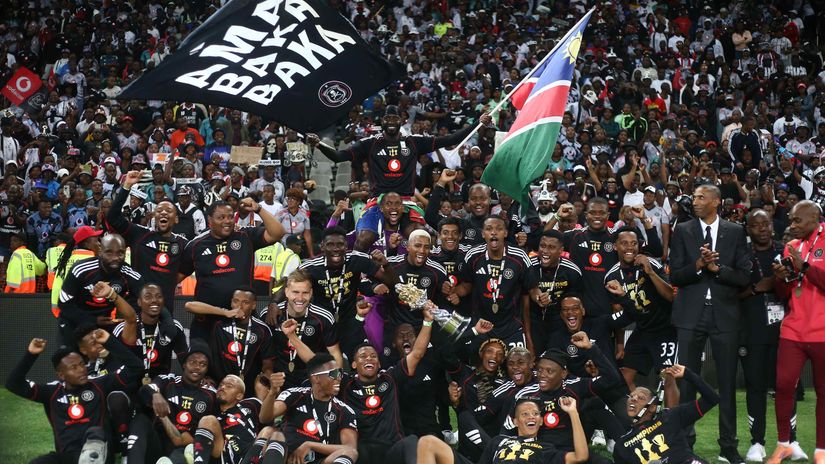
Mamelodi Sundowns secured their place in African football history after drawing 1-1 against AS FAR in Rabat to claim the 2026 CAF Champions League title.
The draw saw them claim the title following a 2-1 win on aggregate, having triumphed 1-0 in the first leg of the final.
Download our MozzartSport App For More News
Sundowns demonstrated adaptability, composure under pressure and intelligent game-state management, while AS FAR relied heavily on aggressive pressing, wide overloads and vertical attacking sequences to destabilize the South African side.
AS FAR began the match in a 4-2-3-1 structure with Ahmed Tagnaouti in goal behind a defensive line consisting of: Anas Bach, Mendy Fallou, Marouane Louadni and To Carneiro.
Mohammed Hrimat and Khalid Ouarkhane operated as the midfield double pivot, while Reda Slim and Ahmed Hamoudan occupied the wide zones.
Abdelfettah Hadraf and Youssef El Fahli functioned fluidly between striker and attacking midfield responsibilities, constantly alternating roles to disturb defensive references.

Sundowns lined up in a narrow 4-3-2-1 shape with Ronwen Williams in goal, Khuliso Mudau, Keanu Cupido, Khulumani Ndamane and Divine Lunga forming the back four.
Teboho Mokoena, Jayden Adams and Nuno Santos composed the midfield triangle.
Kutlwano Lethlaku and Tashreeq Matthews played as narrow inside forwards behind Brayan Leon.
The early stages immediately established AS FAR’s aggressive intention without possession.
The Moroccan side initiated a high press close to Sundowns’ penalty area, attempting to lock play centrally and force rushed decisions during the first phase of build-up.
Their front players curved pressing runs intelligently to block direct passing lanes into midfield, particularly targeting the midfield double pivot between the lines.
In response, Sundowns adapted by using Adams as a dropping pivot in third-man combinations.
Adams frequently dropped beside or ahead of the centre-backs, creating numerical superiority against the first line of pressure and allowing Sundowns to escape compact pressure situations through short combinations.
Sundowns also used an important structural mechanism during deep build-up.
Williams positioned himself centrally while the two centre-backs split extremely wide, creating a temporary back three in possession.
This widened AS FAR’s pressing distances and generated improved passing angles toward the fullbacks.
The objective was not merely possession retention but forcing AS FAR’s front line to stretch horizontally, creating pockets where Mathews or Santos could receive facing forward.
This structural flexibility was crucial because AS FAR’s pressing intensity was initially disrupting Sundowns’ rhythm.
Both teams attacked predominantly through the left side, but the tactical interpretation differed significantly.
Sundowns attacked through interior progression before accessing width.
Matthews drifted intelligently into the left half-space between AS FAR’s midfield and defensive lines, attracting Hrimat out of position.
Once Matthews received centrally, Sundowns immediately looked to release Lunga on overlapping runs into wide areas or find Leon’s runs behind the opposition defense.
AS FAR, however, attacked inversely. They first established width through Slim on the right side or Hammoudan before targeting To Carneiro’s underlapping and overlapping depth runs.
Their strategy focused heavily on delivering crosses into dangerous central areas for El Fahli and Hadraf.
One of the most important tactical dynamics of the first half revolved around Matthews’ positioning.
The Sundowns forward continuously occupied spaces between the lines, especially around the left half-space, creating major problems for Hrimat as the holding midfielder.
Hrimat frequently faced a dilemma between holding his defensive position or following Matthews into deeper zones.
This uncertainty repeatedly opened spaces between AS FAR’s midfield and defensive lines.
The pressure eventually forced Hrimat into a tactical foul that earned him a yellow card in the 19th minute.
That booking limited his defensive aggression afterwards and gave Sundowns greater freedom in central progression.
Out of possession, AS FAR settled into a compact 4-4-2 mid-block once their high press was bypassed.
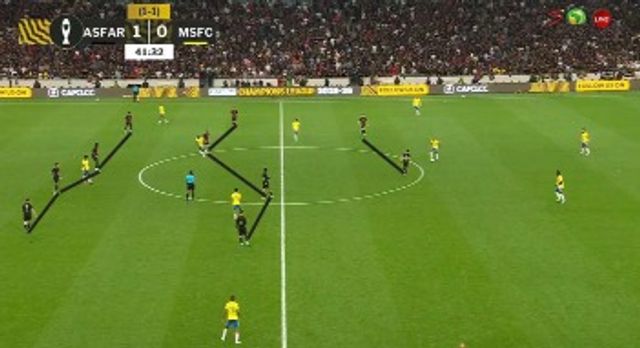
The shape aimed to deny Sundowns access to interior channels by reducing central spaces between midfield and defence.
Their wingers tucked inward aggressively while the strikers screened passing lanes into Sundowns’ midfield trio.
This forced Sundowns into wider circulation and eventually encouraged longer direct passes from the 25th minute onward.
Sundowns deliberately bypassed midfield pressure by targeting Leon with direct balls, using second-ball situations to advance territory rather than sustained possession.
AS FAR’s attacking threat became increasingly dangerous through wide progression and depth runs behind the Sundowns' defensive line.
Slim’s and Hammoudan’s pace on the wings caused persistent problems, particularly on the left, because Lethlaku struggled to recover defensively and support Mudau quickly enough.
This repeatedly isolated Mudau in two-versus-one situations.
The warning signs appeared before the opening goal when AS FAR created a dangerous opportunity through a right-sided cross that Hrimat failed to convert.
The breakthrough eventually came through exactly the type of situation AS FAR had targeted throughout the first half.
Hamoudan delivered from the left side after exploiting space wide, while Reda Slim attacked aggressively inside the penalty area.
Lunga reacted late and fouled Slim after being beaten by pace, leading to a penalty. Hrimat converted confidently to level the aggregate score at 1-1.
Tactically, the goal highlighted Sundowns’ vulnerability during defensive transitions when their wide structure became stretched and isolated.
However, Sundowns responded excellently through positional adaptation.
Nuno Santos began dropping deeper during build-up phases to join Adams, the pivot, which allowed Mokoena greater freedom to advance between AS FAR’s midfield and defensive lines.
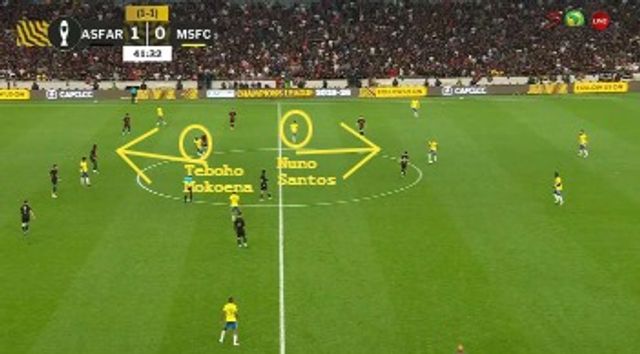
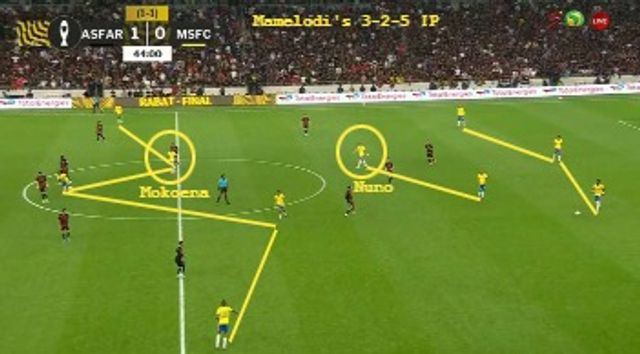
This subtle midfield staggering improved Sundowns’ occupation of central zones and gave them more presence around second balls and knockdowns.
Their equalizer perfectly reflected these improved attacking relationships.
Lethlaku influenced play from the right half-space before delivering toward Leon, whose cross was flicked by Mathews.
The loose ball eventually fell to Mokoena, who finished brilliantly from the edge of the central zone around the penalty spot.
The second half introduced important tactical adjustments from Sundowns coach Miguel Cardoso.
Lethlaku was withdrawn for Marcelo Allende, with Santos shifting wider toward the right flank.
This immediately improved Sundowns’ defensive stability because Allende offered superior positional discipline and ball retention.
The structural balance became stronger, particularly against AS FAR’s left-sided attacks.
Sundowns also began using more wide crosses toward Leon, recognizing AS FAR’s increasingly aggressive fullback positioning left spaces behind the defensive line.
AS FAR responded by pushing both fullbacks significantly higher up the pitch in an attempt to sustain territorial dominance.
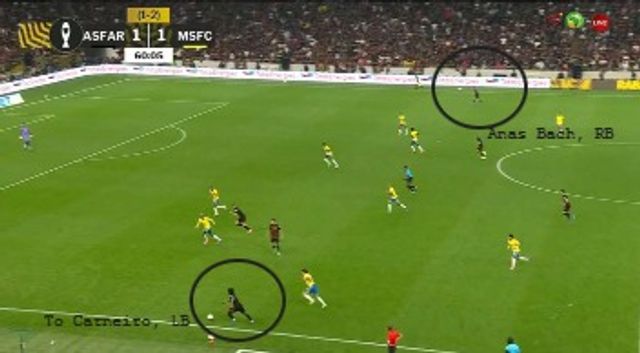
While this increased attacking numbers in advanced zones, it also exposed transitional vulnerabilities whenever possession was lost.
Sundowns exploited this by attacking directly into vacated channels after recoveries, especially through Lebo Mothiba, who was introduced and later Arthur Sales after Santos departed.
The defining moment arrived when AS FAR earned a second penalty following a VAR review after Williams fouled El Fahli.
Tactically, the move again originated from vertical penetration behind Sundowns’ defensive line rather than patient possession.
However, Williams’ penalty save against Hrimat fundamentally shifted the emotional and tactical momentum.
From that moment onward, Sundowns prioritized defensive control above all else.
The introduction of Grant Kekana in the closing stages transformed Sundowns into a compact 5-4-1 deep block.
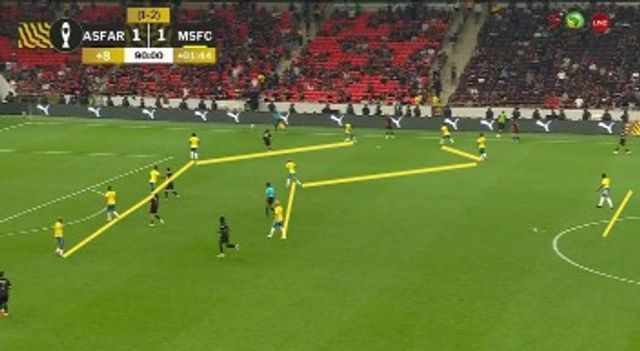
Their defensive line narrowed significantly, while midfield distances became extremely compact centrally.
Rather than pressing aggressively, Sundowns focused on protecting zone 14 and defending crosses aggressively inside the box.
Their rest-defence structure during defensive transitions was excellent, with central defenders dominating aerial situations while midfielders collapsed quickly around second balls.
Ultimately, Sundowns’ triumph came from tactical flexibility rather than dominance.

They survived AS FAR’s aggressive pressing, adapted structurally in possession, manipulated central spaces through Matthews and Mokoena, and showed mature game-state management after equalizing.
AS FAR created problems through wide attacks, vertical running and compact defensive organization, but their increasing attacking aggression eventually exposed transitional weaknesses they could not fully control.
Sundowns balanced suffering and control far better across both legs, and that tactical maturity ultimately delivered African football’s biggest prize.