


TACTICAL ANALYSIS: How superb positioning powered Mamelodi Sundowns’ first leg win over AS FAR



.jpg)



Reading Time: 6min | Wed. 20.05.26. | 20:51
While the scoreline remained narrow, the tactical balance of the match consistently leaned toward the South African side
Mamelodi Sundowns secured a controlled 1-0 victory over AS FAR in the first leg of the CAF Champions League final through a performance shaped by structural superiority, left-sided overloads and intelligent possession management.
While the scoreline remained narrow, the tactical balance of the match consistently leaned toward the South African side, who manipulated AS FAR’s compact defensive block through rotations, width occupation and midfield support structures.
Download our MozzartSport App For More News
Mamelodi Sundowns began the match in what could best be described as a 1-3-2-5 structure in possession.
Ronwen Williams operated behind a back three consisting of Khuliso Mudau, Khulumani Ndamane, and Keanu Cupido.
Aubrey Modiba played as an extremely aggressive left-sided wingback, often advancing into the final line alongside Tashreeq Mathews, who drifted between the left touchline and left half-space.
Brayan Leon occupied the central striker role, while Kutlwano Lethlaku held width on the right and Nuno Santos floated between the right half-space and deeper midfield zones.
Jayden Adams and Teboho Mokoena formed the double pivot during the first phase of build-up.

AS FAR, meanwhile, alternated between a 1-4-4-3 interpretation and a more recognizable 1-4-4-2 out-of-possession structure.
Ahmed Tagnaouti started in goal behind a back four of Anas Bach, To Carneiro, Marouane Louadni and Yunis Abdelhamid.
Mohammed Hrimat and Khalid Ait Ouarkhane occupied central midfield, while Reda Slim and Ahmed Hammoudan worked from wide positions.
Youssef El Fahli operated underneath striker Abdelfettah Hadraf, often joining the first pressing line to create a narrow front pairing during defensive phases.
The game’s opening moments immediately revealed Sundowns’ primary attacking idea.
In just the second minute, Ndamane broke AS FAR’s defensive line with a long diagonal toward Mathews, whose run into depth nearly produced the opener before Louadni recovered with a critical intervention.
That sequence established two recurring themes: Sundowns’ willingness to stretch the block horizontally through switches and AS FAR’s vulnerability when defending movements into the channels behind their fullbacks.
AS FAR defended primarily through a compact 4-4-2 midblock.
The front two attempted to screen central progression while the midfield line stayed narrow to deny access into interior zones.
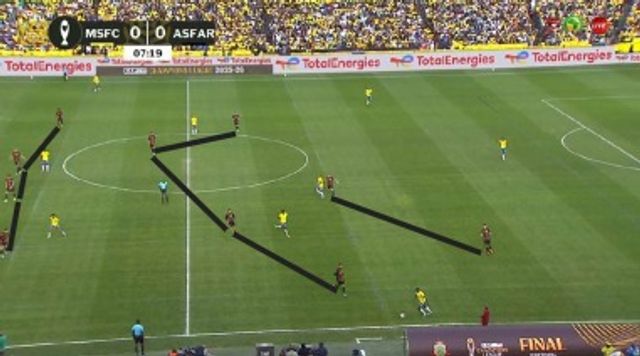
However, Sundowns manipulated this structure cleverly through asymmetrical spacing during build-up.
Modiba pushed aggressively high on the left, transforming the shape into a 3-2-5, while Mudau remained slightly deeper on the opposite side to stabilize rest-defence.
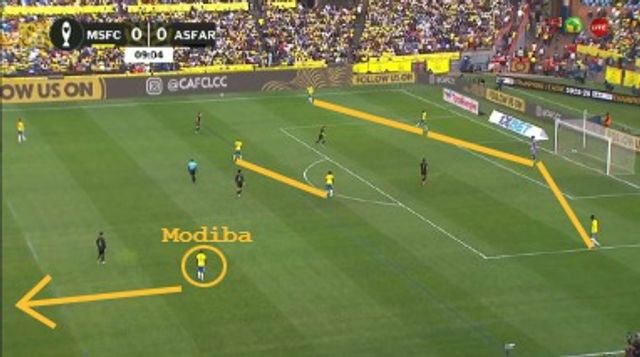
This asymmetry forced AS FAR’s right-sided winger, Reda Slim, into difficult defensive decisions.
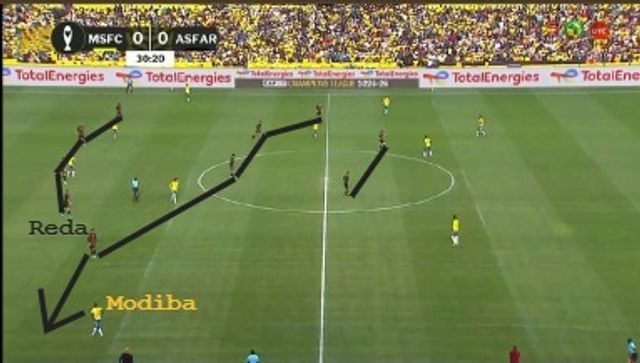
Whenever the ball travelled toward Modiba, Slim used that pass as a pressing trigger, jumping aggressively toward the advancing wingback.
That pressing trigger, however, also created structural gaps.
Because Slim stepped high toward Modiba, spaces opened around the right half-space of AS FAR’s defensive block.
Sundowns repeatedly attempted to exploit those moments through Mathews’ movements inside and Nuno Santos’ positioning between midfield and attack.
Rather than circulating possession aimlessly, Sundowns used positional occupation to force individual defensive dilemmas.
The left side became the dominant attacking corridor throughout the first half.
Mathews and Modiba coordinated intelligently, alternating between overlapping and underlapping patterns to destabilize the compactness of AS FAR’s right flank.
When Modiba advanced wide, Mathews drifted inside into the half-space.
When Mathews stayed wider, Modiba attacked the inside lane aggressively.
This constant rotation prevented AS FAR from maintaining stable reference points defensively.
AS FAR’s own attacking strategy looked almost entirely transition-oriented. Instead of building sustained possession, they searched for depth immediately after regaining the ball.
The primary target zone was Sundowns’ left defensive channel, vacated whenever Modiba advanced high upfield.
Reda Slim and El Fahli frequently attacked those spaces through diagonal channel runs before switching play toward the opposite flank to isolate defenders in transition moments.
Their direct approach also extended to restarts. Goalkeeper Ahmed Tagnaouti regularly launched long balls forward, bypassing Sundowns’ midfield pressure entirely.
The objective was not necessarily clean progression through possession but rather winning second balls and generating chaotic attacking situations higher up the pitch.
However, Sundowns’ rest-defence structure handled those moments effectively.
With Mudau holding a deeper position and Adams often protecting central spaces, Sundowns consistently maintained enough numerical security behind the ball to suppress transitions before they fully developed.
The breakthrough eventually arrived in the 37th minute and fittingly originated from pressure created down the left side.
Mathews drew a foul from Yunis Abdelhamid near the edge of the area after another aggressive progression into dangerous territory.
Aubrey Modiba then converted the resulting free kick brilliantly, curling the ball beyond Tagnaouti to give Sundowns a deserved lead.
The second half maintained many of the same structural dynamics, although Sundowns introduced subtle positional refinements to gain even greater control.
Out of possession, they shifted into a more compact 4-4-2 midblock, limiting AS FAR’s ability to access central progression.
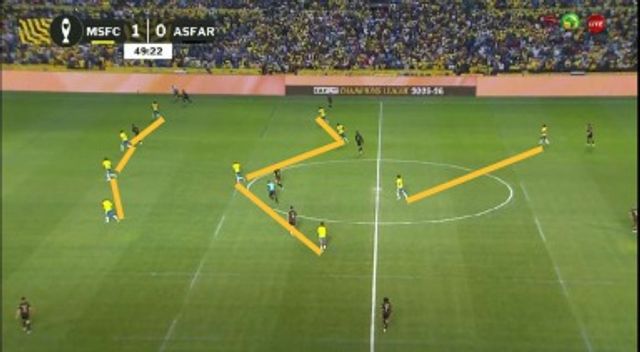
In possession, however, Nuno Santos began dropping deeper alongside Mokoena and Adams during the first phase.
This adjustment transformed the build-up structure into more of a 3-3-4 shape.
That deeper movement from Santos created additional superiority against AS FAR’s first pressing line.
With three central players now available underneath the ball, Sundowns circulated possession more comfortably and manipulated pressure with greater patience.
The deeper support also freed Brayan Leon to focus more aggressively on runs in behind the defensive line.
One of the clearest examples arrived in the 62nd minute when Mathews dropped deeper to receive before threading a pass into Leon’s run beyond the AS FAR backline.
The striker failed to convert, but the sequence perfectly demonstrated Sundowns’ evolving attacking mechanism: deeper connective support enabling direct vertical penetration.
As the second half progressed, AS FAR increasingly retreated into a deeper defensive shell.
Their midfield line dropped closer to the back four, often creating a situational back five during sustained Sundowns attacks.
This defensive retreat was less a strategic preference and more a consequence of Sundowns’ territorial dominance and circulation quality
Sundowns’ positional play around the edge of the box became particularly impressive during this phase.
Through intricate short combinations, rotations, and quick wall passes, they repeatedly opened narrow shooting windows around the penalty area.
Only the outstanding performance of Tagnaouti prevented the match from drifting beyond reach, particularly after his crucial save from Lethlaku following another sharp attacking combination.
The final twenty minutes showcased Sundowns’ game management maturity.
Rather than forcing attacks recklessly, they circulated possession patiently and adjusted their build-up depending on AS FAR’s pressure intensity.
When pressed tightly, they bypassed pressure through longer direct passes. When allowed space, they calmly recycled possession across the back three and midfield triangle.
Mokoena nearly produced a second goal in the 84th minute when his perfectly struck free kick beat both the wall and goalkeeper before crashing against the upright.
That moment summarized the match itself: Sundowns consistently generating high-quality situations while AS FAR struggled to sustain meaningful attacking pressure.

Ultimately, this was a tactically mature performance from Mamelodi Sundowns. Their asymmetrical structure, intelligent left-sided rotations, and disciplined rest-defence gave them control over nearly every phase of the game.
AS FAR’s compact block and transition approach carried some threat early on, but their inability to progress consistently or escape sustained pressure gradually pushed them deeper into survival mode.
Sundowns did not simply win through individual quality; they won because their structure repeatedly created superior positional conditions across the pitch.