


TACTICAL PREVIEW: Analysing battles that will define Kenya Police's clash against Tusker





.jpg)



Reading Time: 5min | Thu. 02.04.26. | 21:03
Both sides mirror each other in certain principles, particularly their use of a compact 4-4-2 out of possession, but diverge sharply in how they manipulate space in possession and exploit wide areas
Good Friday’s FKF Premier League clash between Kenya Police FC and Tusker FC at the Police Sacco Stadium sets up as a fascinating tactical chess match.
Both sides mirror each other in certain principles, particularly their use of a compact 4-4-2 out of possession, but diverge sharply in how they manipulate space in possession and exploit wide areas.
It is a battle of micro-details, where the timing of a press, the angle of a fullback’s run, or the quality of a set-piece delivery could swing the game.
Download our MozzartSport app for more news
Out of possession, Kenya Police operate within a disciplined and compact 4-4-2 mid-block designed to suffocate central progression.
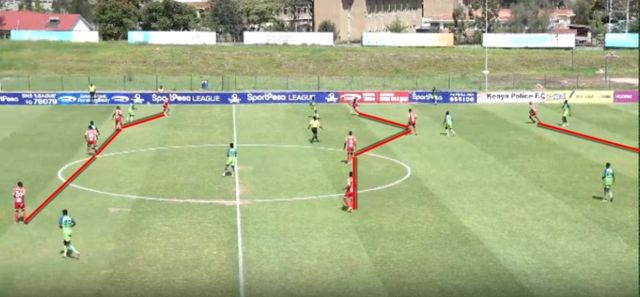
Their vertical compactness is key - they shrink the space between defensive and midfield lines, effectively denying access to interior channels.
This forces opponents wide, where Police can spring pressing traps. Their pressing mechanics are particularly aggressive when the opposition circulates the ball laterally toward the flanks.
That lateral pass becomes a pressing cue: the near winger jumps, the fullback steps high, and the midfield shifts across to create a man-oriented overload.
The touchline acts as an auxiliary defender, boxing the opponent into tight spaces. This coordinated press often results in rushed clearances or turnovers in dangerous areas.

Tusker, under Julien Mette, employ a similar 4-4-2 mid-block but with more synchronised lateral shifting.
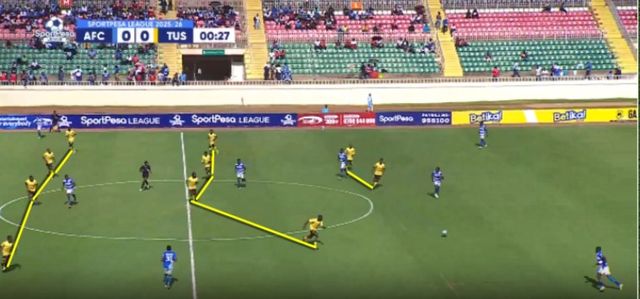
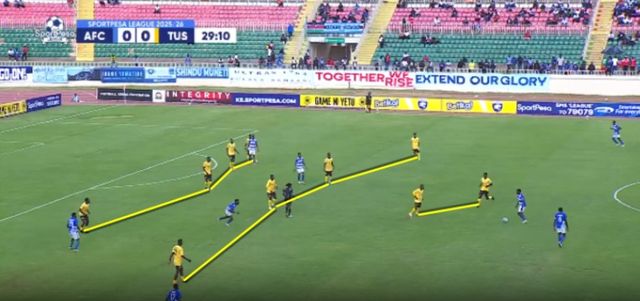
Their defensive structure moves as a unit, maintaining horizontal compactness while ensuring vertical distances remain tight.
However, Tusker’s standout out-of-possession tactic is their aggressive pressing from kick-off situations - launching the ball into wide areas and immediately collapsing onto that zone with a swarm of players.
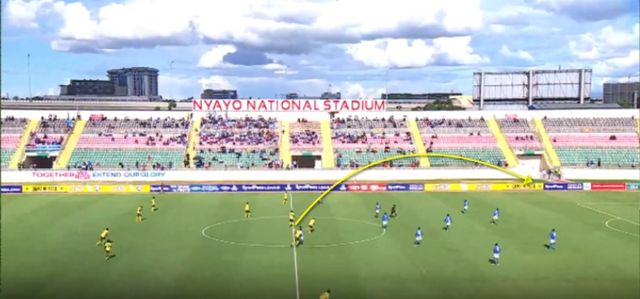
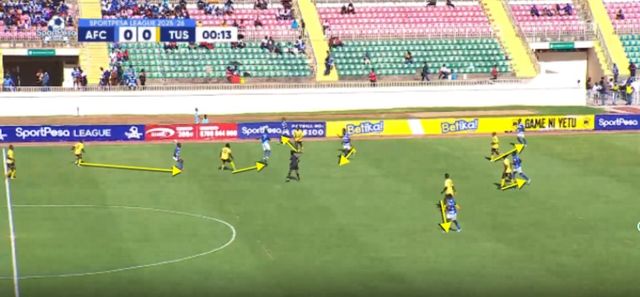
It is a premeditated trap, designed to pin the opponent and win second balls high up the pitch.
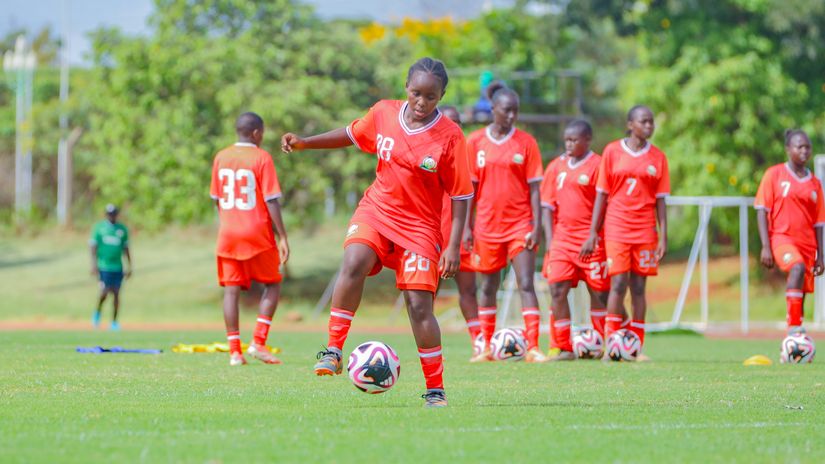
Their wingers play a crucial role here, stepping high to close down opposition centre-backs, while fullbacks engage opposition wide players in tight duels.
The coordination is impressive when executed well, but if the press is broken, gaps can appear - particularly with fullbacks\wingers caught high.
In possession, Kenya Police display a structured yet flexible build-up. In the first phase, they often form a 4-3 or 5-1 structure: the centre-backs stay narrow inside the box, fullbacks tuck in close, and a pivot drops to create numerical superiority against a high press.
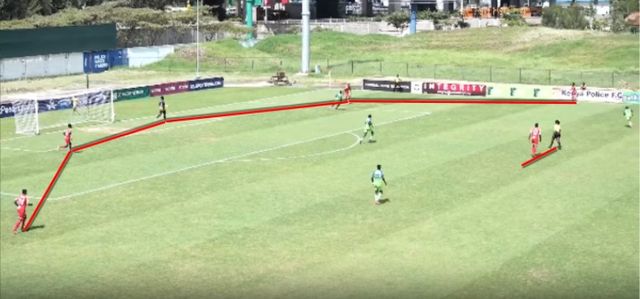
This allows them to circulate the ball safely before advancing. As they progress toward the halfway line, the fullbacks push high, stretching the pitch horizontally.
A key pattern emerges on the left flank, where Eric Zakayo drops into midfield pockets while left-back Hernest Malonga overlaps aggressively.
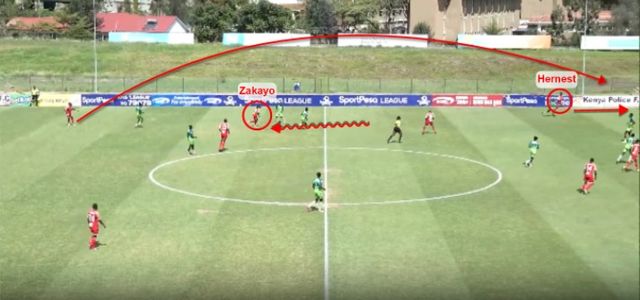
This positional rotation creates confusion in defensive marking and opens lanes for progression.
Yves Koutiama is the focal point in attack. His runs in behind the defensive line are constantly targeted with vertical through balls from midfield.
Police frequently utilise wide overloads to deliver crosses into the box, aiming for Koutiama’s aerial presence.
Malonga’s inswinging deliveries, especially from the right side during set-pieces, are a major threat.
In open play, Police often transition into a 4-1-5 shape, with five players occupying the front line and the pivot anchoring the midfield. This aggressive positioning allows them to attack quickly after regaining possession, particularly in advanced areas.
Tusker’s in-possession structure is more patient and methodical. They build from the back using a 4-2 or 5-2 shape, with two deep midfielders offering passing lanes and stability.
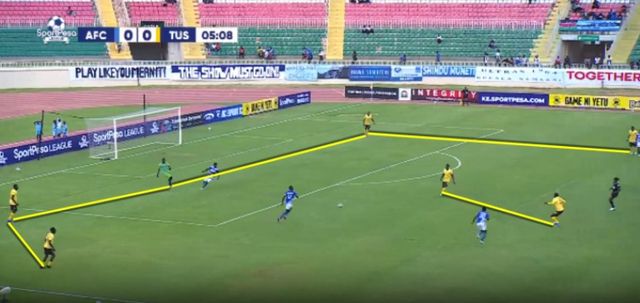
Their approach is to draw the opponent in, then exploit the vacated spaces - especially on the flanks.
Kapaito, the second striker, plays a pivotal role by dropping into midfield or drifting wide to create overloads.
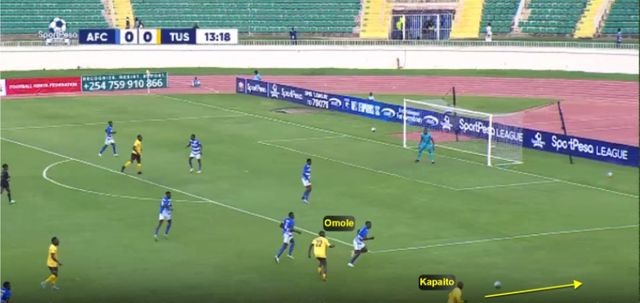
This movement has a ripple effect: it frees up the wingers to push high and isolate opposition fullbacks in 1v1 or 2v1 situations.
Tusker are particularly adept at switching play quickly, targeting the blind side of defenders to catch them off balance.

However, this approach comes with risks. When their fullbacks push high to support attacks, they can be exposed in transition.
If possession is lost in midfield, opponents can exploit the space behind the fullbacks, forcing Tusker’s centre-backs to shift wide.
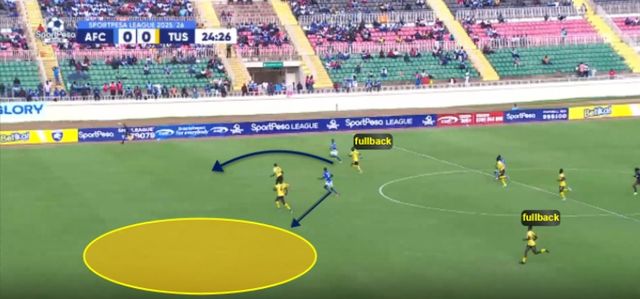
This creates central gaps that can be attacked with early crosses or direct runs. Kenya Police, with their quick transition play and direct verticality, are well-positioned to exploit this weakness - especially if Koutiama times his runs well against a stretched backline.
The midfield battle will be crucial. Kenya Police rely on a double pivot during build-up and a single pivot in advanced phases, while Tusker use a double pivot consistently.
The presence of Kapaito dropping into midfield could give Tusker a numerical advantage, but it also risks leaving Ibrahim Joshua isolated up front. If Police’s midfield can track Kapaito effectively and win second balls, they can disrupt Tusker’s rhythm and launch counterattacks.
Wing play is another decisive area. Kenya Police’s left flank, with Zakayo and Malonga, is a dynamic channel of progression.
Their interchanging movement can unsettle Tusker’s defensive structure, especially if the winger drops deep and the fullback overlaps into space. On the opposite side, the right winger maintains width, providing balance and a crossing outlet.
Tusker, meanwhile, rely heavily on their wingers to create chances through isolation and quick switches. Their ability to stretch the pitch and deliver early crosses will test Police’s high defensive line.
.jpg)
Set-pieces could be the ultimate difference-maker. Kenya Police possess a physically dominant squad with a strong aerial presence.
Their hybrid marking system in defensive corners - three zonal markers and several man-markers - offers both coverage and accountability.
Offensively, Malonga’s inswingers are dangerous, often targeting the near post or the six-yard box. Tusker will need to be alert and organised to avoid conceding in these situations.
As the game progresses, expect tactical adjustments. Kenya Police tend to go more direct in the second half, utilising long balls from centre-backs and the goalkeeper to bypass midfield congestion.
This could be a response to Tusker’s pressing intensity, allowing them to exploit space behind the defensive line. Tusker, on the other hand, may look to refine their pressing triggers and ensure better synchronisation to avoid being caught in transition.