


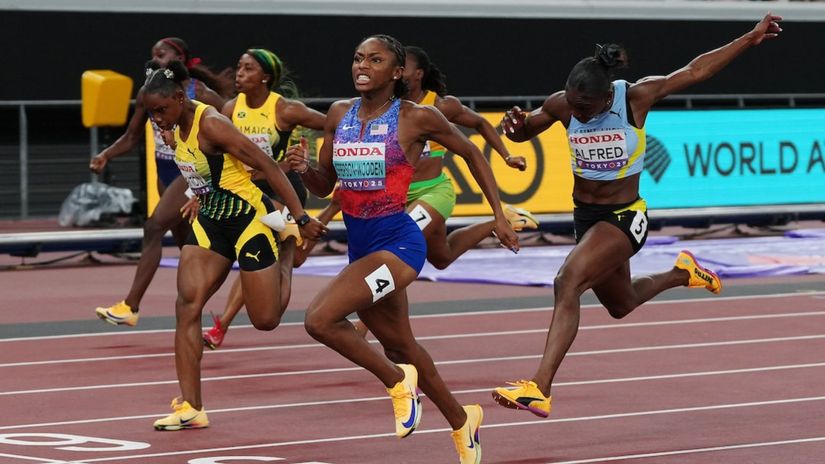
EXPLAINER: Why women’s 100m Olympic champion at LA 2028 will be crowned on opening day






Reading Time: 4min | Mon. 26.01.26. | 17:26
Since 1972, athletics has typically dominated the second week of the Olympics, while swimming anchored the opening days. The last time athletics took precedence over swimming was at the 1968 Mexico City Games
Los Angeles 2028 Olympic Games will mark a historic shift in how athletics is staged, with women’s sprinting placed firmly at the center of the global spotlight from day one.
Follow our WhatsApp channel for more news
According to the confirmed competition schedule, athletics will, for the first time in Olympic history, span the entire duration of the Games, from the opening day to the closing ceremony.
The program will burst into life on Saturday, 15 July 2028, with the women’s 100 meters taking center stage as the first major athletics final of the Olympics.
All three rounds of the women’s 100m; heats, semi-finals and the final will be contested on the same day, meaning the fastest woman in the world will be crowned on the very first official day of competition in Los Angeles.
Why the one-day format?
World Athletics president Sebastian Coe explained that the decision was driven by a combination of logistical challenges, athlete consultation and a desire to elevate women’s athletics.
“There were some challenges in the timetable in Los Angeles, and that actually gave us the opportunity of having athletics going first this time,” Coe said.
Venue allocation played a major role in reshaping the traditional Olympic schedule. SoFi Stadium, set to be renamed the 2028 Stadium during the Games will host the opening ceremony and all swimming events.
Organizers will require time to convert the venue into a swimming arena, forcing athletics to move forward in the program and opening the door for a bold rethink of the schedule.
Since 1972, athletics has typically dominated the second week of the Olympics, while swimming anchored the opening days. The last time athletics took precedence over swimming was at the 1968 Mexico City Games.
Crucially, the decision to stage the women’s 100m in one day was not imposed without consultation. Coe revealed that World Athletics held extensive discussions with elite athletes and their coaches before settling on the format.
“We spoke to all the top 100m athletes in a detailed engagement. We had the exchanges, the WhatsApps, the written verification, particularly amongst their coaches,” he said.
The feedback, Coe noted, was overwhelmingly positive from the women’s side.
“The overwhelming majority of the female 100m runners were comfortable about doing the three rounds in the day, were equally excited about being the first major medal of the Games, and don’t see it as being working against the interests of women’s athletics,” he explained.
Coe was also keen to dismiss suggestions that the move was designed to shield men’s events.
“This isn’t about finding an opportunity to protect the men and just put the women out there first. They were absolutely engaged with it,” he said.
Interestingly, while women embraced the idea, men were more cautious.
“We actually also engaged with the men, and the men were more reticent about doing all that in one day. It was the women and their coaches who were comfortable around that,” he explained.
To support athlete welfare, organizers have built in a longer recovery window between the semi-finals and the final on the same day. Coe revealed that out of 20 individual discussions with top-level athletes, 17 were comfortable with the format, with many coaches describing it as “perfectly manageable”.
A schedule built for stars and doubles
Athletics will be contested across 13 days, from 15 to 30 July, with in-stadium events at the iconic LA Memorial Coliseum running for the first 10 days. The focus will then shift to road events on July 27, 29 and 30, culminating in the men’s marathon on the final day, with medals presented during the closing ceremony.
Finals will feature in 17 of the 20 athletics sessions, with the timetable carefully designed to allow for multiple event doubles. Combinations such as the 100m and 200m, 200m and 400m (plus relays), 800m and 1500m, and even long jump and triple jump have been factored in.
A new repechage format will further support athlete recovery, offering at least 36 hours between round one and repechage in the 400m, and around 24 hours in the 800m and 1500m. The mixed 4x100m relay will also make its Olympic debut, strategically placed between the 100m and 200m events.
-1920x1080.jpg)
Games shaped by equality and scale
The LA 2028 Olympics will also be a milestone for gender representation, with women accounting for more than 50 per cent of all athletes for the first time in Olympic history.
Nearly 11,200 athletes will compete across 51 sports and disciplines, making it the biggest Olympics ever staged. Organizers have described it as a Games spread across 49 competition venues in 18 zones throughout Los Angeles and Oklahoma City.
The schedule will climax with a ‘Super Saturday’ on July 29, featuring 26 finals across 23 sports.
As Coe hinted, the women’s one-day sprint format may shape future Olympic planning.
“It may well be when we get to Brisbane [2032], we look at something different. But if it works, and the women are comfortable with that, then it may well be that we will follow their lead,” he offered.