


World Athletics boss weighs in on 'super shoe' debate after Sawe's historic feat


.jpg)

.jpg)
.jpg)



Reading Time: 2min | Sat. 02.05.26. | 14:45
"Yes, shoes play a part, but not the biggest part...," Coe
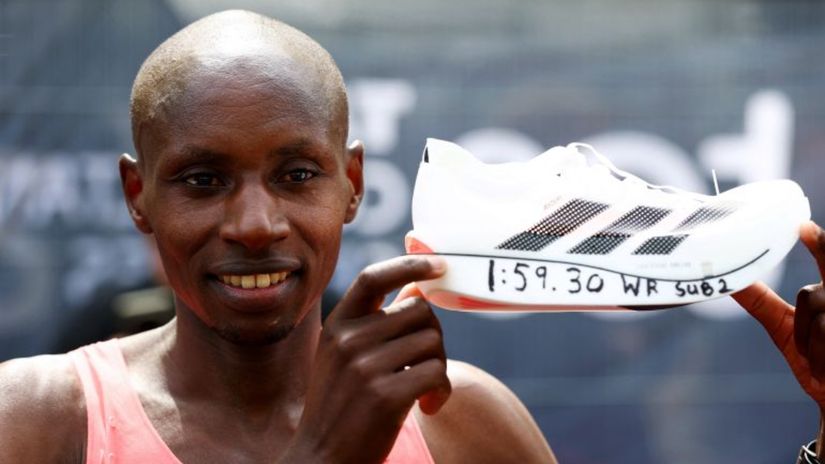
We have all seen it, the conversation around Sabastian Sawe's 97 gram shoe valued at approximately Ksh64,000 that the Kenyan used while making history, becoming the first human to run the marathon in under two hours (1:59:30).
Download our MozzartSport App For More News
Sawe's Adidas Adizero Adios Pro Evo 3, a revolutionary racing shoe dubbed a 'sub-100-gram supershoe,' is said to represent a dramatic drop from the typical 138–200 grams of elite running shoes.
The impact, just as massive, a study cited by the Wall Street Journal suggests that reducing shoe weight by about 100 grams (3.5 ounces) can save roughly 57 seconds over a marathon distance.
In the midst of a debate on the said advantage, World Athletics president Sebastian Coe says the federation will not "strangle innovation".
"I don't think any society, any civilisation, any sector of the economy has been served well if you try to strangle innovation," he told BBC Sport Africa on a visit to Botswana before the World Relays.

"The role of World Athletics is very clear, we want to enable, but we also have a regulatory responsibility."
And it was not just Sawe, Yomif Kejelcha, who also ran under two hours on his marathon debut, finishing 10 seconds behind the Kenyan, and Tigst Assefa, who set a new world record time as the winner of the women's race, all wore the same shoe.
"Yes, shoes play a part, but not the biggest part," Coe weighs in. "The biggest part is the mentality of the athlete, the physicality of the athlete, the world-class coaching, the world-class programmes that are now being run through federations to support their athletes. That's all a part of the improved performances."
Still, the rise of super shoes over the past decade, particularly when it comes to the marathon, has prompted World Athletics into a more active regulatory role.

By 2020, the governing body had introduced limits on sole thickness, the design of carbon-fibre plates designed to propel the body forward, as well as commercial availability, to prevent excessive technological advantage.
But for critics, the concern goes beyond regulation. The fear is that technology could erode the essence of distance running and that performances could reflect engineering rather than human endurance.