


 V. Karuga
English club finds new home in Kenya through charity project impacting entire community









Reading Time: 7min | Thu. 23.04.26. | 18:57
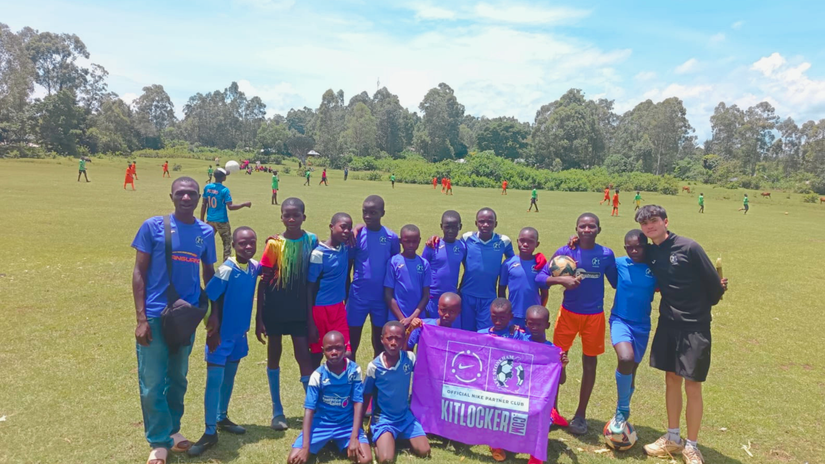
In October 2025, Dockree travelled to Kenya through a volunteer initiative. He had been coaching at Stoneham and has helped with their socials for several years, embedded in the rhythms of non-league football
There is a version of football that exists far from the noise. No floodlights, no broadcast deals, no urgency to monetise the moment. Just the game in its rawest form, dust rising from uneven ground, voices carrying across open fields, the ball never quite rolling true.
Download our Mozzart Sport app for more news
You hear it before you see it. A shout, a laugh, a call for the ball that sounds less like instruction and more like hope.
Somewhere outside Oyugis, in a village called Guu, football is being built from almost nothing, and yet somehow from everything.

Jacob Dockree does not look like the kind of person you expect to find at the centre of it. He is 18, English, and from his Instagram, you notice the black mullet first, the kind that signals youth more than structure.
But his voice, over the phone, is steady. Not rehearsed, not performative, just certain in the way belief tends to sound when it has not yet been worn down.
He is the Chair of AFC Stoneham Kenya and International Lead for AFC Stoneham, a club founded in 1919 that has just recorded its highest-ever league finish, earning promotion to the eighth tier of English football.
That history matters, but it does not explain what is happening in Guu. For that, you have to start with a journey.
In October 2025, Dockree travelled to Kenya through a volunteer initiative. He had been coaching at Stoneham and has helped with their socials for several years, embedded in the rhythms of non-league football.
He arrived carrying around a hundred donated kits, tops and shorts stitched with a badge that had never been meant for this place. The gesture was simple, but the response reshaped everything.
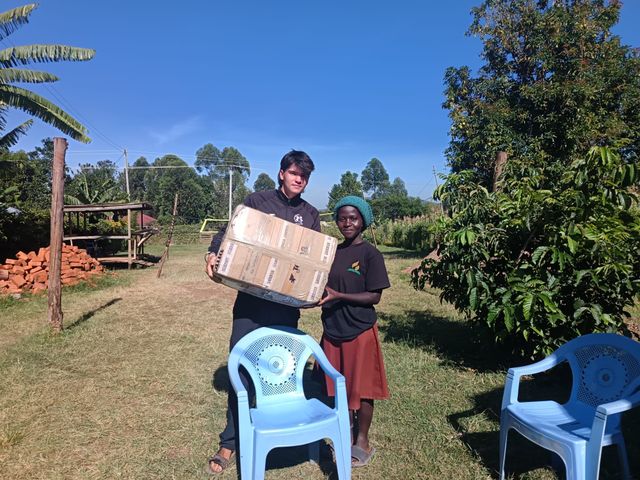
“Stacey immediately asked to use the name,” he says.
Her name is Stacey Nick, local organiser, co-founder, and now deputy chair. In that moment, between donation and decision, the idea shifted. It stopped being an act of giving and became something closer to shared ownership.
“We’re not just a sister club,” Dockree explains. “We’re an evolution of an impactful community-focused club, hoping to impact the lives of locals here in Guu and Oyugis.”

The language is deliberate. This is not a project imposed from outside. It is something built in place, with local structure, local leadership, and local belief at its core.
Newton, the assistant coach and ladies' first team coach, remembers the beginning in more practical terms. “We started with just one ball, a patch of very uneven grass and no equipment,” he says. “It’s incredible to see the growth and impact already. We are very excited for what is next.”
Growth here is not abstract. There are now four teams, close to a hundred children involved, and a senior side competing in the sub-county league while junior and girls teams play friendlies across the region.
Dockree does not point to results when asked what convinced him to stay committed in the long term. He points to something harder to quantify. “The desire and pure love of football from everyone here immediately showed me that this needed to be a long-term project for this community.”
It is the kind of statement that risks sounding cliché until you hear the context behind it, the daily repetition, the voluntary effort, the consistency required to sustain something without guarantees.
There is a story he returns to often, from a rainy friendly match in November. Conditions had deteriorated to the point where the referee wanted to abandon the match.
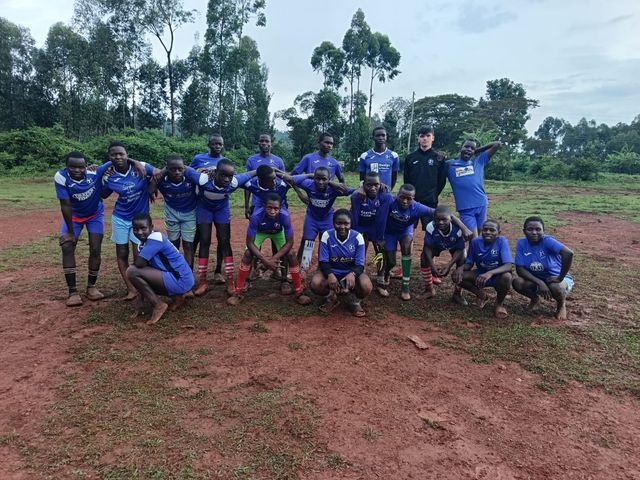
The players insisted on continuing. They negotiated, convinced both officials and opponents, and carried on playing in the rain. The game ended in a draw, but that detail is almost incidental. What mattered was the insistence.
“They convinced the ref and the other team to keep playing,” Dockree says. “That proved to us we had a special group of players that epitomise hard work and resilience.”
The image stays with you, not because of the result, but because of what it represents. A refusal to let the game be taken away.

You begin to understand the project more clearly through individual stories. Mary is 15, a midfielder in the girls' team. When training began, Dockree recalls that she would apologise constantly for mistakes, for misplaced passes, for things most players learn to ignore. Confidence, in those early stages, can be fragile and easily misread.
She travels a long distance to attend training, and yet she arrives early. Every session. Over time, the pattern shifted. The apologies faded, replaced by presence and assurance.
“She’s massively gained confidence and ability,” Dockree says. “She helped keep the girls' heads up in a friendly defeat to Shabana Starlets in December.” The detail is important, not a victory, but a response to defeat. Growth measured, not in scorelines, but in behaviour.
Kasim’s development in the senior team follows a similar trajectory. “He’s gained the confidence not only in himself but also to help and lead his teammates,” Dockree says. Leadership here is not assigned through hierarchy. It emerges through repetition, through trust, through consistency.
Sponsar, the lead youth coach, frames it in a language that bridges both ambition and discipline. “Victory is not just a goal,” he says. “It is a habit. Let’s make it a winning one.” It is the kind of phrase that could exist in any dressing room, but here it carries additional weight because the infrastructure around it is still being built.
The limitations are real. There is no home pitch suitable for matches. Games are played on a neutral school ground, while training takes place on a field that is functional but far from ideal.
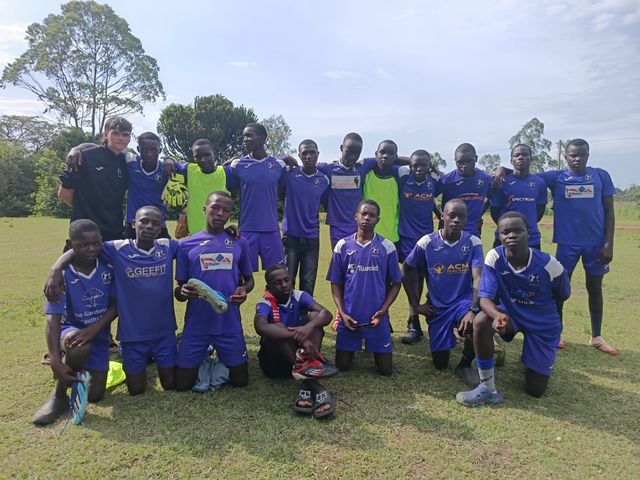
Securing land and developing a proper surface would require funding that currently sits beyond reach. Yet the absence of a permanent home has not stalled progress. If anything, it has reinforced the collective commitment to continue regardless.
Dockree is careful in how he defines the club’s identity. “We very much see ourselves as a Kenyan club with English roots,” he says. The distinction is not cosmetic.
Management, organisation, and operational structures are local. Coaches are local. Decision-making is local. Even as AFC Stoneham in England provides support through kit and equipment, the foundation in Kenya is designed to sustain itself.
The symbolism extends to the kit itself. The next version will feature the Kenyan flag, a deliberate assertion of identity aimed at both local and international audiences.
Stacey Nick sees the project through a broader emotional lens. “AFC Stoneham Kenya represents everything beautiful about football,” she says.
“The club is proof that dedication and belief can take you all the way.” Her perspective carries a sense of ownership that reflects the club’s evolution from an introduced idea into a locally embedded institution.

On the pitch, ambitions remain grounded but clear. The senior team is targeting promotion from the sub-county league to the county level. A strong opening result has reinforced belief within the squad, but Dockree remains measured in his assessment.
“We know it will be a huge challenge,” he says, “But I believe the willpower they show me every day can get us over the line.” Promotion would serve as both a reward and a signal, evidence that the structure being built can translate into competitive success.
Beyond competition, the project continues to expand its network. Partnerships with local schools have already been established, and discussions are ongoing with Shabana.
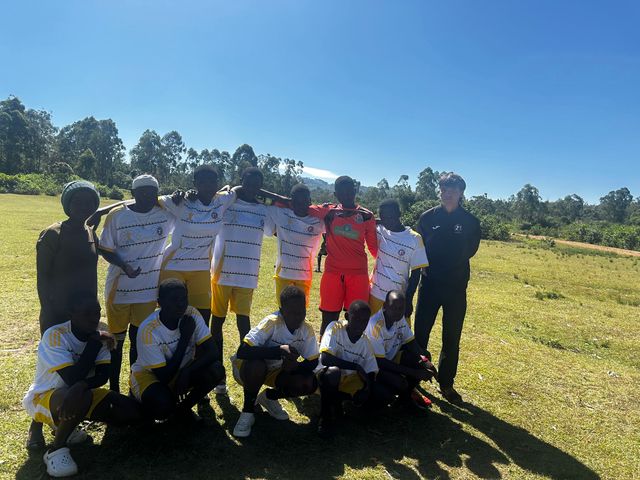
The long-term vision includes climbing the Kenyan football pyramid while creating pathways that extend beyond the immediate environment, opportunities that could reshape what is possible for players in Guu and Oyugis.
The most symbolic moment, however, will take place far from Kenya. In May, Stacey will travel to England to observe UEFA-qualified coaches and gain exposure to different training methodologies.
The exchange is designed to flow both ways, not only to bring knowledge back, but also to challenge assumptions about Kenyan football from those who may not yet understand its depth.

At the same time, AFC Stoneham will play at Wembley Stadium in the FA Vase final, a historic moment for the English club. In Guu, preparations are already underway to ensure the match is watched collectively, turning a distant event into a shared experience.
Dockree is aware of how easily stories like this can be simplified into narratives of hope. He resists that framing, focusing instead on the underlying work required to sustain progress. There have been logistical hurdles, financial constraints, and structural challenges, each requiring solutions that are often improvised rather than planned.
“I’ve immersed myself in Kenyan life and found every aspect of it incredibly rewarding,” he says.
“This project is proof of how much impact this game we love can really have. To be able to be a part of these kids and this club’s journey is a privilege.”
Impact, in this context, is not abstract. It is visible in confidence gained, in attendance maintained, in small shifts that accumulate over time. It is present in the way players carry themselves, in the way they respond to setbacks, in the way they begin to see themselves differently.
The connection between a club founded in England in 1919 and a village in Kenya in 2025 is not straightforward. It is shaped by people, by decisions, by moments that could easily have gone another way. But it exists, and it continues to grow.
And in Guu, the game goes on.