


PLAYER COMPARISON: Frank Odhiambo or Mike Kibwage, who makes Gor Mahia tick?

Reading Time: 6min | Tue. 24.03.26. | 20:42
With Kibwage, the backline becomes more technically fluid, emphasising controlled buildup and intelligent passing patterns
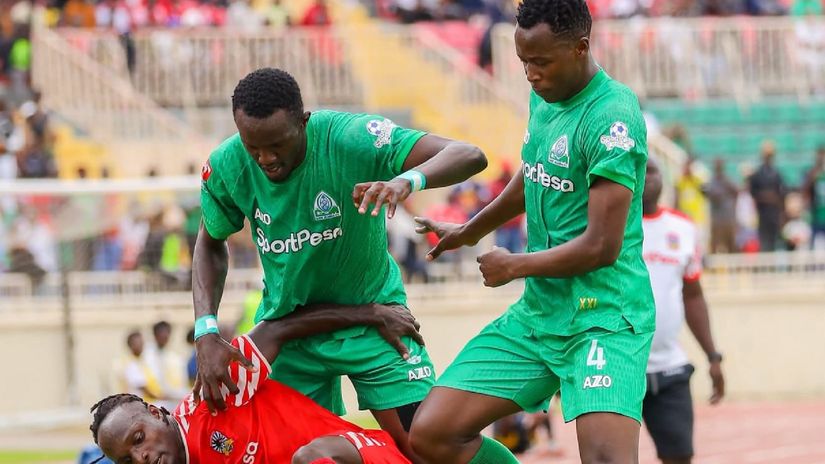
At Gor Mahia, defensive stability has long been anchored on Sylvester Owino at left centre-back, but around him, the right centre-back role has rotated between two distinct profiles: Frank Odhiambo and Mike Kibwage.
Download our Mozzart Sport App for more news
Importantly, Gor Mahia have alternated between two pairings - Owino with Kibwage before Odhiambo’s return to the club, and more recently, Owino with Odhiambo.
These partnerships reveal fascinating contrasts in defensive style and build-up dynamics, each subtly influencing how the team defends space and launches attacks.
At the heart of the defensive structure is Owino, the constant reference point. As the left centre-back, he embodies the archetype of the proactive defender - often stepping forward aggressively to engage attackers, intercept passes, and disrupt opposition build-up.
Think of him as the “spear” of the defensive line: the player willing to break shape momentarily to win the ball early. But every spear needs a shield behind it, and that’s where the identity of the right centre-back becomes crucial.
.jpg)
When Frank Odhiambo partners Owino, the defensive unit acquires a distinctly physical and reactive edge. Odhiambo operates as the shield in this pairing, maintaining positional discipline while Owino steps out to confront attackers.
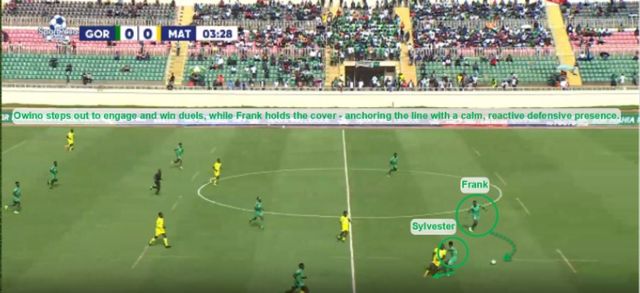
His defensive intelligence lies in his constant scanning and spatial awareness. He checks his shoulder frequently, ensuring he maintains the correct distance to the opposing striker while also keeping the defensive line synchronised with his teammates.
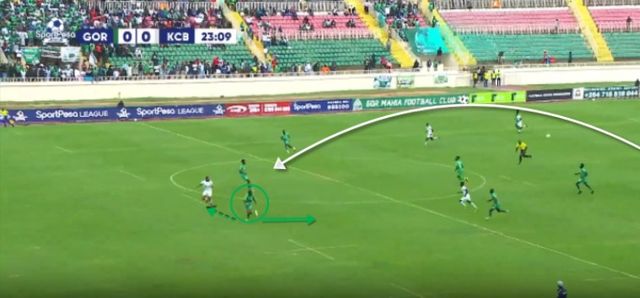
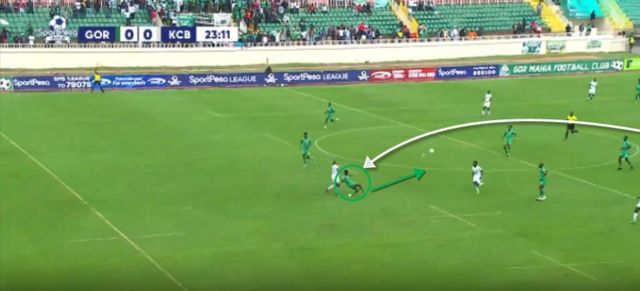
This habit of scanning - something elite defenders are known for - allows him to anticipate movements and adjust his positioning before danger fully develops.
Odhiambo’s presence is particularly noticeable during set-piece defending. Positioned as one of the zonal markers close to the near-post zone, he uses his height, leap, and timing to dominate aerial situations.
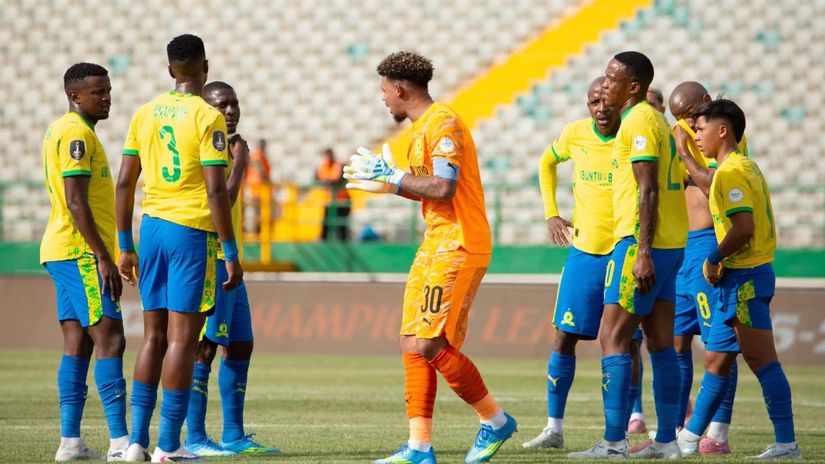
His physical engagement with strikers - often involving subtle nudges and controlled body contact - creates a psychological edge, a “fear factor” that discourages opponents from attacking the same spaces repeatedly.
In aerial duels, his technique is almost textbook. He arches his body in mid-air, aligning himself with the trajectory of the incoming ball before attacking it decisively.
That ability recently produced a memorable moment when he timed his leap perfectly from a long throw-in and headed the ball into the net for his first goal since returning to the club.
Such moments highlight why he and Owino have become primary aerial targets during attacking set pieces like corners and long throws.
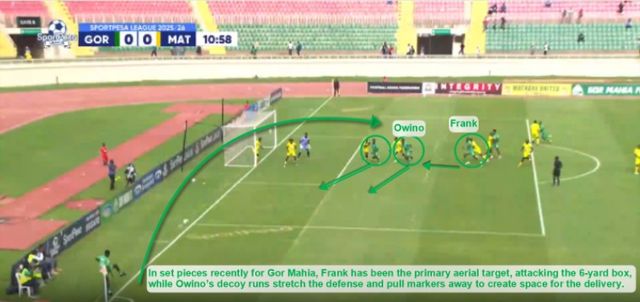
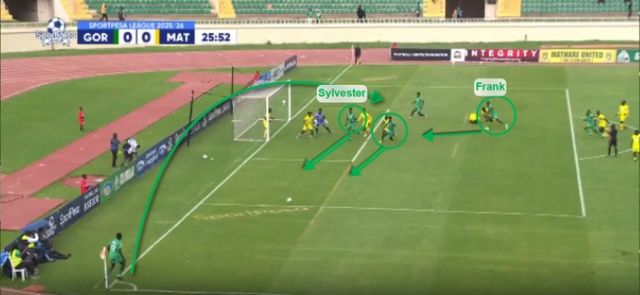
Yet Odhiambo is not simply a traditional defensive enforcer.
He also possesses impressive technical qualities. His ball manipulation, dribbling control, and ability to carry the ball through space give Gor Mahia an additional outlet during buildup phases.
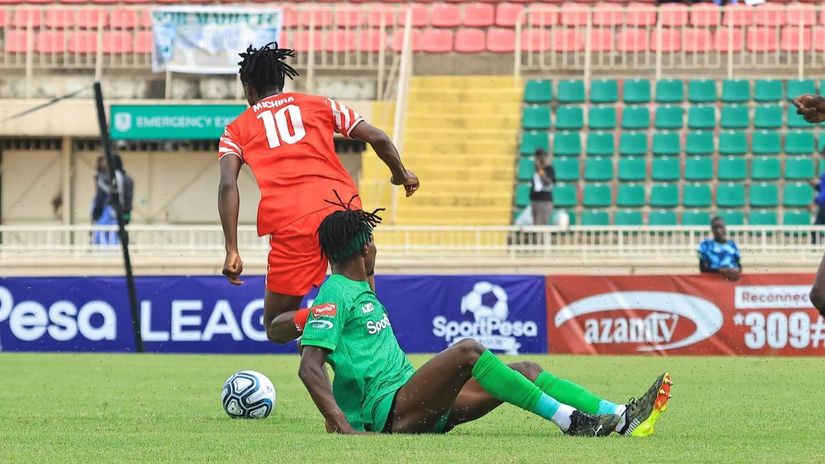
When opposition pressure recedes, he can stride forward confidently with the ball before releasing passes into midfield.
Although he often prefers safe distribution - circulating possession sideways to maintain control - Odhiambo has the vision to attempt ambitious passes.
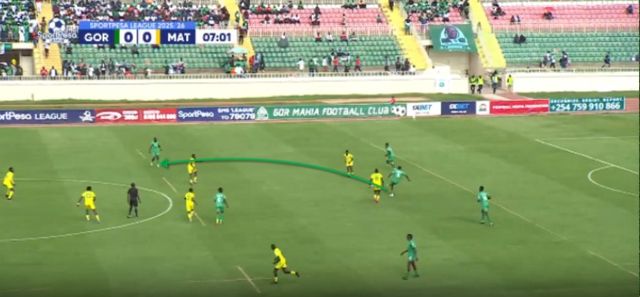
When space opens along the flanks or within the half-spaces, he can thread diagonals that stretch the opponent’s defensive block.
This blend of caution and ambition is key to Gor Mahia’s transition play: he stabilises possession first, then injects verticality at the right moment.
Another fascinating aspect of Odhiambo’s profile is his versatility.
In a recent league match against Sofapaka, he was pushed into a holding midfield role when Kibwage was subbed on as a centre-back. That temporary positional switch illustrated his tactical intelligence and spatial awareness.
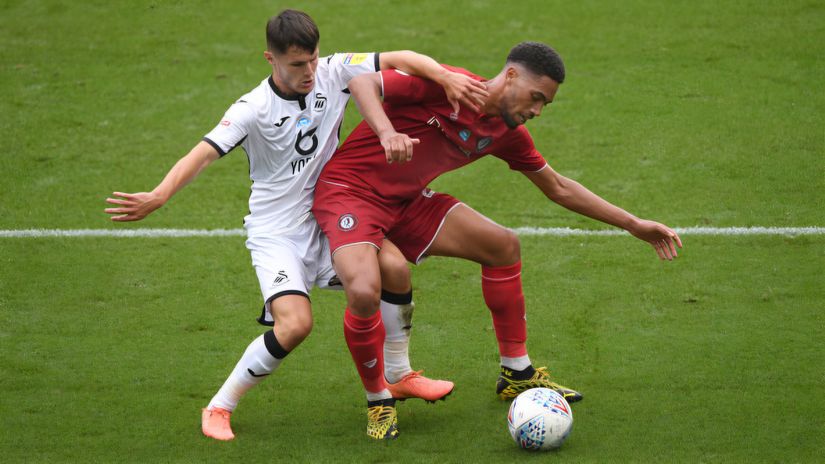
As a makeshift pivot, he connected play alongside Enock Morrison with quick one-touch passes while maintaining his defensive instincts, reinforcing the idea that modern centre-backs must be comfortable operating beyond traditional boundaries.
Defensively in open play, Odhiambo excels in what coaches call “rest defense” - the positioning used to slow opposition counterattacks.
His recovery sprints and off-ball movement allow him to delay attackers, often positioning himself between multiple opponents and forcing them into rushed decisions.
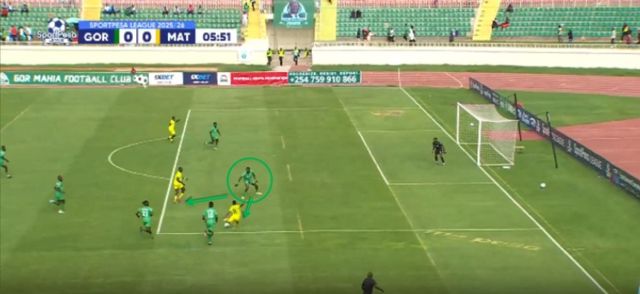
It is a subtle skill, but one that prevents dangerous transitions from becoming immediate threats.
The dynamic changes when Mike Kibwage replaces Odhiambo as Owino’s partner. While still playing as the right centre-back, Kibwage’s influence is felt more strongly in the build-up phase.
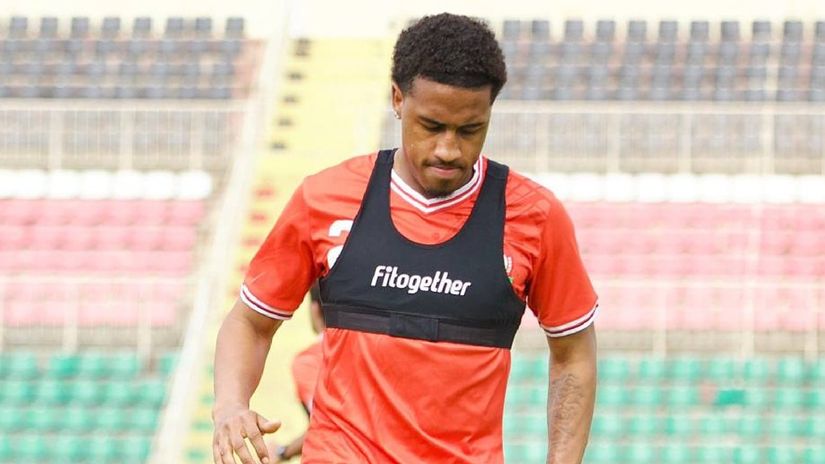
If Odhiambo is the shield, Kibwage is the architect - the defender responsible for designing the team’s passing routes out of defense.
Kibwage thrives in the low build-up phase, where Gor Mahia attempt to progress the ball from the back through controlled passing sequences. His passing range is impressive, both in weight and trajectory.
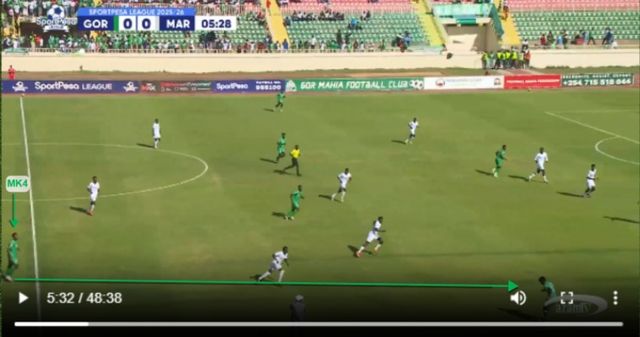
Whether delivering short combinations into midfield or launching long diagonals toward the opposite wing, he functions like a quarterback orchestrating play from deep.
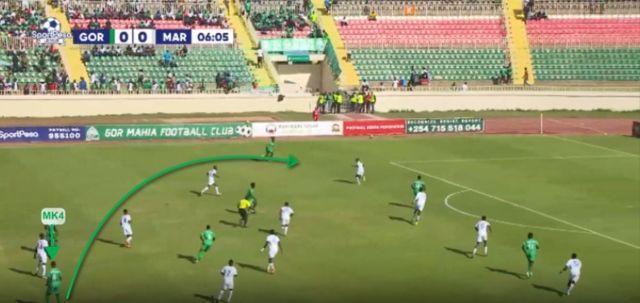
One recurring pattern involves Kibwage drifting slightly wide to the right when the right-back pushes forward.
In these moments, he temporarily becomes a makeshift right-back, forming a triangular structure with the deep-lying midfielder and the other centre-back.
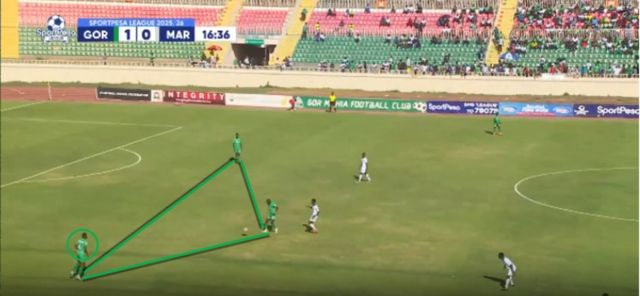
This triangular shape creates multiple passing lanes, making it difficult for opponents to press effectively.
From this position, Kibwage can thread line-breaking passes through opposition pressure, unlocking attacks before the opponent has time to reorganise.
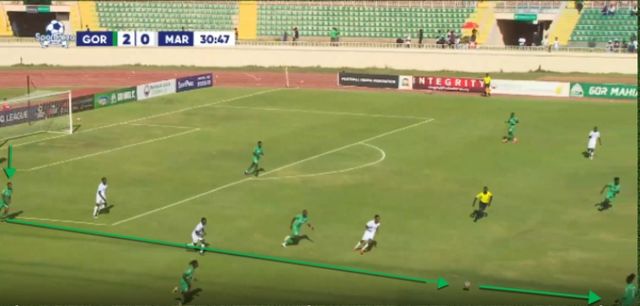
Against Mara Sugar, his statistical output demonstrated this composure: he recorded an 89 per cent overall passing accuracy, completing 76 of his 80 short passes for a remarkable 95 per cent success rate.
Unlike Odhiambo, Kibwage rarely carries the ball over long distances, particularly under pressure. Instead, he relies on quick one-touch combinations that maintain the tempo of possession.
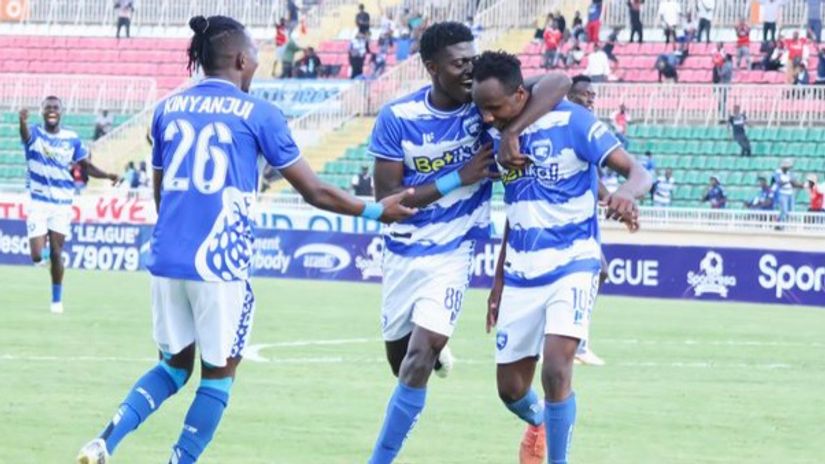
This preference for rapid circulation keeps Gor Mahia’s attacking structure fluid and minimises the risk of turnovers in dangerous areas.
Defensively, Kibwage remains reliable. He competes effectively in aerial duels and handles one-versus-one battles with opposing strikers confidently. His ball recovery ability is also noteworthy, allowing him to regain possession quickly after turnovers.
His adaptability has also been evident in positional adjustments.

During the match against Mara Sugar, he temporarily switched sides with Owino and operated as a left centre-back before returning to his usual right-sided role.
Such adaptability reflects a defender comfortable with tactical shifts, an increasingly valuable trait in modern football.
Interestingly, in a recent Mozzart Bet Cup match against BB Bread FC, where Kibwage and Odhiambo started together as the two central defenders - Odhiambo on the left and Kibwage on the right. While this pairing is not the usual configuration, it demonstrated how both players could adjust their roles when required.
Ultimately, the common thread connecting these partnerships is Sylvester Owino.
Whether paired with Odhiambo or Kibwage, he remains the stabilising force - the experienced organiser who ensures the defensive line retains its structure. His aggressive stepping-out style complements both partners in different ways.

With Odhiambo, the defense becomes physically imposing and transition-resistant.
Their aerial dominance makes Gor Mahia particularly dangerous during set pieces, both defensively and offensively. With Kibwage, the backline becomes more technically fluid, emphasising controlled buildup and intelligent passing patterns.
This contrast highlights an important lesson in football: defensive partnerships are rarely about identical skill sets.
Instead, they flourish when contrasting qualities complement each other. Odhiambo’s athleticism and defensive shielding balance Owino’s proactive engagement, while Kibwage’s passing vision enhances the team’s build-up rhythm.
In many ways, these partnerships resemble different styles of musical harmony.
Owino provides the steady rhythm, Odhiambo adds the powerful bass notes of physical dominance, and Kibwage introduces the melodic passing patterns that guide the team forward.
Together, even without forming a trio, they illustrate how tactical diversity within a defensive unit can strengthen a team’s overall system - ensuring Gor Mahia remain both resilient at the back and purposeful in transition.