


TACTICAL ANALYSIS: How Sundowns weathered Malien's storm to keep their CAF Champions League dream alive

.jpg)
.jpg)
.jpg)

Reading Time: 6min | Mon. 23.03.26. | 15:44
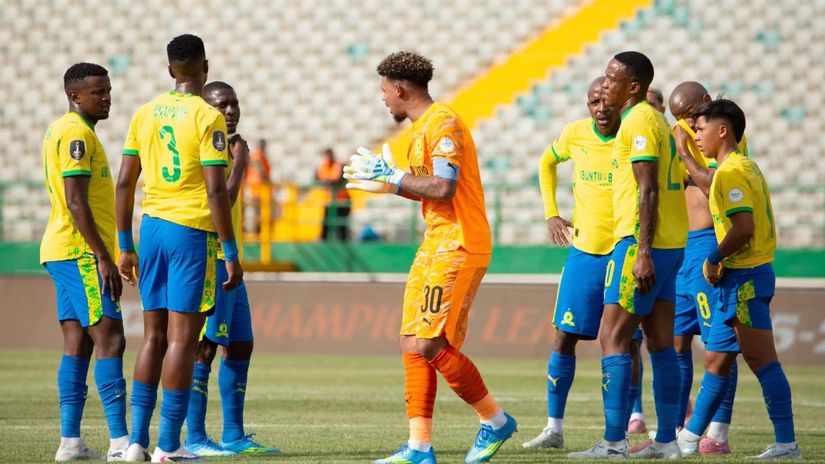
Despite the loss on the night, Sundowns’ ability to absorb pressure enabled them to progress on aggregate, winning 3-2 across the two ties
Stade Malien secured a 2-0 victory over Mamelodi Sundowns in the second leg of their CAF Champions League quarter-final, a match defined by aggressive pressing, fast transitions, and the exploitation of Masandawana’s high defensive line.
Follow Our WhatsApp Channel For More News
Despite the loss on the night, Sundowns’ ability to absorb pressure enabled them to progress on aggregate, winning 3-2 across the two ties.
The game was a tactical showcase: Malien demonstrated clinical execution in attacking transitions and wide-channel exploitation, while Sundowns’ defensive resilience and mid-to-late adjustments underscored their experience in managing knockout matches.
Stade Malien began the game in a traditional 1-4-4-2 formation, designed to balance defensive coverage with rapid attacking transitions.
Traore Ng’olo occupied the goal, protected by Abdoul Bode at right-back, Dramane Traore at left-back, and the central defensive pairing of Babe Diarra and Ismaila Simpara.
Haman Mandjan and Mamadou Traore orchestrated the central midfield, providing both defensive support and outlet passes for forward movements.
On the wings, Moussa Diallo and Daouda Coulibaly combined pace with width, while Tadeus Nkeng led the line as a target man, supported closely by Ousmane Coulibaly as the second striker.
This dual-forward system allowed Malien to simultaneously threaten through the centre and stretch Sundowns’ wide defenders.
Mamelodi Sundowns, by contrast, deployed a 1-2-3-5 formation, prioritising possession-based build-up and high offensive positioning.
Ronwen Williams occupied the goal, flanked by centre-backs Grant Kekana and Khulumani Ndamane, with Jayden Adams operating as a defensive anchor ahead of them.
The central midfield trio - Adams, Teboho Mokoena, and Marcelo Allende - provided both creative support and defensive cover.
Fullbacks Khuliso Mudau and Aubrey Modiba pushed high to join striker Iqram Rayners, while inside forwards Nuno Santos and Arthur Sales exploited half-spaces to create passing lanes and attacking overloads.
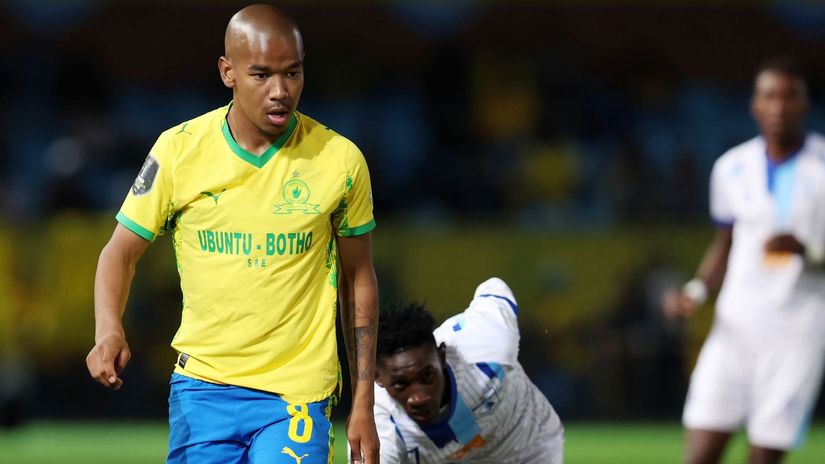
Sundowns’ approach aimed to stretch Malien horizontally and vertically but relied heavily on precise coordination to avoid exposure behind the advanced defensive line.
The opening moments immediately showcased Stade Malien’s aggressive strategy. In the first minute, a rapid transition from the right wing saw Mamadou Traore deliver a cross that found Nkeng, who converted a first-time header past Ronwen Williams, putting Malien ahead 1-0.
The goal was a textbook example of exploiting a high defensive line: Nkeng’s positioning between the two centre-backs and Coulibaly’s slight drop into the half-space created immediate numerical superiority for Malien in the final third.
This instant breakthrough set the tone for the first half, signalling to Sundowns that absorbing pressure would be critical.
After the goal, Stade Malien sustained intense pressure around Sundowns’ penalty area. Their mid-block defensive shape, compact and disciplined between lines, allowed them to press effectively when Sundowns attempted to build from the back.
Wide runners Diallo and Coulibaly continually stretched Sundowns’ central midfield and fullbacks, opening gaps for through balls to Nkeng and Coulibaly.
Sundowns, while attempting patient build-up with Allende and Adams, were repeatedly forced into hurried passes, leading to misplacements and disrupted rhythm.
Malien’s pattern of pressing in combination with second-ball retrieval emphasised tactical discipline and awareness of Sundowns’ vulnerabilities.
By the 16th minute, Stade Malien’s threat was clear once more. Nkeng received a perfectly timed through ball behind Sundowns’ defenders but was adjudged offside, denying him a second goal.
Nevertheless, the movement demonstrated Malien’s dual-pronged threat: Nkeng as a target man for crosses and Coulibaly’s dropped runs into pockets between midfield and defense. Sundowns’ high line, combined with fullbacks frequently pushing forward, left exploitable spaces that Malien consistently targeted.
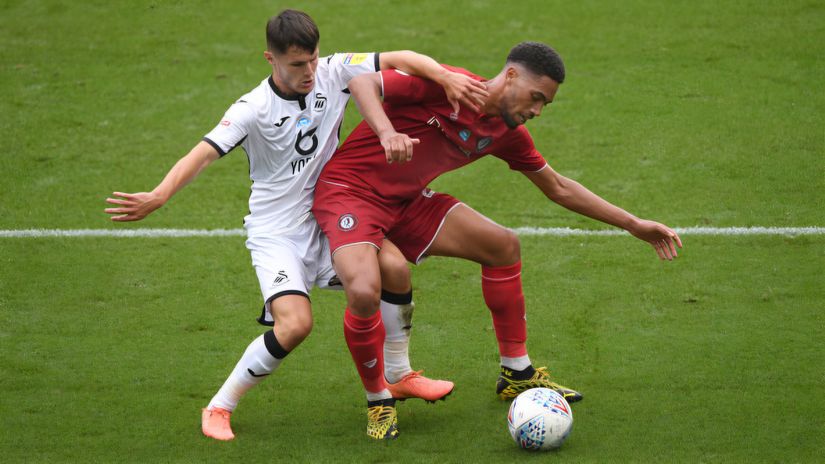
From 20 to 40 minutes, Stade Malien gradually shifted their attacking emphasis to the left side. Long balls over Sundowns’ defensive line, combined with quick wing-to-wing transitions, created repeated opportunities.
Physical duels and high-intensity challenges became a key feature: Malien dominated second balls, disrupting Sundowns’ passing rhythm and forcing defensive errors.
The culmination of this pressure arrived in the 40th minute, when Mandjan scored the second goal. Initially hitting the crossbar, the ball was deflected by a Sundowns defender before Mandjan’s finish, demonstrating Malien’s emphasis on persistence, duels, and exploiting high defensive lines.
By this stage, Sundowns’ structure was stretched, with fullbacks and inside forwards frequently pulled out of position, allowing Malien’s forwards to occupy central channels and half-spaces effectively.
Despite trailing 2-0, Sundowns sought to regain control through controlled possession, utilising intricate passes in midfield to connect with the advanced fullbacks and inside forwards.
They aimed to use high-tempo passing and diagonal balls to exploit space behind Malien’s defenders.
Yet, repeated pressure from Malien’s mid-block, coupled with aggressive duels, hindered Sundowns’ rhythm. Mis-passes and hurried long balls became common, highlighting how Malien’s pressing and transitional strategy effectively constrained Sundowns’ buildup.
At the start of the second half, Sundowns made an immediate adjustment. Khulumani Ndamane was replaced by Keanu Cupido to bolster central defensive agility and stability.
Sundowns attempted low, short build-up play from the back, seeking to draw Malien forwards high, then exploit space to their interior midfielders/inside forwards behind via goalkeeper distributions and long passes.
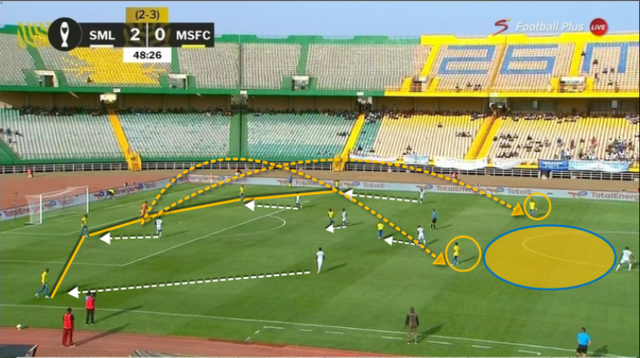
By min 53, Rayners had a goal ruled out for offside, showing that Sundowns were beginning to create clear attacking opportunities, even if they were limited by precise defensive tracking from Malien.
Sundowns continued to exchange passes behind Malien’s defensive block, particularly via Allende and Arthur Sales, creating potential openings.
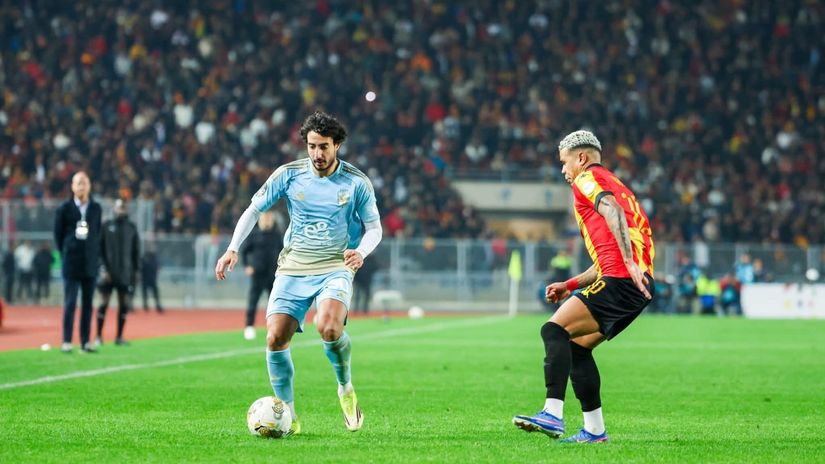
On the left, Modiba pushed higher, attempting to exploit the space behind Bode, Stade Malien’s right-back.
To further enhance the attacking threat, Bryan Leon and Tashreeq Mathews were introduced at min 62, replacing Arthur Sales and Rayners, with the explicit intent of widening attacks and creating numerical superiority in the wide channels.
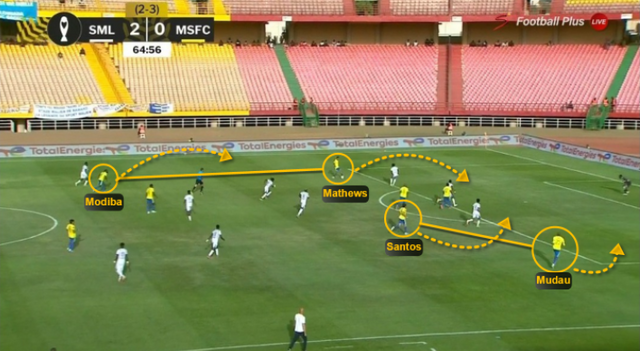
This forced Malien to adapt, tracking runners tightly and maintaining their mid-block shape.
Despite these strategic adjustments, Sundowns were undermined by discipline issues. At min 77, Modiba received a red card for a mistimed challenge on Diallo, reducing Sundowns to ten men.
In response, Divine Lunga replaced Nuno Santos, sacrificing offensive width to maintain defensive compactness, and Mdunyelwa replaced Marcelo Allende at min 80, reinforcing midfield defensive coverage.
Sundowns transitioned to a 5-3-1 deep block, prioritising structural integrity over attacking ambition.
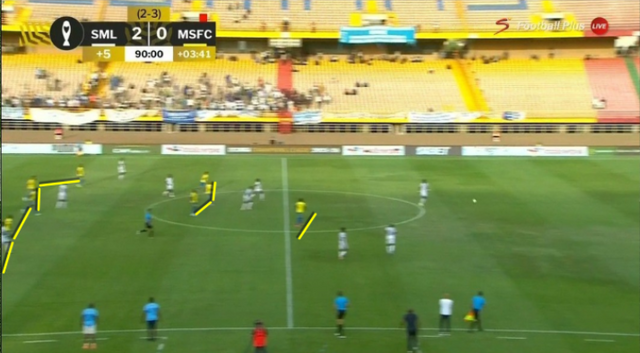
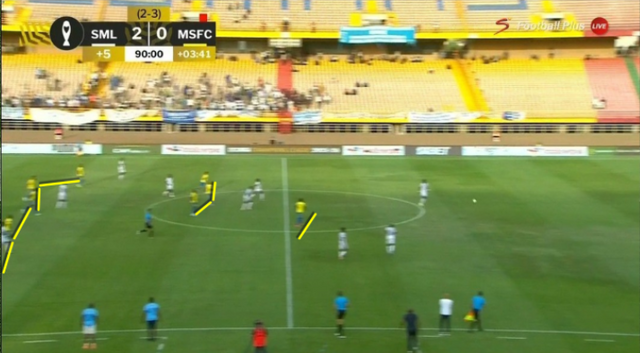
This adjustment proved crucial: despite Malien continuing to press and seeking a third goal, Sundowns’ organisation prevented further breakthroughs, highlighting the value of compactness and coordinated defensive positioning.
Throughout the match, Stade Malien maintained consistent defensive organisation.
Their 4-4-2 mid-block prevented central penetration, with wide defenders and midfielders tracking runners closely.
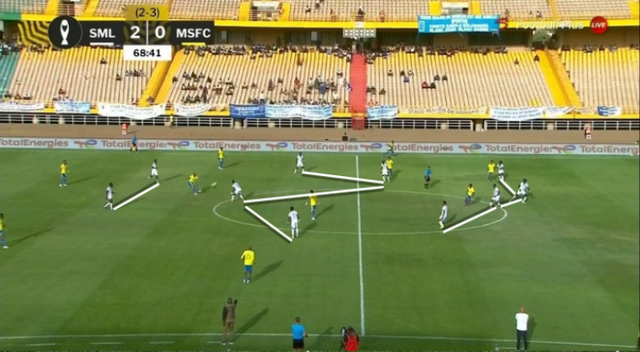
The second striker occasionally dropped to press centrally, allowing the team to maintain mid-block cohesion while still supporting forward transitions. Sundowns’ attempts to exploit diagonal runs or overlapping movements were largely contained, except during brief sequences prior to Modiba’s dismissal.
In conclusion, Stade Malien’s early aggression, exploitation of wide channels, and ability to punish Sundowns’ high defensive line were decisive in securing a 2-0 victory on the night.
Their pressing, transitional speed, and physicality highlighted a disciplined tactical approach that maximised their strengths and targeted Sundowns’ vulnerabilities.

Mamelodi Sundowns, however, demonstrated resilience through structured low-block defense, timely substitutions, and post-red-card adaptations, enabling them to progress on aggregate despite conceding two early goals.
This tie underscores several tactical lessons: high-intensity pressing and early offensive momentum can dominate individual games, but structural discipline, adaptability, and controlled transitions are critical over two-legged fixtures.
Stade Malien’s execution was near-perfect for a single match, but Sundowns’ ability to absorb pressure, reorganise defensively, and exploit counter-attacks ensured their ultimate success in advancing to the next stage of the CAF Champions League.
Notably, Malien’s tactics exemplified intelligent, aggressive football with precise execution, while Sundowns’ adaptability and defensive awareness highlight why they ultimately secured the aggregate win, despite a challenging second-leg performance.