


TACTICAL ANALYSIS: How Mamelodi Sundowns’ thumped Stade Malien
.jpg)




Reading Time: 6min | Mon. 16.03.26. | 17:28
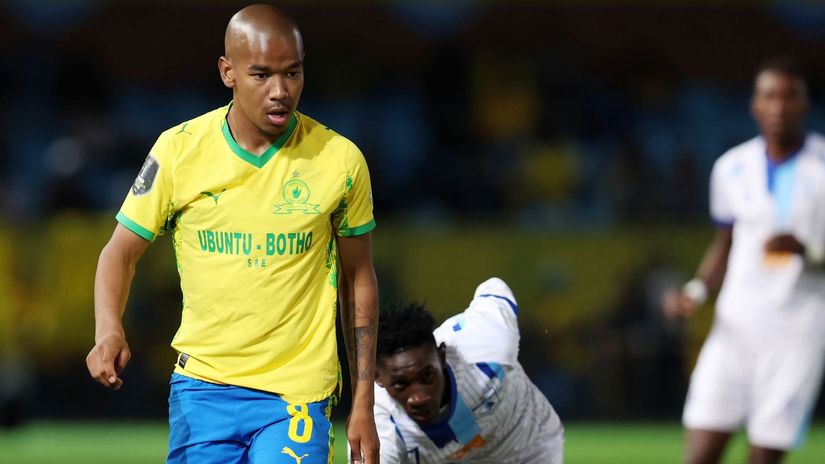
From the opening exchanges, Sundowns imposed their rhythm through intricate passing networks and coordinated movement across the pitch
Mamelodi Sundowns secured a commanding 3-0 victory over Stade Malien in a CAF Champions League quarter-final defined by structural superiority, positional rotations, and relentless control of possession.
Follow our WhatsApp channel for more news
From the opening exchanges, Sundowns imposed their rhythm through intricate passing networks and coordinated movement across the pitch.
This tactical analysis explores the strategic factors that shaped the contest - from starting structures and defensive schemes to build-up patterns, pressing mechanisms, and the adjustments that allowed Sundowns to dominate every phase of play.

Sundowns began the match with a structure that resembled a 4-2-3-1 in possession.
Ronwen Williams operated in goal behind a central defensive pairing of Grant Kekana and Khulumani Nadamane.
Khuliso Mudau and Aubrey Modiba played as aggressive full-backs, constantly pushing into advanced areas to stretch the opposition horizontally.
In midfield, Teboho Mokoena and Jayden Adams formed the double pivot responsible for ball progression and defensive balance, while Nuno Santos occupied the central creative zone between the lines.
Arthur Sales and Tashreeq Mathews operated across wide and half-spaces, interchanging frequently with the full-backs, while Bryan Leon acted as the focal point of the attack.
Stade Malien set up in a 4-3-3 formation. Goalkeeper Traore Ngolo started behind a defensive line consisting of Mery Camara at right-back, Awine Francis at left-back, and central defenders Diara Babe and Simpara Ismaila.
Haman Mandjan and Bello Ahmadou formed a double pivot in midfield, with Traore Mamadou slightly advanced ahead of them.
In attack, Coulibaly Ousmane and Daouda Coulibaly played on the flanks while Taddeus Nkeng led the line as the central striker.
Sundowns’ rotations continually distorted Stade Malien’s defensive references.
Out of possession, Stade Malien adopted a mid-block that often resembled a 4-4-2, occasionally collapsing into a deeper 5-3-2 when defending their penalty area.
Their left winger, Daouda Coulibaly, frequently tracked Mudau deep into defensive territory, effectively forming a temporary back five.
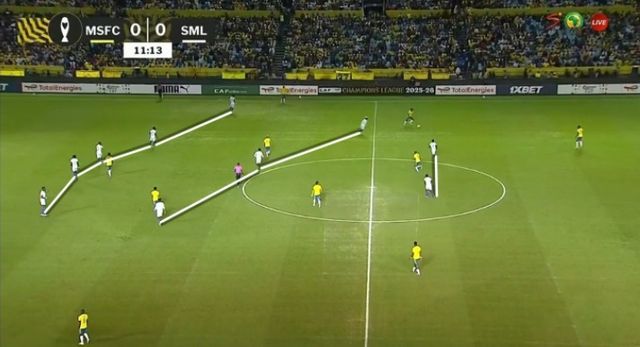
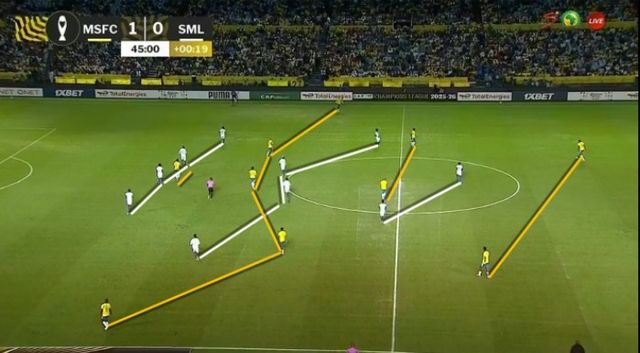
The intention behind this structure was clear: deny central penetration and force Sundowns toward wide areas where defensive numbers could accumulate.
However, this system required immense discipline and coordination, particularly when dealing with Sundowns’ positional rotations.

Sundowns quickly identified ways to manipulate this block.
By circulating the ball patiently and shifting the point of attack, they repeatedly forced Stade Malien’s midfield line to slide laterally, creating small gaps between defensive units.
Those spaces became the key channels through which Sundowns progressed the ball.
One of the defining characteristics of Sundowns’ performance was their build-up structure.
Mokoena and Adams frequently dropped closer to the centre-backs, creating a temporary back four during the initial phase of possession.
This movement provided both security and multiple passing lanes for progression.
The full-backs responded by pushing higher up the pitch, effectively transforming Sundowns’ attacking structure into a wide-spanning formation.
Sales and Mathews would drift inside into half-spaces, allowing Mudau and Modiba to provide width along the touchlines.
This positional choreography produced a constant rotation of roles.
When Sales dropped deeper to receive the ball in midfield, Nuno Santos moved closer to the attacking line.
Meanwhile, Leon’s movement between defenders pinned the opposition centre-backs, preventing them from stepping forward to intercept passes.
Through these rotations, Sundowns created numerical superiority in central areas while simultaneously maintaining width on the flanks.
Stade Malien’s mid-block began to crack under sustained pressure.
Their midfield struggled to maintain compact distances between lines, especially when forced to chase the ball during Sundowns’ quick passing sequences.
The breakthrough arrived in the 34th minute and perfectly illustrated Sundowns’ tactical approach.
Arthur Sales received the ball in the right half-space and delivered a perfectly weighted pass into the channel for Mudau’s overlapping run.
With the defensive line stretched and the goalkeeper exposed, Mudau calmly finished to give Sundowns the lead.
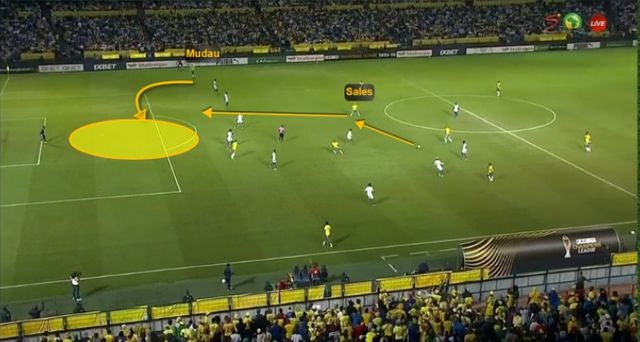
This goal encapsulated the tactical blueprint: positional rotation creating a wide channel, a perfectly timed run from the full-back, and precise execution in the final third.
Another decisive factor in the match was Sundowns’ control of interior channels and half-spaces.
Rather than relying solely on crosses from wide areas, they consistently targeted the zones between Stade Malien’s full-backs and centre-backs.
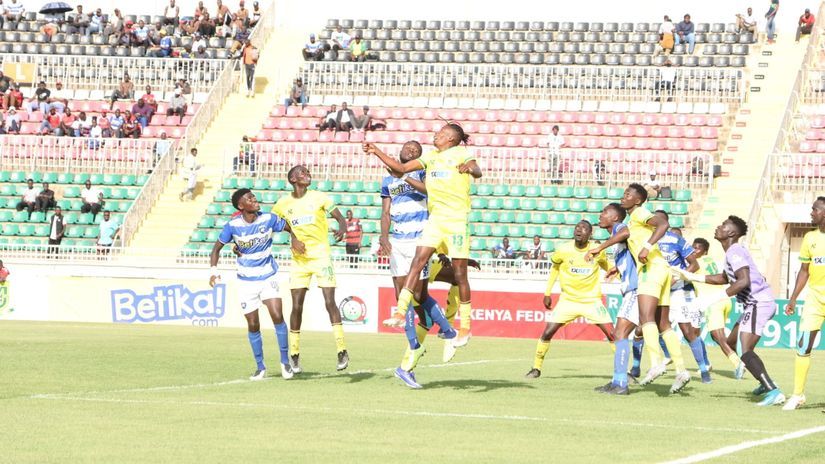
Nuno Santos played a central role in this strategy. Operating between midfield and defense, he constantly received the ball in pockets of space before releasing runners into the channels.
Sales also contributed by dropping deeper to connect play and switch the point of attack.
By dominating these zones, Sundowns forced Stade Malien’s defenders into difficult decisions: step forward and leave space behind, or remain deep and allow creative players time on the ball.
Sundowns’ dominance was not limited to possession.
Their pressing structure ensured that Stade Malien rarely progressed the ball through controlled build-up.
When Stade Malien attempted to start attacks with long goal kicks toward their right wing, Sundowns positioned their players to win second balls immediately.
Leon and the attacking midfielders formed the first line of pressure, while Mokoena and Adams aggressively contested loose balls.
This coordinated pressing prevented Stade Malien from establishing rhythm.
By the 22nd minute, Sundowns controlled 75 per cent of possession - a statistic that reflected both their ball retention and their success in regaining possession quickly.
Equally important was their rest-defense. Even when committing numbers forward for corners or sustained attacks, Sundowns maintained structural balance behind the ball, allowing them to counter-press effectively whenever possession was lost.
The second half began with a subtle tactical shift from Sundowns.
Instead of building exclusively from higher areas, they occasionally dropped deeper around their own penalty area to lure Stade Malien’s press forward.
This adjustment created larger spaces between defensive and midfield lines once the press was bypassed.
The second goal in the 53rd minute emerged from this dynamic.
After Mathews recovered the ball during a pressing moment on the left flank, Nuno Santos delivered a perfectly timed pass into Bryan Leon’s run.
The striker slipped between defenders and finished decisively to double the lead.
As the game progressed, Sundowns introduced fresh legs.
Monnapule Saleng and Iqraam Rayners replaced Mathews and Leon, while Marcelo Allende came on for Adams later.
These substitutions slightly altered the attacking structure.
Sundowns now resembled a 2-2-5-1 in possession: the center-backs remained deep, Mokoena and Modiba dropped into supportive positions, while five attacking players occupied the highest line across the pitch.
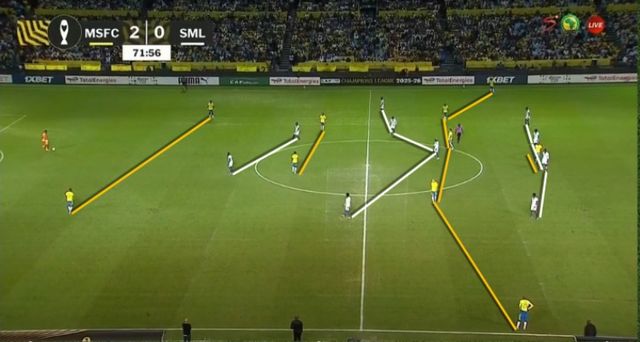
This aggressive shape further stretched Stade Malien’s defensive organisation.
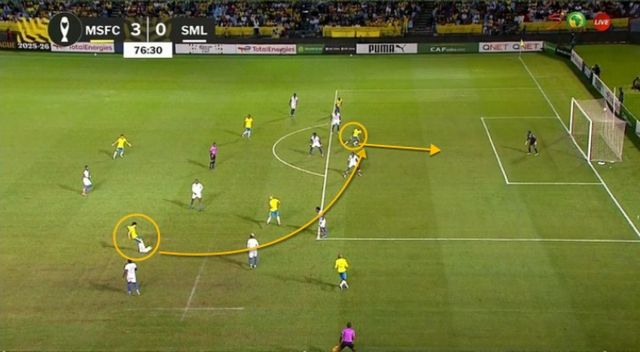
The third goal illustrated Sundowns’ continued control.
Nuno Santos again found space in the right half-space before delivering a precise cross for Rayners, whose finish initially appeared offside before VAR confirmed the goal.
With a three-goal advantage, Sundowns shifted into game management mode.
Rather than forcing attacks, they circulated possession patiently, waiting for openings while denying Stade Malien opportunities to counter.
The statistical dominance underlined the tactical disparity: Sundowns finished the match with overwhelming possession, hundreds of accurate passes, and multiple shots on target, while Stade Malien struggled to register meaningful attacking moments.
This match showcased why Sundowns are widely regarded as one of the most tactically sophisticated teams in African football.
Their positional play, rotational fluidity, and intelligent pressing created a structure that controlled every phase of the match.
Stade Malien’s mid-block initially aimed to limit central access, but Sundowns’ constant movement and precise passing gradually dismantled that structure.
By exploiting half-spaces, dominating possession, and maintaining strong rest-defense, Sundowns ensured their superiority translated into goals.
Ultimately, the 3-0 scoreline reflected more than individual quality - it was the product of a cohesive tactical system that repeatedly created advantages across the pitch.