


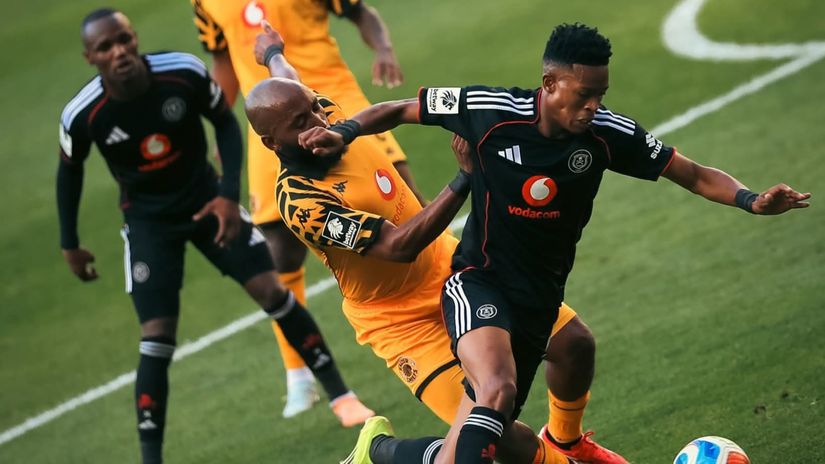
TACTICAL ANALYSIS: Breaking down formations that saw Soweto Derby evenly


.jpg)

Reading Time: 5min | Wed. 29.04.26. | 19:41
Orlando Pirates demonstrated superior control in possession and territorial dominance, particularly in the second half
The Soweto Derby between Orlando Pirates and Kaizer Chiefs ended in a 1-1 stalemate, but the scoreline barely scratches the surface of a tactically rich and dynamically evolving encounter.
As always, this fixture carried immense competitive weight, with both sides not only chasing points but also local bragging rights.
Download our MozzartSport App For More News
The narrative heading into the match hinted at contrasting approaches: Orlando Pirates’ structured positional play against Kaizer Chiefs’ transition-heavy and compact defensive scheme.
Ultimately, the match was closely contested, shaped by phases of dominance rather than outright control, with each team imposing their identity in different moments.
From the outset, Orlando Pirates set up in a 4-2-3-1 base shape that morphed fluidly depending on the phase of play.
Their double pivot of Makhehleni Makhaula and Thalente Mbatha provided the foundational stability for build-up, often dropping to facilitate circulation between the center-backs, Seema Kamogelo and Sibisi Nkosinathi .
The fullbacks, Deon Hotto and Sibelebele Kamogelo, were aggressively advanced, effectively pinning Kaizer Chiefs’ wide midfielders and stretching the horizontal compactness of the opposition.
Ahead of them, Relebohile Mofokeng operated as an advanced playmaker between the lines, drifting into interior pockets to connect play, while Tshepang Moremi and Oswin Appolis inverted into half-spaces to support central overloads.
Kaizer Chiefs, on the other hand, adopted a 4-1-4-1 that shifted into a 4-4-2\4-1-4-1out of possession, particularly when initiating their press.
Brandon Peterson started in goal. Thabiso Monyane operated at right-back, Bradley Cross at left-back, and Given Msimango partnered Aden McCarthy in central defense.
Sibongiseni Mthethwa played as the holding midfielder, shielding the backline while also supporting build-up play, alongside Lebohang Maboe.
Siphesihle Ndlovu took up the attacking midfield role, with Wandile Duba on the right wing and Pule Mmodi on the left, while Glody Lilepo led the line as the main striker.
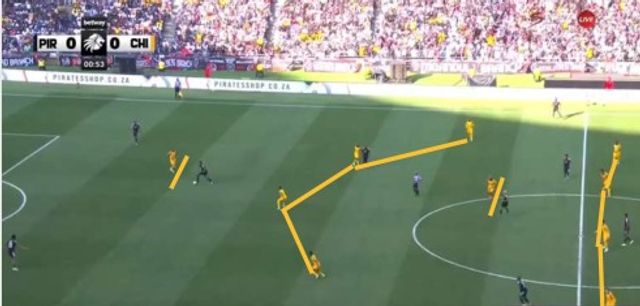
Their defensive scheme was characterized by a disciplined midblock, often collapsing into a 4-5-1 when deeper, prioritizing vertical compactness and denying access into Zone 14.
Their strength lay in their ability to crowd central zones, forcing Orlando Pirates wide and limiting clear-cut central penetrations.
However, this came at the cost of exposing the flanks, particularly when their fullbacks were isolated against overlapping runs.
In possession, Orlando Pirates built through a 2-2 structure at the base, with their center-backs splitting wide and the double pivot offering vertical and lateral passing options.
This allowed the fullbacks to push high into the final line, effectively creating a 2-3-5\2-2-6 in advanced phases.
Their rotational mechanisms were particularly evident on the right flank early on, where Tshepang Moremi’s runs in behind were targeted through diagonal switches and vertical passes.
However, Kaizer Chiefs’ defensive compactness and well-timed stepping from midfield limited the effectiveness of these patterns.
Kaizer Chiefs’ build-up structure was more asymmetric, often forming a 3-2 shape with the left-back tucking in alongside the center-backs, while Mthethwa and Maboe dropped deeper to orchestrate progression.
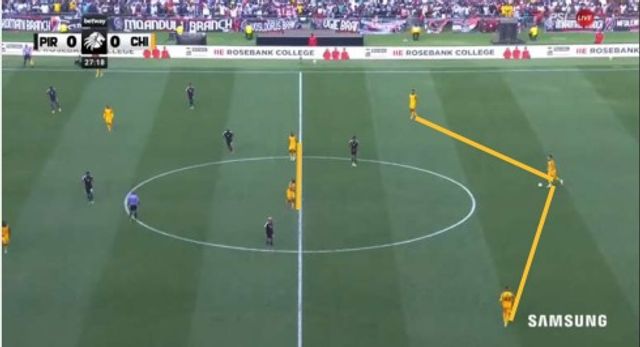
This created space for Thabiso Monyane to advance aggressively on the right flank, effectively transforming their shape into a 3-2-5 in possession.
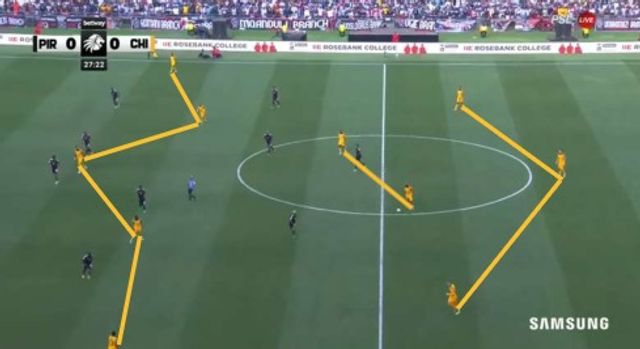
Their use of width-to-depth progression was notable, particularly through Mmodi on the left, who served as a key outlet in early attacking phases.
Orlando Pirates sought to exploit the half-spaces through inverted wingers and Mofokeng’s positioning, but Chiefs’ compact midfield line often congested these areas.
Conversely, Chiefs found joy in the wide areas, especially on the left, where Mmodi consistently received in space and drove forward.
Zone 14 remained largely inaccessible for both teams due to the density of players and disciplined screening by the pivots.
Pressing dynamics played a crucial role in shaping the game’s rhythm.
Kaizer Chiefs employed a situational high press, often triggering when the ball was circulated to Orlando Pirates’ right side.
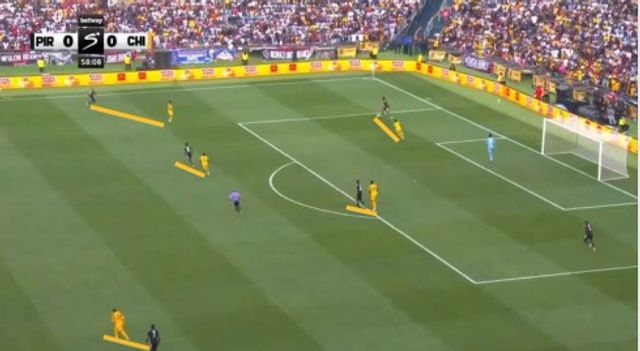
Their pressing traps were designed to force long balls, disrupting Pirates’ preferred short build-up.
Orlando Pirates, in turn, adopted a 4-4-2 midblock out of possession, with their wingers dropping to form a compact second line.
However, their pressing lacked consistent coordination in the first half, allowing Chiefs to bypass pressure through third-man combinations and bounce passes.
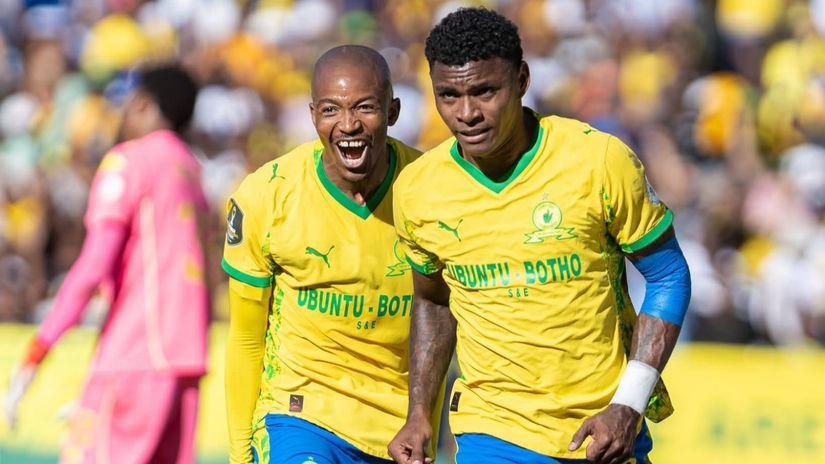
Transitions were a defining feature of the match, particularly for Kaizer Chiefs. Their defensive strategy hinged on absorbing pressure and exploiting the spaces left behind by Orlando Pirates’ advanced fullbacks.
This approach paid dividends in the 61st minute when Duba capitalized on a turnover, driving through the right channel before releasing Mmodi, who finished clinically.
The move exemplified Chiefs’ transition efficiency, turning defense into attack with minimal touches and maximum verticality.
Orlando Pirates responded with tactical adjustments that shifted the momentum.
The introduction of Patrick Maswanganyi in the first half had already brought balance, but the second-half substitution of Evidence Makgopa added a new dimension to their attack.
Makgopa’s presence allowed for more direct play and better occupation of central defenders, enabling Pirates to sustain pressure in the final third.
Their shift to a more aggressive gegenpressing approach post-65 minutes disrupted Chiefs’ build-up and pinned them deeper.
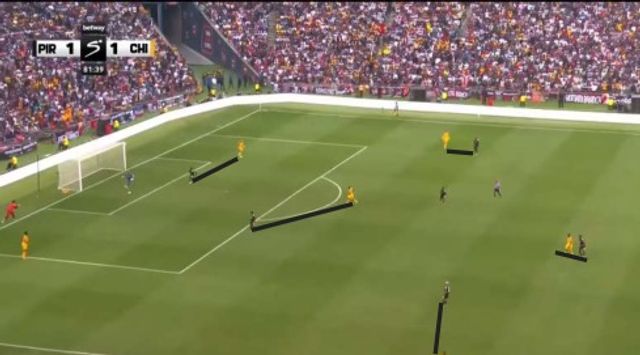
The equalizer in the 74th minute was a product of this sustained pressure and improved rest-defense.
Pirates’ ability to counterpress immediately after losing possession ensured that Chiefs could not transition effectively.
The goal itself came from a wide overload on the left, where Oswin Appolis drew defenders before releasing Hotto.
The rebound, instinctively finished by Sibelebele, highlighted the importance of fullback involvement in advanced zones.
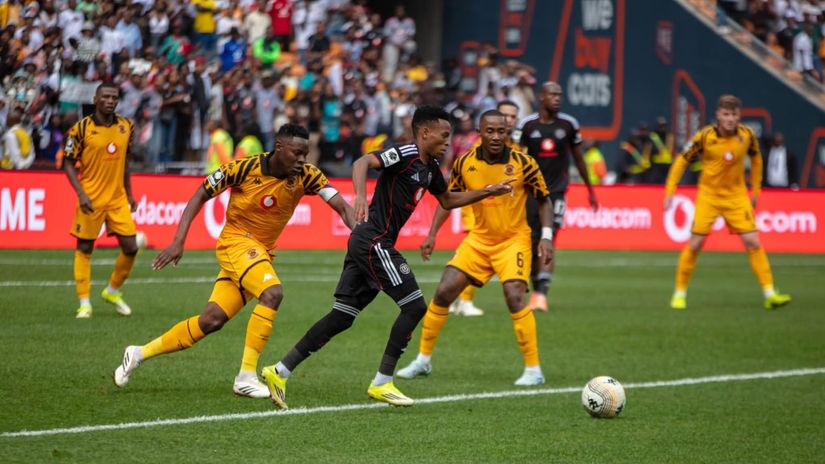
Defensively, both teams exhibited contrasting approaches. Kaizer Chiefs maintained compactness and relied on recovery runs and positional discipline, particularly in central areas.
Their stepping triggers were well-timed, especially when Mofokeng received between the lines.
Orlando Pirates, meanwhile, improved their defensive organization in the second half, with better spacing and more coordinated pressing.
Their rest-defense structure, allowed them to manage transitions more effectively as the game progressed.
Tactically, the match evolved through phases of control and adaptation. Chiefs’ initial success in transitions and compact defending gave them the edge, but Pirates’ adjustments in personnel and pressing intensity shifted the balance.
The introduction of a two-striker system by Chiefs late in the game, with Flavio Silva joining Glody Lilepo, aimed to stretch Pirates’ backline, but the lack of sustained possession limited its impact.
In conclusion, the 1-1 draw was a fair reflection of a match defined by tactical nuance and strategic adaptation.
Orlando Pirates demonstrated superior control in possession and territorial dominance, particularly in the second half, but were initially vulnerable in transitions.
Kaizer Chiefs, while less dominant on the ball, executed their defensive and transitional strategy effectively, capitalizing on key moments.
The game underscored the importance of balance between attacking ambition and defensive security, with both teams showcasing strengths and exposing vulnerabilities.
Ultimately, it was a contest where tactical adjustments and in-game management proved just as crucial as individual moments of brilliance.