



TACTICAL ANALYSIS: How Kenya Police FC gunned down Tusker despite limited possession









Reading Time: 5min | Mon. 17.11.25. | 20:25
What unfolded was a match of two distinct phases: Police dictating through directness and transitional efficiency in the first half, and Tusker imposing positional control and territorial pressure in the second
A fiercely contested FKF Premier League encounter ended with Kenya Police FC edging Tusker FC 2–1, a result shaped not only by critical moments but also by clear structural contrasts, defined game plans, and evolving tactical adjustments from both sides.
Follow our WhatsApp channel for more news
What unfolded was a match of two distinct phases: Police dictating through directness and transitional efficiency in the first half, and Tusker imposing positional control and territorial pressure in the second.
-min.jpg)
Tusker started in a 4-4-2 organisational structure, aiming for balance between wide threat and central progression.
Joseph Ochuka played in goal, protected by fullbacks Collins Odhiambo on the right and Dennis Wanjala on the left, with Thomas Teka and Charles Momanyi as the centre-back pairing.
In midfield, Dennis Iguma acted as the deep pivot, tasked with shielding the back four and initiating build-up play by linking with both centre-backs.
Ahead of him, Fabian Adikiny served as the progression engine - stepping into pockets between the lines, supplying penetrative passes, and conducting long switches into wide or half-space channels.
The flanks were occupied by Thomas Omole and Cliff Oruko (who tucked inside or stretched wide depending on the phase of play).
Up front, the striking pair of Denis Oguta and Dennis Oalo alternated roles: one attacking depth with runs in behind, the other providing presence up top for link play and finishing.

Kenya Police lined up in a 4-2-3-1, a shape built for stability in the double-pivot and verticality in attacking transitions.
With Job Ochieng in goal, Daniel Sakari and Geoffrey Onyango flanked centre-backs Abud Omar and David “Cheche” Ochieng.
Their double pivot of Charles Ouma and Brian Musa balanced defensive anchoring with forward ball progression.
Higher up, David Okoth played as an advanced midfielder, floating laterally into half-spaces and wide channels to combine with wingers Eric Zakayo and Edward 'Ondimo' Omondi.
Target man David Simiyu led the line, crucial in Police’s long-ball scheme designed to exploit second balls and transitional moments.

Kenya Police entered the first half with a clear method: long restarts, especially goal kicks, aimed at the left-wing zone.
This area was key because it allowed Edward Omondi to contest aerial balls and receive knockdowns, while David Okoth made swerving support runs into the same corridor, creating overloads.
Tusker responded with a compact 4-4-2 out-of-possession block, with Oalo and Oguta acting as the first defensive line.
Their press remained moderate, more concerned with funnelling play rather than aggressively winning the ball.
However, Police’s insistence on bypassing midfield nullified Tusker’s press entirely.
A long ball from Job Ochieng sparked the opener: Simiyu rose to flick a header into the path of Zakayo, who timed his run in behind perfectly.
His deft loop over the onrushing goalkeeper exploited Tusker’s poor spacing and reactive defensive transition.
It was a textbook execution of Police’s direct verticality, putting them 1–0 ahead.
Tusker attempted to reply through their own set-piece weapon - long throws from Collins Odhiambo, aimed to generate chaos in the box.
While they posed danger, Kenya Police remained structurally disciplined, supported by aerial dominance through David 'Cheche' Ochieng and Abud Omar.

In settled build-up, Tusker stretched their backline into a low 4-1 shape, with Iguma dropping close to the centre-backs as they circulated possession patiently.
Their goal was to draw Police’s first-line press and then find Adikiny between the lines to initiate wide switches.
A costly error shifted the momentum further away from Tusker.
A misplaced back pass from Collins Odhiambo towards the penalty spot allowed Simiyu to pounce decisively and slot home.
The goal perfectly captured Police’s opportunistic identity - thriving off mistakes and transitions rather than elaborate construction.
Tusker continued to dominate spells of possession, moving wingers Oruko and Omole to opposite flanks after the water break.
Their attacks blended central progression via Adikiny and Iguma with explosive width, but the final incision eluded them as Police defended with discipline.
Tusker opened the second half with double changes - Curtis Wekesa and Yakeen Mutheheli came on for Omolle and Oruko - and instantly increased their intensity through wide areas.
Their focus shifted heavily to crossing patterns, especially from the left, where Denis Wanjala played a major role.
Police responded with a higher defensive line, attempting to trap Tusker’s runners offside in half-space channels.
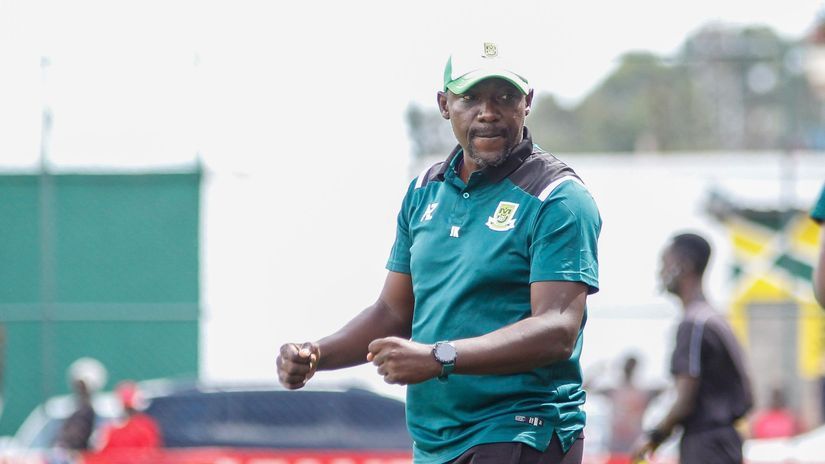
Set-piece dynamics also intensified. Kenya Police used two split zonal markers (one near post, one goal-line) while assigning seven man-markers and one edge-of-box guard for second balls.
Tusker repeatedly targeted the back post with rehearsed deliveries.
As Tusker’s momentum grew, Kenya Police switched into match-killing mode around the 70th minute - slowing tempo, managing transitions, and fragmenting the game through fouls and stoppages.
Late substitutions brought on additional defenders, transforming the structure into a 5-4-1/4-5-1, a pure low block designed to survive the onslaught.
Tusker pinned Police deep inside their box in the final minutes, forcing four consecutive corners as they committed virtually every player forward, retaining only one man in rest defense, especially in set-piece scenarios.
In stoppage time, pressure finally cracked Police’s defensive wall.

Substitute Joash Onyango shoved Kapaito inside the box, resulting in a penalty that the former Kariobangi Sharks forward calmly converted in the 93rd minute.
However, despite Tusker’s late surge and territorial dominance, the referee’s whistle confirmed a 2–1 victory for Kenya Police.
Police were more efficient in exploiting key moments, while Tusker paid heavily for early errors despite controlling large phases.
The contest served as a reminder that tactical plans succeed not only through structure but through execution, timing, and situational adaptability.