


.jpg)
How Kelvin Kiptum’s death sparked a dark chapter in Eliud Kipchoge’s career





.jpg)

Reading Time: 3min | Sun. 29.03.26. | 17:11
In the days following Kiptum’s death, sections of social media were flooded with baseless conspiracy theories alleging that Kipchoge had a hand in the tragedy
The athletics world was plunged into mourning on Sunday, 11 February 2024, following the sudden and tragic death of men’s marathon world record holder Kelvin Kiptum.
Kiptum, just 24, lost his life in a road accident along the Eldoret-Kaptagat road.
Download our Mozzart Sport App for more news
He died alongside his coach, Gervais Hakizimana, in an incident confirmed by Elgeyo Marakwet County Police Commander Peter Mulinge.
The news sent shockwaves across the global athletics fraternity, cutting short the life of a rising star many believed would redefine marathon running.
Kiptum had etched his name into history only months earlier, delivering a breathtaking performance at the Chicago Marathon on October 8, 2023.
He had clocked an astonishing 2:00:35, to shatter the previous world record set by Eliud Kipchoge at the Berlin Marathon in 2022.
By so doing, he became the first man to run under two hours and one minute in an official race.
His record was ratified by World Athletics just a week before his death.
Kiptum had been scheduled to compete at the Rotterdam Marathon on April 14, 2024, a race that was expected to further showcase his dominance.
However, as the athletics community grappled with grief, an unexpected and deeply troubling narrative began to unfold, one that would drag Kipchoge into the eye of a storm.
In the days following Kiptum’s death, sections of social media were flooded with baseless conspiracy theories alleging that Kipchoge had a hand in the tragedy.
The accusations, entirely unfounded, quickly spiraled into a campaign of online abuse that deeply affected the two-time Olympic champion and his family.
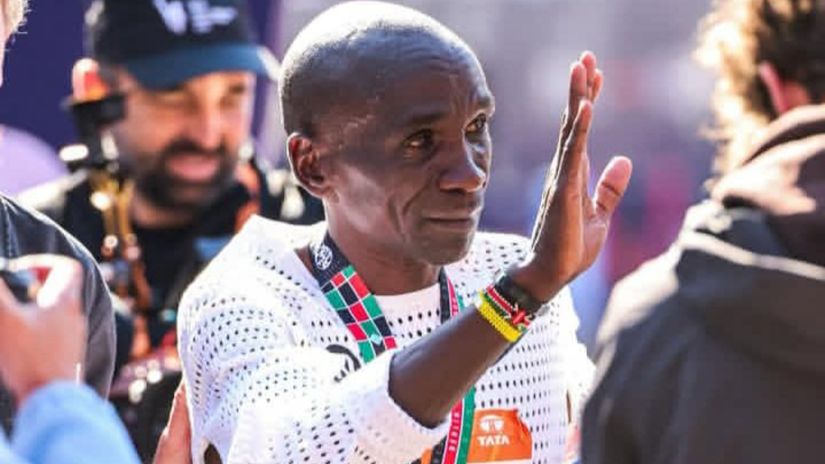
Speaking on an episode of Engage, Kipchoge opened up about the ordeal, revealing the emotional toll it took on him.
“I was really down to my knees. I asked myself, I’m the oldest athlete in this country, and this young man has only spent three years running. I’ve spent over 20 years building my name. How could I harm him?” he posed.
The impact extended beyond digital spaces. Kipchoge disclosed that his family received threats, forcing them to change their daily routines.
His children, who previously cycled to school, had to be driven by their mother due to safety concerns.
“I was threatened. My family was threatened. There was fear around the estate and the whole community,” he revealed.
The psychological strain appeared to spill over into Kipchoge’s performances on the road.
Kipchoge finished 10th at the 2024 Tokyo Marathon held on Sunday, 3 March, his lowest placing since his marathon debut in 2013.
He crossed the line more than two and a half minutes behind the winner, Benson Kipruto.
Despite the setback, he was selected to represent Kenya at the Paris 2024 Olympics.
However, in a rare turn of events, Kipchoge recorded a Did Not Finish (DNF), marking one of the most difficult periods of his illustrious career.
Reflecting on the experience, Kipchoge admitted that the events of 2024 broke him.
“I was a strong man, but I think I broke. I sank, and then I came back,” he explained.
Two years later, Kipchoge has chosen to draw lessons from the experience, urging resilience and truth in the face of adversity.
“Life is not always positive. You might step on a sharp nail, but don’t look back. Stand on your truth. It may take years, but the truth will always come out,” he said.
Despite everything, the marathon legend remains focused on a greater purpose of using sport as a tool for global change.
“I aim to change the life of a human being. I want to impact over three billion people through running and sport,” he added.