


Controversy surrounding Argentina continues as Swiss red card sparks outrage





Reading Time: 3min | Sun. 12.07.26. | 11:06
Another decision in Argentina's favour will only fuel conspiracy theories about the tournament being rigged – judge for yourself
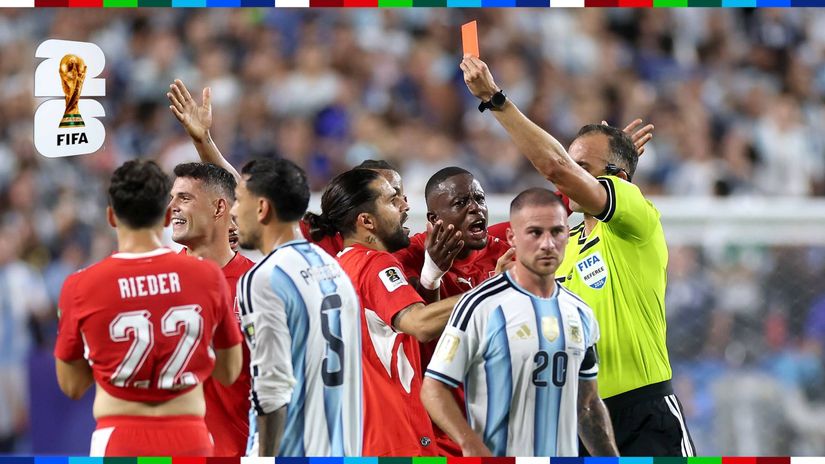
Switzerland's World Cup dream ended in bitter controversy on Saturday, as Breel Embolo was sent off after a VAR review during his side's 3-1 extra-time defeat to Argentina in the quarter-finals.
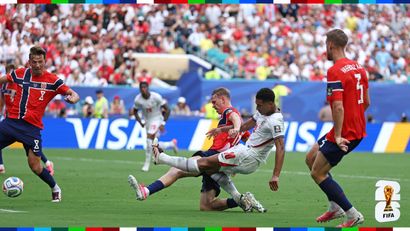
The incident unfolded when referee initially booked Leandro Paredes for a challenge on Embolo. However, video replays suggested the Swiss forward had already begun going to ground before any contact was made.
After reviewing the footage, the referee rescinded Paredes' yellow card and instead cautioned Embolo for simulation. Since the striker had already been booked earlier in the match, the second yellow resulted in a red card, forcing Switzerland to play the rest of the contest—then level at 1-1—with 10 men.
"I just don't understand how VAR can make that kind of decision," Swiss defender Nico Elvedi said after the match.
The dismissal came just moments after Dan Ndoye had brought Switzerland back on level terms, completely changing the complexion of the game. "After the equalizer, we had the momentum on our side, and I wanted to make substitutions there as well, to bring on fresh attacking players," Switzerland coach Murat Yakin said.
"We were dominant. We controlled the game. But the red card, we are punished because of a rule that is, to me, absolutely incomprehensible. Of course it hurts enormously that we were eliminated in this way. We didn't deserve that today."
🚨🗣️ Switzerland coach Murat Yakin on Embolo’s red card:
— The Touchline | 𝐓 (@TouchlineX) July 12, 2026
"We were punished by a MISTAKE. There was no reason for that 2nd yellow card. I DON’T UNDERSTAND."
"It was an innocent situation, not harmful. The refereeing error punished us and disrupted our plan."
"That decision was… pic.twitter.com/bvBEV0mApN
The decision marked only the second time at a World Cup that a yellow card has been overturned under the "mistaken identity" protocol. The regulation allows VAR to intervene when the wrong player is shown a yellow or red card.
Ironically, if Paredes had never been shown a yellow card for the challenge in the first place, VAR would not have been permitted to step in and review the incident.
"For a situation where beforehand there should have been yellow cards several times, he gave a yellow card in a situation that, to me, was a harmless foul -- or if it was even a foul at all," Yakin said. "They protect their referee over a rule that destroyed our game today. That hurts enormously."
The problem with the new ‘mistaken identity’ rule is that it sets a dangerous precedent.
— Ben Jacobs (@JacobsBen) July 12, 2026
Breel Embolo dived, so if called on the field it’s a second yellow, but that wasn’t the decision.
Yet an amendment to IFAB wording before the tournament states: “When the referee shows a… pic.twitter.com/xKhopGR7DU
Embolo was visibly emotional after receiving his marching orders, leaving the pitch in tears before being comforted by teammates and members of the coaching staff.
Argentina eventually took advantage of their numerical superiority in extra time, with Julian Alvarez and Lautaro Martinez scoring the goals that sealed their place in the semi-finals.
Embolo also entered an unfortunate piece of World Cup history, becoming just the fourth player in the past 60 years to receive a second yellow card for simulation. He joins Mexico's Luis Perez (2006 vs. Portugal), Ghana's Asamoah Gyan (2006 vs. Brazil), and Italy's Francesco Totti (2002 vs. South Korea) on that unwanted list.