


FALSE 10: The only Zero football has ever had
Reading Time: 8min | Sat. 27.12.25. | 11:53
His talent was immense, his energy contagious, his smile infectious, his name a sign, and his story unique
He never stood out on purpose. After all, no one likes show-offs and attention seekers. It was his energy, his aura... He was meant to achieve something big, and his name was a sign predestined to remain written down in history books.
After spending his youth days and taking his first professional steps in his hometown at FUS Rabat, the 22-year-old forward Hicham Zerouali was set to take on the greatest challenge of his career.
Back in the 1990s, it wasn't easy for an African player to join a European side, let alone a team from Scotland, one of the cradles of football. Yet, Zerouali made it happen, showing that his story would be nothing but unique.
In December 1999, he joined the Scottish Aberdeen for £450,000 and almost instantly won the fans' (popular Dons) hearts.
If you asked the ones old enough to remember that cold day, December 8, 1999, they'd undoubtedly tell you how amazed they were when a relatively unknown new lad almost scored a screamer with his first touch of the ball on his debut with his new club.
They'd also recall him coming off the bench at 1-1 and assisting for one of the two goals in Hearts' net, as well as the joy they felt because of a 3-1 win and the incredible reinforcement Aberdeen got.
"My first memories of Hicham are when the club took us to Cadiz during the winter break in season 1999/2000."
"I hadn't seen much of him, so my first glimpse was during a practice game at the training ground out there. I remember watching him taking the ball to the byline, so everybody was expecting a cross."
"But, instead, he took a shot with the outside of his right boot, and there was so much bend in it that it beat Jim Leighton at his near post which, believe me, wasn't easy. Everyone was like 'f*****g hell' - after that and we knew we had a player on our hands," Zerouali's former teammate, the custodian David Preece, told Football Scotland.
In his first season at the legendary Pittodrie Stadium, the "Moroccan Magician" - though that nickname would shortly be replaced with another one that would stick with him for the rest of his life - helped Aberdeen reach both the Scottish League Cup and Scottish Cup finals. Yet, he didn't play much. Even the fact that his 35-meter banger against St. Mirren was the club's 700th goal in the Cup didn't make much of a difference.
Simply, the well-organised, disciplined, and rigid Scottish football approach Aberdeen nurtured under the Danish manager Ebbe Skovdahl wasn't ready for the free-flowing style Zerouali carried.
Nevertheless, those for whom football is played, the fans, adored him.
They saw him as someone who brought skill, artistry on the pitch, and poetry in motion. To this day, Aberdeen have never had a Brazilian player. This Moroccan was their "Samba Boy".
"He fitted in very well in wider social sense as well. He had an Aberdonian girlfriend pretty quickly and he also had some friends locally who he could speak Arabic to."
"Initially he never knew a word of English but he picked it up. He was always a big part of the group. Players like Zero always stick with the fans," Preece added.
Football fans in Great Britain have always been known for the nicknames they give to their favourite players. But the "Moroccan Magician"? Way too long for their standards.
They needed something short and catchy, something that could fit perfectly into a song. That's why and that's when Zerouali's "alias" was born - Zero.
For the supporters, it was ideal. However, for the player himself, it made no sense. He played games, scored goals, recorded assists, and wore #47. Nothing linked him to the nickname he was given. That had to change.
He had to do something; he had to try to make a connection, the one that would launch him to the stars. Still, no one saw it coming. It was unexpected and unforeseen, especially for a rigid and traditional league like the Scottish.
But for Zerouali, a denial wasn't an acceptable answer. And so, pretty soon, when the forward appeared on the pitch, the crowd noticed something was different - a big white "0" was sitting on the back of his red jersey just below his last name.
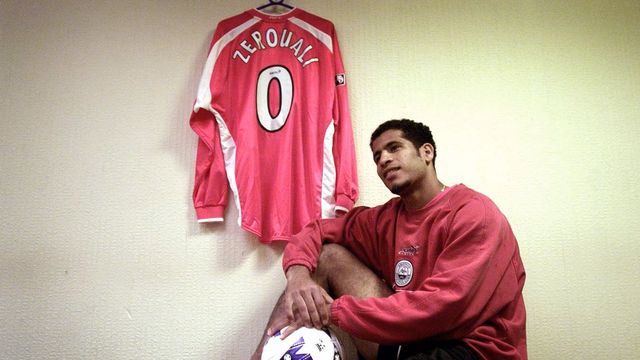 Hicham Zerouali and his famous #0 jersey (©Aberdeen FC)
That way - though it's uncertain if he was aware of that - Zerouali became the first and only player wearing #0 a football has ever had. Later that year, the Scottish Football Association overturned their decision and outlawed wearing this number.
Nevertheless, it went down in history that Zero - according to sources - played seven games with "0" on his back, and that's something no one ever will be able to steal from him.
Paradoxically, the fame he gained among Aberdeen fans and the general football public because of this "innovation" wasn't followed by successes on the pitch.
His second season with the Dons brought Zero only seven appearances, while the broken ankle deprived him of representing Morocco at the 2000 Olympic Games in Sydney.
He started his third and last season at Pittodrie wearing #11 instead of #0, but his aura was still intact. Moreover, he saved the best for last.
With eight goals in 19 appearances in the 2001/2002 campaign, Zero definitely etched his place in the fans' hearts, while they still talk about his hat-trick against Dundee and his ultimate goal with the club - a screamer against Kilmarnock.
Because of his skills on the pitch, but even more because of his spirit off it, he was the fans' hero. He was one of them.
"As a guy, he kind of grew into the Scottish culture."
"There was one day when he was really struggling because he was going through his first-ever hangover. He was sitting on the treatment table at Pittodrie feeling sorry for himself. Honestly, it was brilliant. He was ill."
"He kept groaning 'I'm not well, I'm not well.' And so the boys were winding him up with a bit of 'What's the matter, what's wrong with you?"
"And I'll always remember the line he came back with: 'It wasn't me, it was the Jack D!"
"I can still hear him saying it and that line will always stay with me."
"He was curled up in a wee ball on the treatment table, suffering from having drunk Jack Daniels the night before, and when he came out with that, the whole place just erupted."
"So that was him totally immersed in the Scottish culture by that point," another of his former teammates, Darren Young, told Scotland Football.
His ultimate campaign with the Dons brought Zero another critical achievement - he made a name for himself internationally.
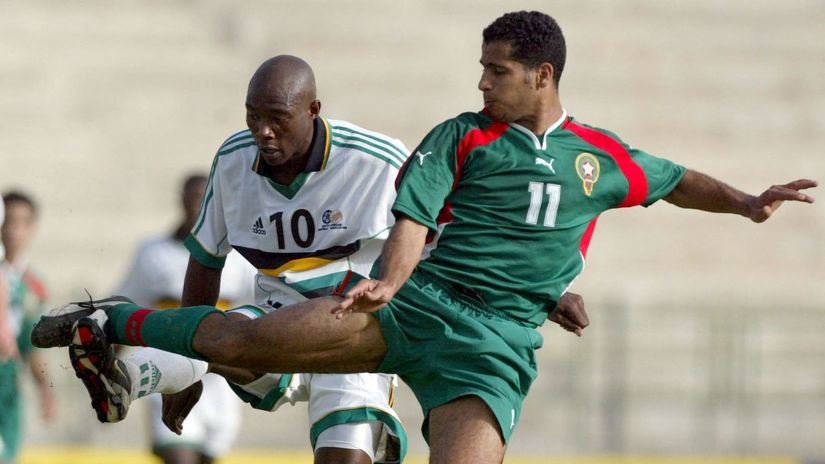
At the 2002 Africa Cup of Nations, he bagged a brace in Morocco's only victory in the tournament, against Burkina Faso (2-1), leaving a mark, despite his national team's early elimination.
In total, he played 18 games for the Atlas Lions, scoring six goals.
The end of his third season in Scotland marked the moment to say goodbye. Aberdeen finished the season in the Scottish Premier League in fourth place and secured their spot in the UEFA Cup qualifiers, which they would play without their beloved Moroccan.
In July 2002, Zero joined Al-Nasr Dubai from the United Arab Emirates, and after a year in the Middle East, he decided to return to his hometown, to FAR Rabat, with which he won the Coupe du Trone in November 2004.
On December 5, 2004, almost five years following his debut with Aberdeen, and just a week after clinching the Cup trophy, Zero lost control of his car, struck a tree, and tragically died aged 27.
"We always remained in touch until the night before he passed away. We'd spoken on the phone. He had just won a cup final and I believe he'd scored in it. We said our goodbyes and I had a couple of missed calls from him the next day."
.jpg)
"Then I found out he'd been involved in a car accident that day, but he'd already been buried by the time we got any significant information," revealed Phil McGuire, one of Zero's closest friends dating back to their shared Aberdeen days, 15 years after his death via Sai's Substack.
"The Moroccan Magician" left behind a daughter and a girlfriend in Aberdeen, a city with which he had an unbreakable bond. Thousands of fans appeared at Pittodrie, where a memorial and tribute were held. And even though he didn't spend much time with the Dons, his legacy was immense.
"He really lit up Pittodrie for a couple of seasons. Zero definitely left his mark on the city of Aberdeen and they still talk about him now, which is a testament to the man and his ability," said Preece, perfectly summing up Zero's time in Scotland.
Last year, during a game against Celtic, on the 20th anniversary of his death, the Dons paid tribute to their African hero with an emotional banner that read: "Hicham Zerouali Forever Young".
It didn't take much for people of Aberdeen to fall in love with Zero: just his contagious energy, his infectious smile, his Brazilian-like skills, and, in the very end, three seasons, 43 matches, 11 goals, and one big white zero on a red jersey.
The zero worth more than a bunch of them that make up million-figure sums fans can barely pronounce, and by which players' value is measured today. This zero had a soul and was priceless.
Aberdeen, Pittodrie Stadium, and the Dons still carry his memory in their hearts, but Zero deserved to have his story heard. After all, this article is there to contribute to the sharing of his legacy at least in part.
Hicham Zerouali (January 17, 1977 - December 5, 2004) - The only Zero football has ever had.