


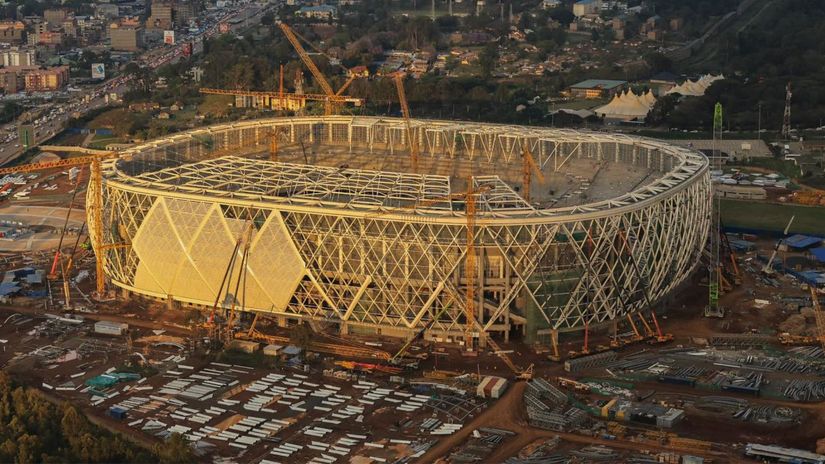
Latest update from Talanta Stadium as roofing structure takes shape [VIDEO]

.jpg)
.jpg)
.jpg)




Reading Time: 4min | Tue. 04.11.25. | 20:10
As it stands, the roofing steel works at the stands on the touchlines are almost complete. The steel works had begun about two weeks ago, and might be completed in the next few days on both sides
Works at the Talanta Sports City Stadium continues to take shape at neck-breaking speed, with the latest updates showing tremendous improvements in the roofing and curtain wall, among other works.
Follow our WhatsApp channel for more news
Talanta Stadium is an ambitious flagship project by the Government of Kenya (GoK) to build an ultramodern sporting facility that, upon completion, will not only be the biggest in Kenya but also the most modern in East and Central Africa.
Kenya embarked on the facility's construction after winning the bid to host both the 2024 African Nations Championship (CHAN) and the 2027 Africa Cup of Nations (AFCON) alongside neighbours Uganda and Tanzania in a joint bid dubbed PAMOJA.
Whereas the Moi International Sports Centre, Kasarani and the Nyayo National Stadium were enough to host the 2024 CHAN, Talanta was aimed at adding the number of stadiums to three and was earmarked to be the main stadium of the 2027 AFCON.
The construction of the stadium began in March 2024 in a groundbreaking ceremony that was presided over by President William Ruto.
According to the latest videos and photos posted by the Cabinet Secretary (CS) for Youth Affairs, Creative Economy and Sports, Salim Mvurya and the government, the roofing is progressing at a fast pace.
As it stands, the roofing steel works at the stands on the touchlines are almost complete. The steel works had begun about two weeks ago, and might be completed in the next few days on both sides.
It is this steel structure that will hold the canopy, which will cover the stadium, the electrical works that will be used in the floodlights, as well as the floodlights themselves.
From the general guidelines of roofing by FIFA, seats located within an angle of 15 degrees from the drip line may offer little protection from rain, depending on the direction of the wind.
.jpg)
Seats located within an angle of 15-30 degrees from the drip line are moderately protected and may get wet when it rains heavily.
The safest place away from the rain is located beyond an angle of 30 degrees from the drip line, as it will protect the spectators by remaining dry unless in severe rain conditions.
According to FIFA, the VVIP, VIP, broadcast and media tribunes seats must be located beyond the 15-degree line and preferably beyond the 30-degree line.
The roofing design must always consider the height of the roof above the pitch orientation and the shadowing of the pitch from direct sunlight, which has an effect on growing conditions for the grass and also affects TV broadcasts.
As such, it is recommended that the roofing materials be transparent in order to achieve the desired levels of shading, with glass and polycarbonate being the most common.
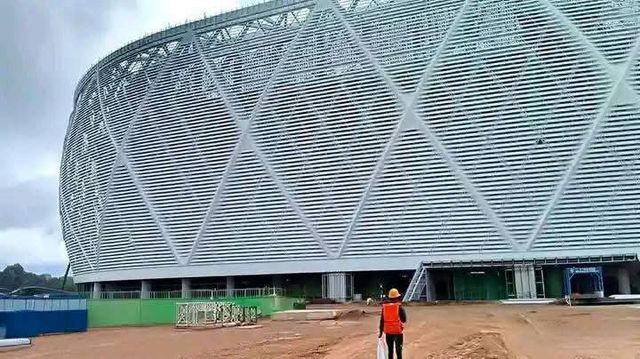
The Moi International Sports Centre, Kasarani, for exampl,e uses Teflon-coated fibreglass membrane, a light and durable material that is made up of fibreglass with a teflon coating that utilises PVC-coated polyester for enhanced longevity.
On the roofing design, the Talanta Sports City Stadium will be made up of tensile structures and the hydraulic tension cable net system on which the roofing membrane lies, already in place.
This design stabilises the roof by using tension as opposed to compression, which makes the stadium appear very light and elegant, as it requires a minimal amount of structure.
The biggest disadvantage of the modern technology that has only been used in four other stadiums worldwide is that it limits future stadium expansion or development.
Other common roofing designs include simply supported trusses, where the roof structure is supported at two ends with a large truss covering the full length or width of the stadium, making it cost-effective.
Cantilevered roof structures is the other design and involves the roof structure being supported at the rear of the stand, projecting forward, thereby creating a cover without a column. This design is commonly used in phased development as it allows for future changes.
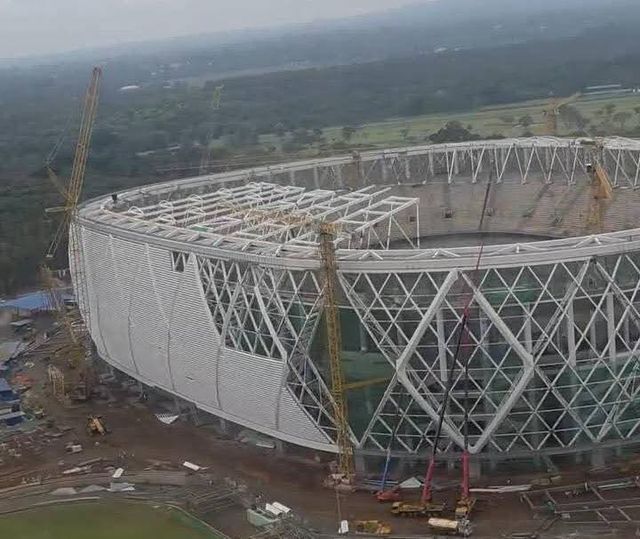
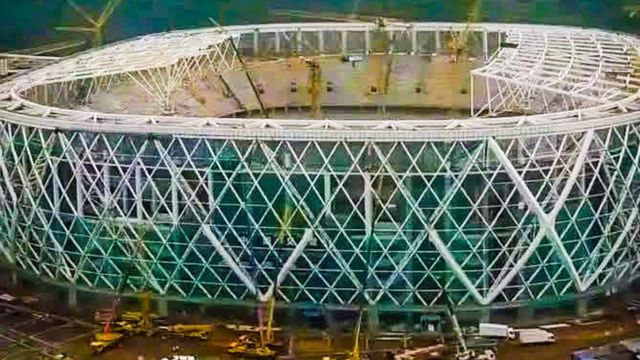
The other major progress in the stadium is on the curtain wall, where significant steel works have been done, with the curtain wall design already taking shape.
![Wanyama, Kipyegon part of first inductees to Kenyan Hall of Fame [PHOTOS]](https://cdn3.mozzartsport.co.ke/upload/825x464/News/Image/2025_11/1762264276385_Untitled_design_-_2025-11-04T164908.561.jpg)
The steel works will hold the shield design as in the Kenyan flag and will also accommodate the electrical materials that will be used for the media facade - a lighting technology that integrates LED or other advanced lighting technologies on the outer wall to create large-scale, visually engaging displays.
The stadium is expected to be complete by 31 December, but with just seven weeks away, it is highly unlikely that it will be complete by then.