


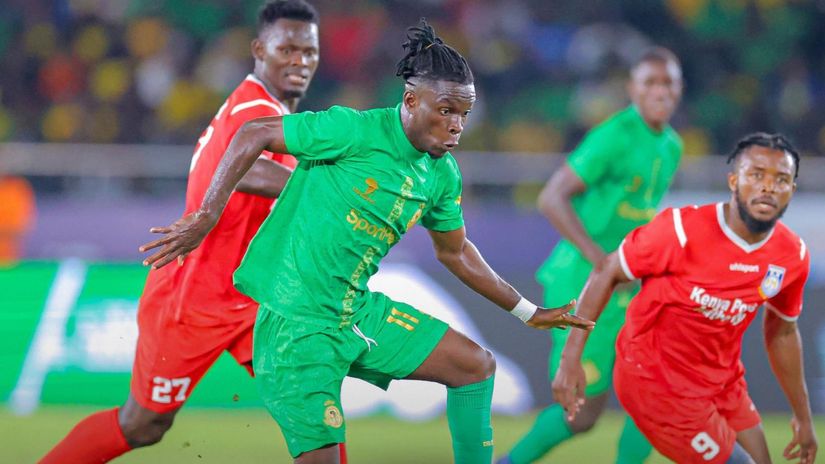
TACTICAL ANALYSIS: A look at Yanga's 1-0 win over Bandari

.jpg)




Reading Time: 6min | Sat. 13.09.25. | 21:36
Beneath the 1–0 scoreline lay a rich tactical battle marked by intelligent adjustments, pressing strategies, and varying approaches to progression
When Young Africans (Yanga SC) hosted Bandari FC, the contest promised a clash of contrasting styles: Timu ya Wananchi’s dynamism in transitions and rotations versus The Dockers' structured attempts to build through overloads and width.
Follow our WhatsApp channel for more news
The match was ultimately decided by an early goal, but beneath the 1–0 scoreline lay a rich tactical battle marked by intelligent adjustments, pressing strategies, and varying approaches to progression.
Lineups and Structures
Yanga lined up with Djigui Diarra in goal, flanked by a centre-back pairing of Frank Assinki and Bakari Mwamnyeto. Farid Mussa started at left-back, with Israel Mwenda on the right.
The midfield pivot was formed by Aziz Andabwile and Lassine Kouma, providing both defensive coverage and progression from deep.
Ahead of them was a flexible front four: Celestin Ecua, Maxi Nzengeli, Sheikhan Khamis, and Prince Dube.
Their rotations and fluid movement between half-spaces, wings, and central channels ensured Bandari’s defensive block was constantly stretched.
Bandari responded with Allan Ngeleka in goal. Their backline comprised Joseph Otieno, Rajab Omar, and the centre-back partnership of Dennis Ng'ang'a and Shariff Amuwombe.
Midfield was anchored by Geofrey Ojunga, Clifford Ouma, and Mubarak Amza, with Darius Msagha and Beja Nyamawi providing width on the flanks.
Mark Makwatta led the line, although his role often involved dropping into deeper zones to link plays.
First Half: Yanga Strike Early and Dominate Transitions
Yanga wasted no time in asserting themselves. Barely two minutes into the game, Ecua made a surging run from deep during transition, ghosting into the box to meet Prince Dube’s cross at the back post.
His header gave Yanga a dream start and immediately set the tone for a half defined by sharp attacking transitions and purposeful forward movement.

From that point, Yanga alternated between measured buildup and direct progression, with either the goalkeeper or the dropping pivot, Aziz Andabwile playing long balls toward the left wing, consistently targeting Bandari’s full-back zones.
This strategy repeatedly unsettled the visitors’ back line and created early momentum.
Yanga’s attacking threats emerged in different forms
Quick counters were their most dangerous weapon, especially after set-pieces. In the 21st minute, they nearly punished Bandari following a defensive corner.
Wide exploitation was also a key feature - while much of their play initially came through the left flank, they later shifted their focus to the right, with the right-back pushing high and stretching the defensive line.
Pressing intensity further underlined Yanga’s dominance; though they avoided overcommitting, their aggressive duels and second-ball recoveries, particularly around the 34th minute, allowed them to force turnovers and maintain attacking pressure.
Bandari attempted to adjust by creating overloads on the right flank
Their in-possession structure frequently resembled a 4-2-4, with Mark Makwatta dropping deep to link play and Rajab Omar inverting to form a 3-3-4.
Yet these movements came at a cost, leaving them exposed to Yanga’s long switches into the open spaces left behind.
Defensively, they mixed strategies: on set-pieces, they employed man-marking supplemented by a zonal marker at the front post, while in open play, Msagha was forced to track deep often to help defend against Yanga’s wide overloads - blunting his own attacking threat in the process.
Bandari also tried holding a high defensive line in an effort to catch Yanga’s runners offside.
Although this worked in moments, it also created gaps in the half-spaces that Ecua and Maxi Mzengeli were quick to exploit.
While they occasionally stayed compact to block central progression, their discomfort against crosses and vulnerability to line-breaking passes remained evident.
By halftime, Yanga’s 1–0 lead was not just the result of an early goal but a reflection of their sharper transitions, better exploitation of space, and overall ability to unsettle Bandari’s defensive structure.
Second Half: Yanga Control, Bandari Struggle for Penetration
The second half unfolded with a different rhythm as Yanga shifted from their transition-heavy approach to one rooted in controlled possession.
They began to create structured triangles in the half-spaces, linking cleverly through midfield to stretch Bandari’s block and progress centrally.
This change of emphasis not only allowed Yanga to dictate tempo but also limited the opportunities for Bandari to build momentum through counterattacks.
Out of possession, Yanga’s pressing became highly situational
They engaged only when the ball reached Bandari’s centre-backs or goalkeeper, refusing to chase aggressively when the keeper maintained composure in the buildup.
Instead, from the 64th minute onward, they dropped into a compact 4-4-2 mid-block, denying access through central channels and forcing Bandari to look wide.
The approach allowed Yanga to absorb pressure in controlled zones while maintaining a solid defensive shape.
Bandari, for their part, persisted with their principle of using the goalkeeper as a “+1” in buildup, effectively forming a back three alongside the centre-backs.
After the early second-half subs, Duke Abuya dropped deep as an auxiliary pivot, supported closely by Mohamed Doumbia and Salum Abobakar, giving them flexibility to shift between 2-2-6 and 2-3-5 structures in possession.
Despite this numerical security in deeper zones, their progression consistently broke down in the final third.

Too often, they were funnelled wide, relying on third-man combinations on the left and switches of play, but these rarely threatened Bandari’s defensive block as they stayed more organised and compact compared to the first half.
The statistics told the story: by the 59th minute, Yanga had registered eight shots on target compared to Bandari’s three.
With the introduction of fresh legs in the 70th minute, Yanga prioritised game management.
They maintained possession in midfield to choke off Bandari’s transitions, while still constructing dangerous movements in attack through third-man runs and clever rotations.
The striker dropped deeper to link play, while the wingers exploited half-spaces to stretch the defensive line. Yanga probed for a second goal but without taking unnecessary risks, balancing ambition with structure.
Bandari’s last real opportunity arrived in the 90th minute, when the new incoming forward, David Sakwa, lined up a free kick. Yet even then, Yanga’s defensive organisation proved unshakable.
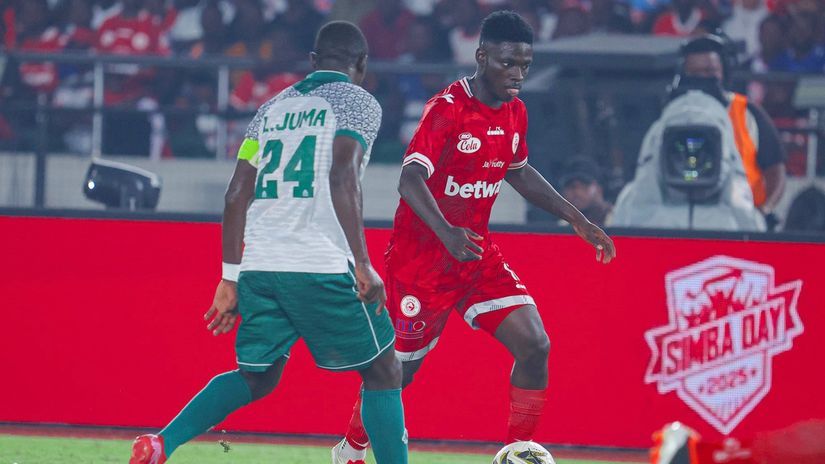
By the final whistle, the match encapsulated the contrast between a Yanga side that blended pragmatism with control and a Bandari team that, despite structural variety and moments of persistence, ultimately lacked the incisiveness to break through.
From Transitions to Control: Why Yanga Edged Bandari
The match was defined by Yanga’s tactical versatility and sharper execution.
In the first half, they thrived on direct transitions, striking within two minutes and repeatedly punishing spaces left by Bandari’s pressing, before shifting in the second half to a more measured, possession-based approach that controlled tempo with composure.
Celestin Ecua embodied this adaptability, scoring the decisive goal and consistently disrupting Bandari’s defensive balance by operating intelligently in half-spaces alongside Maxi Mzengeli, especially in the first half.
Bandari, meanwhile, showed tactical variety with inverted full-backs, a dropping striker, and the goalkeeper as an extra option in buildup, but their reliance on wide overloads lacked penetration, and their defensive weaknesses against crosses and line-breaking passes were repeatedly exposed.
The pressing battle summed up the contrast: Yanga’s selective, disciplined pressing stifled central progression, while Bandari’s aggressive high press left exploitable gaps in wide areas.
Even in set-piece situations, Bandari’s fragility in aerial duels and second balls proved costly, underscoring a broader gap in execution.
Yanga showed why they are one of the region’s strongest sides, blending early aggression with controlled second-half management after introducing a couple of fresh legs.
Their clarity of execution - scoring early and then dictating the tempo - was the difference. Bandari, meanwhile, displayed ambition and variety in their structure but lacked the final-third sharpness and defensive solidity needed to turn ideas into results.
In the end, Yanga’s balance of aggression and control, coupled with Ecua’s early influence, secured a deserved 1–0 win.