


TACTICAL ANALYSIS: DR Congo's masterclass that almost shocked England


.jpg)


Reading Time: 6min | Sat. 04.07.26. | 11:33
Tuchel's substitutions restored attacking fluidity, Gordon supplied two outstanding assists and Kane once again delivered when England needed him most
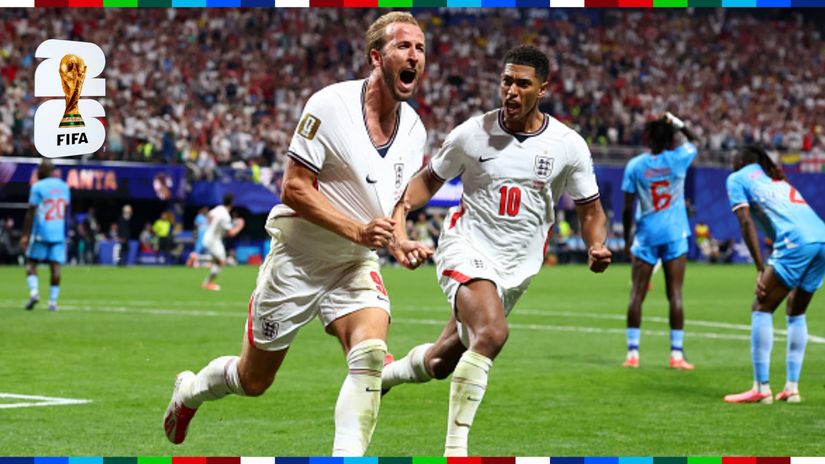
England survived one of the biggest scares of their 2026 FIFA World Cup campaign as Harry Kane's late brace inspired a dramatic 2-1 comeback victory over DR Congo in Atlanta, securing a place in the Round of 16 against co-hosts Mexico.
Download Our MozzartSport App For More News
After Brian Cipenga stunned the Three Lions with an early opener, Thomas Tuchel's side laboured for long periods against a disciplined and tactically organised opponent before Anthony Gordon's introduction transformed the contest.
Kane's two goals not only rescued England but also took him to 13 World Cup goals, moving him ahead of Pelé in the competition's all-time scoring charts.
Although the result ultimately favoured England, the performance was far from convincing. Tuchel's side created enough opportunities to score four or five goals, yet they lacked control without possession for much of the afternoon.
.jpg)
DR Congo's brave build-up, compact defensive organisation and intelligent transitions exposed flaws in England's pressing structure before fatigue eventually tipped the balance.
England began in their familiar 4-3-3 system. Jordan Pickford started in goal behind a back four of Djed Spence, Ezri Konsa, Marc Guéhi and Nico O'Reilly.
Declan Rice anchored midfield alongside Elliot Anderson and Jude Bellingham, while Noni Madueke and Marcus Rashford supported Harry Kane across the front line.
DR Congo mirrored England with their own 4-3-3 formation featuring Lionel Mpasi in goal, Aaron Wan-Bissaka, Chancel Mbemba, Axel Tuanzebe and Arthur Masuaku across defence, with Samuel Moutoussamy, Noah Sadiki and Ngal'ayel Mukau controlling midfield behind Nathaniel Mbuku, Brian Cipenga and Yoane Wissa.
England's attacking shape regularly evolved into a highly aggressive 3-1-6. O'Reilly stepped inside into the left half-space while Rashford held the width, creating overloads on one flank.
On the opposite side, Spence and Madueke rotated intelligently between the touchline and inside channels, producing wide triangles designed to progress attacks before delivering crosses into the penalty area.
It perfectly reflected Tuchel's attacking philosophy, one built around wide progression, physical superiority and repeated deliveries into dangerous areas rather than intricate combinations through central spaces.
Without possession, England initially attempted to defend using a narrow diamond press, placing Kane and Bellingham at the front while the midfield tucked in behind. The intention was to create an additional player against DR Congo's first line and force long balls.
Instead, it achieved the opposite. DR Congo confidently built from a back three, either by dropping a defensive midfielder between the centre-backs or by tucking a full-back inside.
Combined with goalkeeper Mpasi, this consistently created a simple four-versus-two overload against Kane and Bellingham.
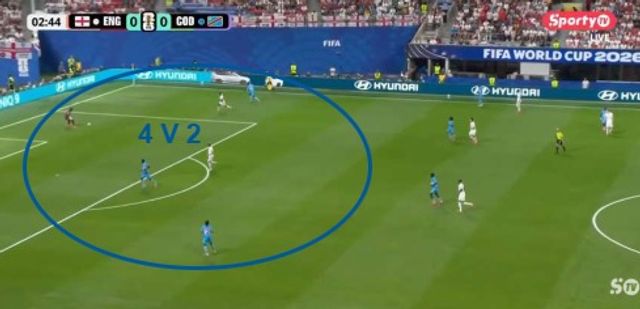
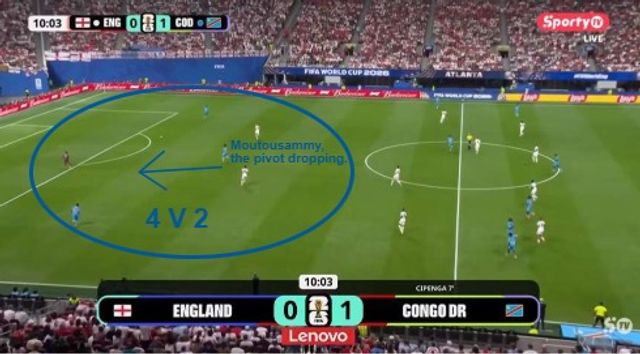
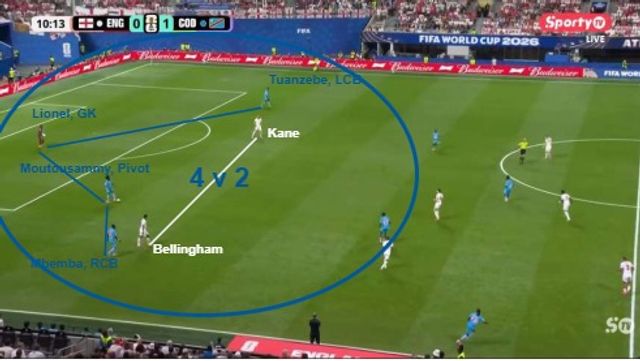
England's reluctance to fully commit additional players into the press proved costly. DR Congo repeatedly bypassed the first line, progressed comfortably into midfield and established sustained possession. Their willingness to build patiently under pressure demonstrated remarkable bravery considering this was their first-ever World Cup knockout match.
England failed to register either a shot or even a touch inside DR Congo's penalty area before the first hydration break, highlighting how ineffective their defensive approach had become.
That structural weakness directly contributed to the opening goal. As England's defensive organisation became stretched, Chancel Mbemba switched play towards the far side where Djed Spence found himself responsible for tracking two runners simultaneously. While he followed Noah Sadiki's movement,
Brian Cipenga drifted unnoticed into space before firing beyond Jordan Pickford at the near post. The goal exposed England's poor defensive spacing, slow pressure on the ball and ineffective communication across the back line.
Following the setback, England attempted to solve the problem by pushing Rashford higher alongside Kane and Bellingham during the press. Rather than increasing pressure, it merely created new passing lanes for DR Congo.
The Congolese calmly played around Rashford before finding Wan-Bissaka free on the right. England's wingers were eventually forced to retreat 10 to 15 yards alongside Declan Rice, effectively recreating the original diamond shape without solving the underlying numerical disadvantage.
Tuchel had been tactically outmanoeuvred during the opening half.
DR Congo's defensive organisation without the ball was equally impressive.
Rather than remaining in one fixed block, they transitioned seamlessly between a compact 4-1-4-1, a narrow 4-4-2 and even a deep 5-4-1 depending on England's positioning.
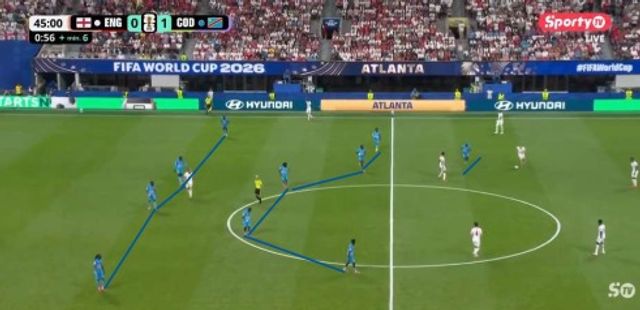
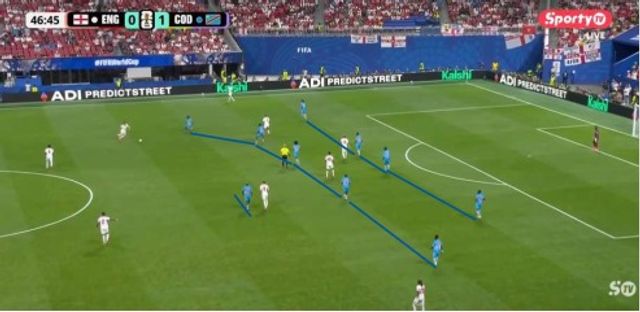
Against goal kicks they aggressively matched England man-for-man, but once the ball progressed they quickly collapsed centrally, denying Kane the space he usually exploits between midfield and defence.
One particularly effective feature involved Samuel Moutoussamy operating directly in front of Kane whenever England settled into possession.
His positioning prevented the striker from dropping into midfield to link attacks, eliminating England's preferred route for central progression. With Kane's combinations removed, England naturally funnelled possession towards the flanks, exactly where DR Congo wanted them.
Wan-Bissaka produced an outstanding individual defensive performance against Rashford, repeatedly winning one-versus-one duels, while Masuaku offered similar security on the opposite side.
England found their wide players regularly, especially Madueke, but progression often stalled because deliveries arrived too slowly after defenders took multiple unnecessary touches in build-up.
By the time Rashford or Madueke received possession, DR Congo's compact block had already shifted across to eliminate space.
Nevertheless, England maintained excellent positional balance in possession despite their frustrations. Their rest-defence remained stable, allowing them to sustain attacks and immediately contest second balls whenever crosses were cleared.
Although their pressing lacked cohesion, their attacking structure prevented DR Congo from launching frequent transitions.
The main exception came through Yoane Wissa, whose hold-up play and ability to carry possession after regaining the ball repeatedly relieved pressure and advanced DR Congo beyond England's first defensive line.
As the match entered its final quarter, Tuchel's substitutions fundamentally altered England's attacking dynamics. Bukayo Saka, Eberechi Eze and Anthony Gordon injected greater speed into England's combinations, particularly down the right-hand side.
The Rice-Eze-Saka triangle offered far more fluid positional rotations than England had previously shown throughout the match.
The equaliser perfectly illustrated the value of coordinated movement. Eze initially stretched DR Congo's defensive line by dropping deeper to receive possession before Rice immediately occupied the vacated half-space.
Rather than remaining there, Rice continued his run into the penalty area, received possession and delivered the decisive cross.
Gordon intelligently recycled the attack before supplying Kane, whose downward header finally beat the outstanding Mpasi.
Those quicker combinations contrasted sharply with England's earlier attacking tempo. Faster circulation prevented DR Congo's man-oriented defensive scheme from settling into shape and forced defenders into uncomfortable one-versus-one situations.
The Congolese block, so disciplined for over 70 minutes, gradually lost its compactness as physical fatigue became increasingly apparent.
England's winner again demonstrated superior reactions around second balls.
After another attack remained alive through Gordon's persistence, Kane produced an exceptional first-time finish into the roof of the net. Once England gained momentum, DR Congo struggled mentally as well as physically. Their defensive intensity dropped significantly, allowing England to dominate the closing stages after spending much of the match chasing the game.
Despite Tuchel's obvious mistakes without possession, England ultimately deserved victory based on the volume and quality of chances created.
Lionel Mpasi delivered arguably the goalkeeping performance of the tournament especially in the first half, producing outstanding saves to deny Bellingham, Kane and several others while Wan-Bissaka's goal-line clearance further frustrated England.
On another day, the Three Lions could easily have scored four or five goals long before Kane's late intervention.
Against Mexico at the iconic Azteca Stadium, however, England will require a far more complete tactical performance if they are to continue their pursuit of World Cup glory.