



TACTICAL ANALYSIS: How Mamelodi Sundowns knocked former coach out of Champions League



.jpg)
Reading Time: 5min | Mon. 16.02.26. | 10:47
The result sealed a quarterfinal place as group runners-up, yet the deeper tactical narrative revealed how Miguel Cardoso’s side manipulated defensive schemes, engineered overloads, and governed every phase of the encounter
In a high-stakes CAF Champions League group decider, where qualification was the headline but control was the subtext, Mamelodi Sundowns dismantled MC Alger 2-0, not through chaos or transition-heavy football but through structural superiority, calculated pressing, and sustained territorial domination.
Follow Our WhatsApp Channel for more news
The result sealed a quarterfinal place as group runners-up, yet the deeper tactical narrative revealed how Miguel Cardoso’s side manipulated defensive schemes, engineered overloads, and governed every phase of the encounter.
This performance was not built on moments of inspiration; it was constructed through repeatable mechanisms that stretched, provoked, and ultimately dismantled MC Alger’s block.
Sundowns began in a nominal 4-2-3-1 that morphed into different shapes constantly in possession.
Ronwen Williams operated as a proactive distributor, positioning himself between split centre-backs Grant Kekana and Khulumani Ndamane during first-phase build-up.
Khuliso Mudau and Aubrey Modiba were deliberately aggressive full-backs, stretching the pitch horizontally and pinning MC Alger’s wide midfielders deep.
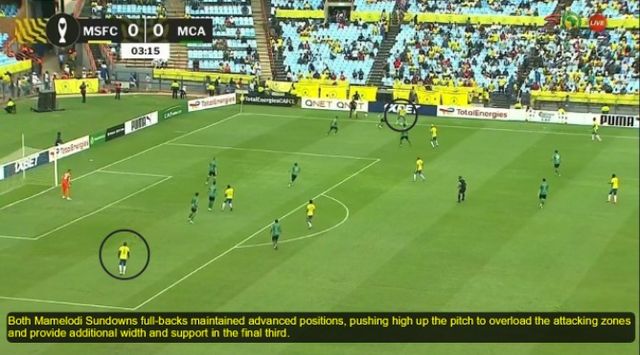
In midfield, Teboho Mokoena functioned as the deeper pivot, frequently dropping to create a 3+1 base, while Jayden Adams provided vertical mobility and second-ball presence.
Arthur Sales, although listed as the No.10, repeatedly dropped into midfield to overload central zones before making delayed attacking runs.

Thapelo Morena and Tashreeq Matthews operated as narrow inside forwards in the half-spaces, rotating intelligently with the advancing full-backs.
Bryan Leon remained the highest reference point, occupying centre-backs and attacking second balls.
On the other hand, Rhulani Mokwena set up MC Alger in a 4-3-3 formation on paper.
Alex Guendouz started in goal, protected by a back four of Yakoub Gassi at right-back, Marouane Khelif at left-back, and Ayoub Ghezala alongside Ayoub Abdellaoui in central defence.
Mohamed Zougrana and Oussama Benhaoua operated as the two central midfielders, with Tabti Larbi positioned as the attacking midfielder.
Out wide, Moslem Anatouf and Zakaria Naidji played on the flanks, while Ferhat Zinedine led the line in a false nine role.
.jpg)
In mid-block situations, they flattened into a 4-4-2, with the false nine stepping alongside the advanced midfielder to screen central lanes.
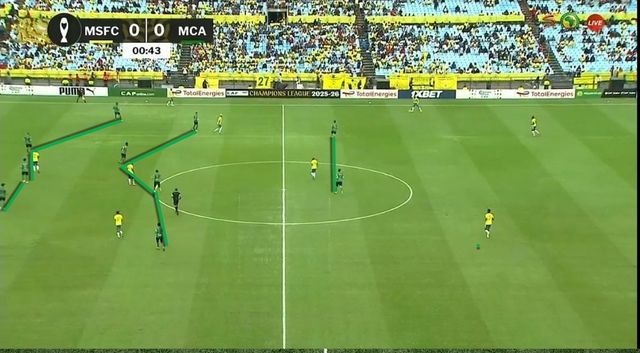
When defending their penalty area, they collapsed into a 5-2-3 or 5-2-1-2 structure, prioritising box density and central protection.
Their defensive objective was clear: deny access to Zone 14, compress vertical distances, force play wide, and defend crosses with numerical superiority.

The tactical problem facing Sundowns was therefore defined - how to access central value zones without exposing themselves to transition against a compact opponent.
Sundowns’ solution began in the build-up. By constructing a 3+1 base with Williams central and Mokoena dropping, they deliberately invited MC Alger’s first line of pressure.
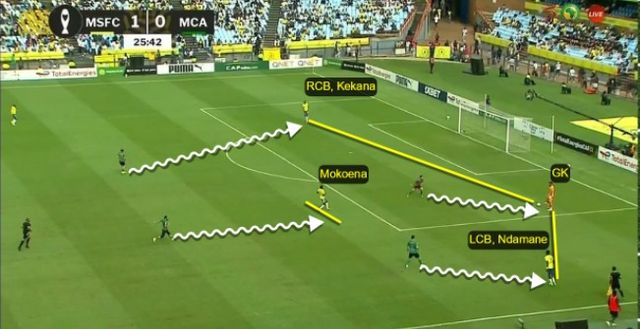
This invitation was strategic. The cause was structural bait: split centre-backs and a visible pivot.
The effect was that MC Alger’s front two stepped higher, stretching their first defensive line.
The outcome was immediate access to the advanced full-backs, particularly Modiba on the left, who often received in space before Alger’s midfield could shift across.
Rotations intensified the effect.
When Sales dropped alongside Mokoena and Adams, and Matthews tucked inside, Sundowns created temporary 4v3 overloads in midfield.
That superiority allowed patient circulation until Alger’s block shifted just enough to expose a half-space or wide isolation.
The opening goal embodied this logic.
Sundowns’ aggressive counterpressure in the attacking third forced a heavy touch at the edge of MC Alger’s box.
Sales reacted instantly, sustaining pressure, and when the goalkeeper parried under duress, Leon attacked the second ball.
The cause was coordinated counterpressing with short inter-player distances.
The effect was defensive panic and an uncontrolled clearance.
The outcome was a structurally manufactured goal, born from territorial dominance rather than opportunism

Targeting individual structural weaknesses was another recurring theme. Sundowns directed pressing runs toward centre-back Ayoub Ghezala, recognising discomfort in possession.
Curved pressing lanes blocked central exits and forced play toward him under pressure.
The cause was a deliberate pressing orientation. The effect was rushed decision-making and imprecise distribution.
The outcome was repeated ball recoveries in advanced zones, reinforcing Sundowns’ territorial hold.
Zone domination further tilted the match. Sundowns consistently accessed the half-spaces and Zone 14 through third-man combinations.

When MC Alger narrowed centrally to protect the box, the wings became accessible.
When they shifted wide to close Modiba or Morena, interior gaps opened between full-back and centre-back.
Sales’ delayed runs and Matthews’ inward positioning exploited those seams.
This spatial manipulation was not incidental; it was engineered through spacing discipline and rotational timing.
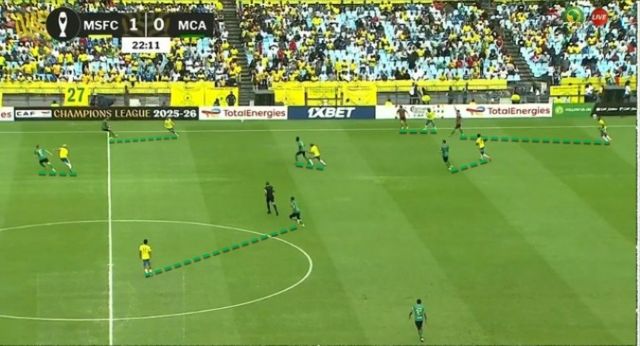
The cause was increased block height and pressing intensity. The effect was more direct distribution from Sundowns.
The outcome, however, did not favour Alger, as Sundowns adapted by controlling second balls and slowing the tempo once ahead.
Allende’s influence was decisive in this management phase. His composure reduced the game’s volatility.
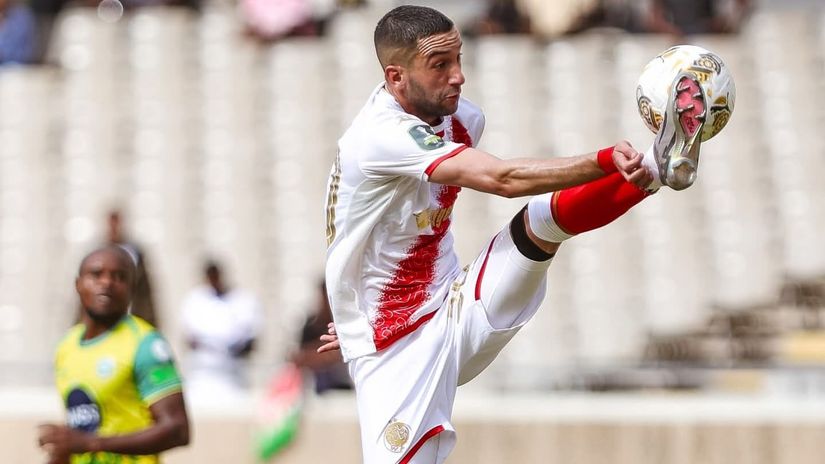
Short passing sequences controlled rhythm and conserved energy.
The cause was tempo modulation through midfield authority.
The effect was reduced transitional chaos. The outcome was secure game-state management as Sundowns navigated the final stages with calculated calm.
Defensively, Sundowns maintained a compact 4-4-2 mid-block when required.
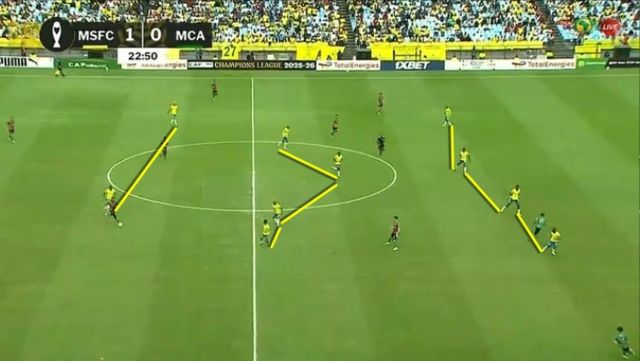
Wingers tracked inside to protect half-spaces, and stepping triggers were activated against vertical passes.
Recovery behaviour was disciplined, with limited overcommitment once the two-goal advantage was established. MC Alger’s late attacking substitutions lacked the structural cohesion to disrupt this compactness.

Ultimately, the 2-0 scoreline reflected systemic superiority rather than isolated brilliance.
Both teams entered in prolific scoring form, yet this contest was defined by control.
Sundowns’ 31-goal domestic return this season signals attacking potency, but here they demonstrated something more sustainable: structural clarity under continental pressure.
The decisive pattern was consistent - invite pressure, stretch lines, overload zones, isolate defenders, control transitions.
Cause led to effect; effect led to outcome.
By the final whistle, progression was secured not through moments of chaos but through mechanisms of control.
In knockout football, that distinction often defines how far a team can travel.