


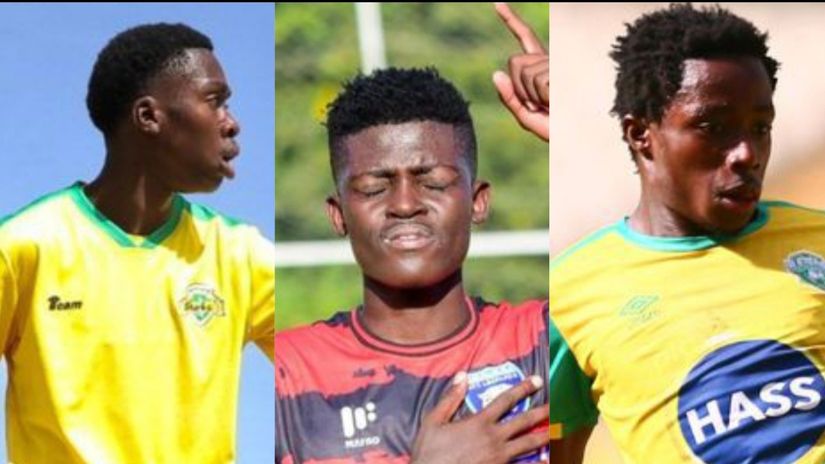
TACTICAL ANALYSIS: How McCarthy can play Aroko, Madada and Wangaya together


.jpg)
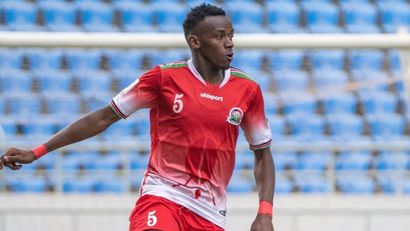


Reading Time: 5min | Wed. 03.06.26. | 19:18
If properly developed within the right system, this next-generation midfield trio could become the engine that drives the national team
When Harambee Stars and former Gor Mahia man Kenneth Muguna confidently declared that Kelly Madada, Kevin Wangaya and Humphrey Aroko would soon become “untouchable” at both club and international level, it sparked an exciting debate across Kenyan football circles.
Download our MozzartSport App For More News
Could we see the three eventually operate together as one complete midfield unit for Harambee Stars in future?
At first glance, the idea appears ambitious because each player currently thrives in different tactical environments within Kenyan football.
However, a closer analysis reveals that their profiles are remarkably compatible.
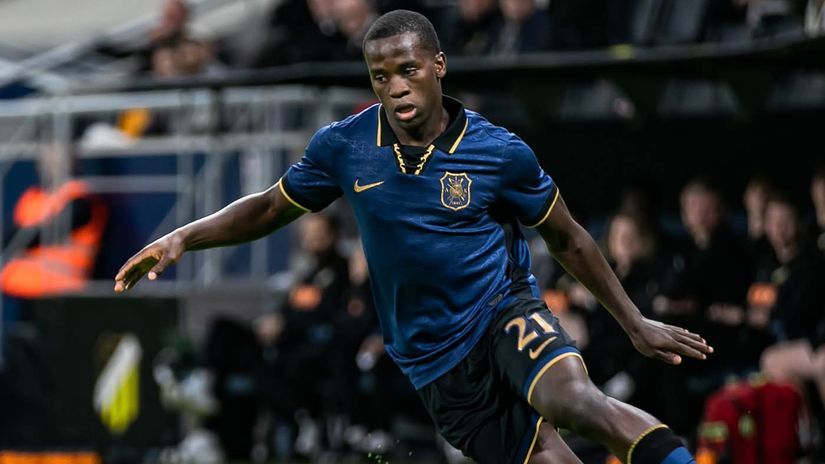
All three possess exceptional football intelligence, elite spatial awareness and technical security under pressure.
Their differences are not conflicting traits, but complementary details that could allow them to function as interconnected pieces within one fluid tactical structure.
Rather than forcing a choice between them, the national team could maximize their collective strengths through a modern hybrid 4-3-3/4-2-3-1 system.
In such a setup, every phase of play - from build-up to defensive transitions - would naturally revolve around their individual qualities.
The foundation of this tactical blueprint begins with Wangaya’s role adjustment.
At club level, Wangaya has excelled in advanced attacking positions, often drifting off the striker and contributing goals and assists at an elite rate.
Yet his performances for Kenya’s U20 side during the 2025 AFCON tournament in Egypt against: Morocco, Tunisia and Nigeria highlighted another dimension to his game: his ability to dictate tempo from deep midfield as a deep-lying play maker.
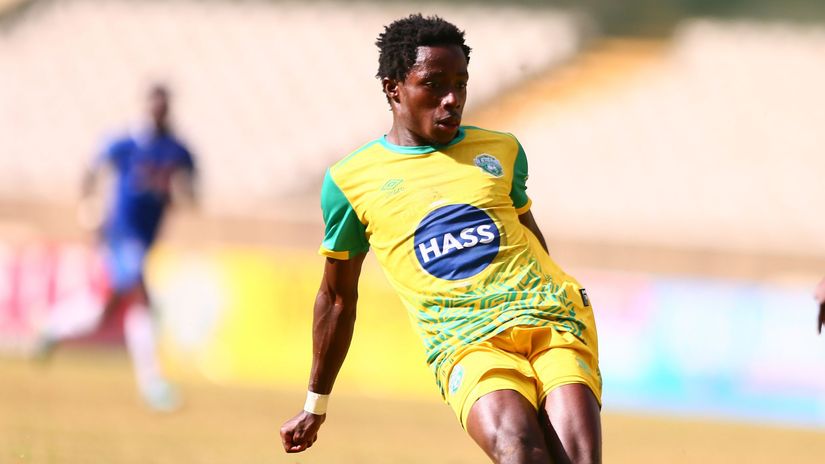
In the national team setup, Wangaya could operate as the central anchor during the first phase of build-up.
By dropping between or just ahead of the center-backs, Wangaya would become the team’s primary press-resistant outlet.
His calmness under pressure would allow Kenya to bypass aggressive presses while maintaining control in tight spaces.
More importantly, his expansive passing range would help progress the ball quickly into advanced areas.
To prevent Wangaya from becoming isolated against physically demanding international midfields, Madada would provide immediate structural support.
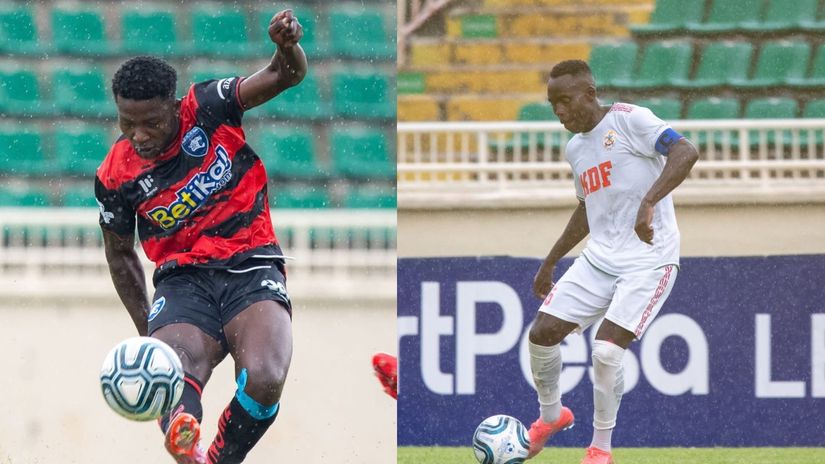
From his natural central midfield position, Madada could drop deeper during build-up to create an asymmetric double pivot.
His exceptional scanning ability and quick combination play would help connect defense to attack while relieving pressure from Wangaya.
This partnership would be crucial in dragging Harambee Stars out of defensive territory.
Wangaya would orchestrate possession from deep, while Madada would function as the transitional bridge carrying the team into the middle third.
As Kenya advances possession higher up the pitch, the midfield structure would evolve dynamically.
With Wangaya maintaining positional discipline as the holding anchor, Madada would gain freedom to express his natural mezzala profile.
Madada’s ability to cover ground relentlessly(see below his heatmap for the whole season) makes him ideal for exploiting half-spaces.
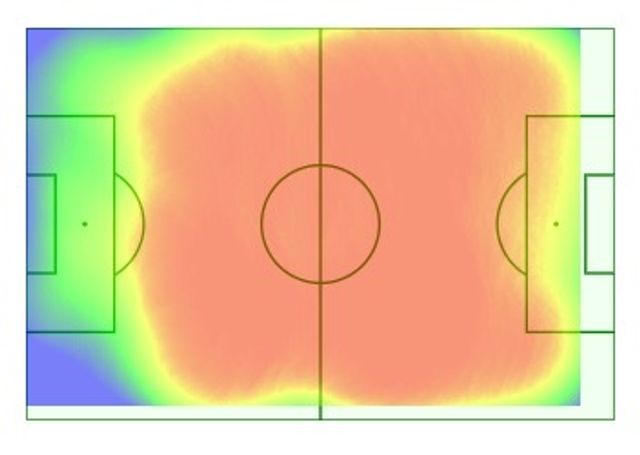
His box-to-box movement constantly forces opposition midfielders to shift shape, creating openings across the pitch.
Whenever the ball is circulated wide, Madada could attack the channels with under lapping or overlapping runs that destabilize compact defensive blocks.
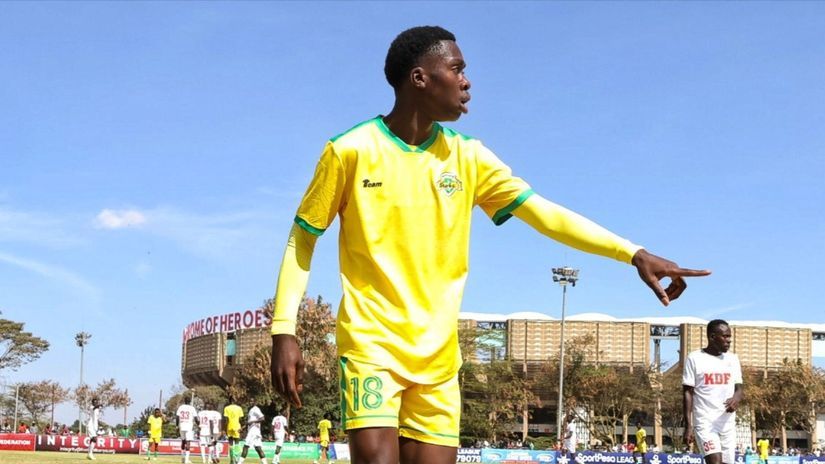
At this stage, Humphrey Aroko becomes the key beneficiary of the midfield’s movement.
Although Aroko often starts from the left wing at club level, his natural instincts pull him into central pockets between the opposition’s midfield and defensive lines.
In this system, he would operate like a floating advanced play maker.
As Madada drags markers into wider areas and Wangaya controls circulation from deep, spaces begin to emerge centrally around the edge of the penalty box.
This is precisely where Aroko thrives.
Both Wangaya and Madada possess the vision to break defensive lines with vertical passes into those dangerous pockets.
Once Aroko receives possession facing forward, Kenya’s attacking structure suddenly becomes far more unpredictable.
Inside the attacking third, Aroko would become the focal point of Kenya’s creativity.
His greatest strength lies in his ability to manipulate defensive structures with minimal touches.
Defenders who hesitate and retreat would be punished by his long-range shooting ability, while those who step forward risk being beaten by his close control and deceptive turning movements.
Several of Aroko’s goals at club level demonstrate this exact quality.
His ability to shift defenders off balance using body feints, fake shots and quick directional changes allows him to create shooting windows from almost impossible situations.
Equally dangerous is he is ambipedal, which prevents defenders from forcing him onto a weaker side.
He could become Kenya’s primary low-block destroyer against compact international defenses.
However, Aroko’s influence extends beyond individual brilliance.
As defenders collapse toward him, secondary spaces naturally open inside the penalty area.
This is where Madada’s late arrivals become devastating.
Because Madada begins his attacking movements from deeper midfield zones, opposition defenders often fail to track his delayed runs into the box.
Whether attacking cutbacks, rebounds, or second balls, his timing allows him to arrive unmarked in dangerous scoring areas.
In many ways, Aroko’s chaos directly fuels Madada’s efficiency.
Modern international football demands balance between creativity and defensive stability. Fortunately, this trio offers both.
Whenever Kenya loses possession high up the pitch, Aroko’s intelligence immediately becomes valuable defensively.
Rather than recklessly pressing, he curves his runs intelligently to block passing lanes and force opponents toward less favorable areas.
This subtle defensive work can trigger rushed clearances and poor transitions from the opposition.
Behind him, Madada’s relentless work rate becomes the engine of the counter-press.
His aggressive recovery runs and willingness to engage in central duels help Kenya regain possession quickly in midfield zones before opponents can launch sustained counterattacks.
Supporting both players is Wangaya, who acts as the team’s defensive organizer.
Drawing from his experience leading Nairobi United’s pressing structure(As illustrated in the diagram below)
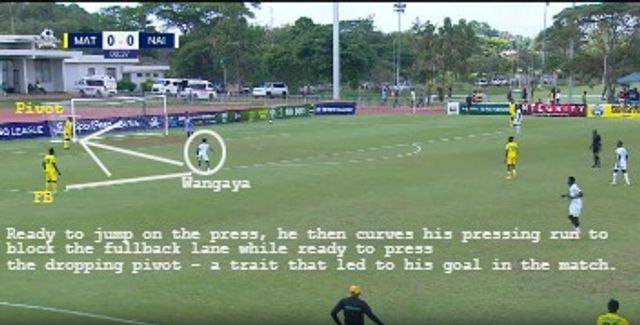
Wangaya would position himself strategically ahead of the center-backs to intercept second balls and shut down central transitions.
The moment possession is recovered, Wangaya’s vision allows Kenya to immediately restart attacking sequences before opponents can reorganize defensively.
In this way, the entire tactical cycle continuously resets itself through the trio’s coordinated movement.
What makes the potential combination of Wangaya, Madada, and Aroko so exciting for Harambee Stars is that their strengths naturally connect across every phase of modern football.
Wangaya offers metronomic control and deep progression during build-up.

Madada provides vertical energy, ball carrying, and transitional balance through midfield.
Aroko delivers unpredictability, creativity, and final-third execution between defensive lines.
Individually, each player already possesses standout qualities.
Together, they could form a midfield structure capable of controlling tempo, breaking compact defenses, and sustaining aggressive counter-pressing at international level.
Muguna’s prediction, therefore, feels less like hopeful speculation and more like a tactical possibility waiting to be fully realized.
If properly developed within the right system, this next-generation midfield trio could become the engine that drives the national team.