


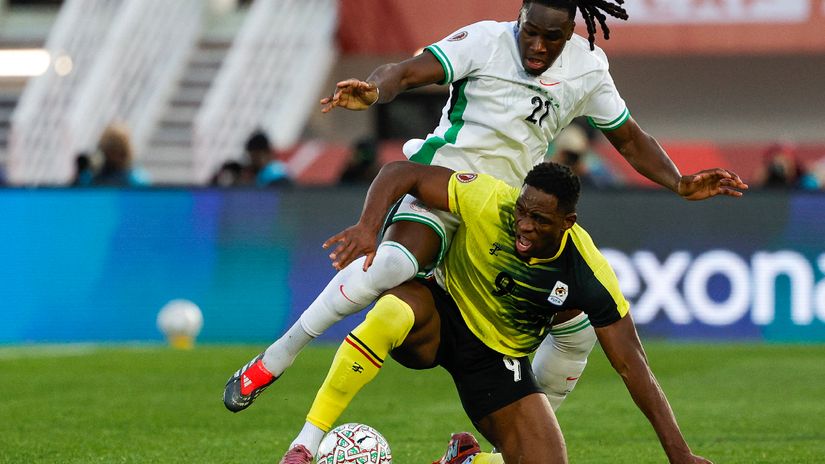
TACTICAL ANALYSIS: How Uganda were architects of their own downfall against structured Nigeria

.jpg)
.jpg)
.jpg)

Reading Time: 5min | Wed. 31.12.25. | 17:11
What began as a balanced contest with Uganda's ambitious left-flank attacks challenging Nigeria's structured build-up evolved into a second-half rout, marked by a red card, clinical finishing, and game management that underscored the visitors' superiority
In a high-stakes AFCON 2025 Group C encounter at Complexe Sportif de Fes, Uganda and Nigeria delivered a match filled with tactical intrigue, individual brilliance, and dramatic twists, culminating in a 3-1 victory for the Super Eagles.
What began as a balanced contest with Uganda's ambitious left-flank attacks challenging Nigeria's structured build-up evolved into a second-half rout, marked by a red card, clinical finishing, and game management that underscored the visitors' superiority.
Follow our WhatsApp channel for more news
This analysis dissects the setups, strategies, key performances, and pivotal moments that defined the game, highlighting how Nigeria's adaptability and exploitation of spaces overcame Uganda's resilience despite the Cranes' early promise and late consolation.
Uganda, under Paul Put, deployed a 4-3-3 formation aimed at balancing defensive solidity with transitional threats.
Dennis Onyango started in goal, protected by right-back Kenneth Semakula, left-back Azizi Kayondo, and central defenders Jordan Obita and Toby Sibbick.
The midfield featured a double pivot of Bobosi Byaruhanga and Baba Alhassan for screening and progression, with Travis Mutyaba as the advanced playmaker. Flanks were occupied by Dennis Omedi on the right and Rodgers Mato on the left, supporting striker Uche Ikpeazu, who provided a physical focal point.
Nigeria, managed by Eric Chele, made slight tweaks to their previous XI, opting for a 4-4-2 to maximize attacking depth. Francis Uzoho guarded the net behind right-back Ryan Alebiosu, left-back Bruno Onyemaechi, and center-backs Calvin Bassey and Igoh Ogbu.
Midfield duo Dele-Bashiru and Raphael Onyedika offered balance, with Moses Simon on the left wing and Samuel Chukwueze on the right, supporting twin strikers Victor Osimhen and Paul Onuachu for aerial dominance and link-up.
The first half showcased Nigeria's early control through a low 4-4-2 build-up, with Onyedika and Dele-Bashiru dropping deep to facilitate progression.
Uganda responded with Mato drifting centrally, allowing Kayondo to maraud forward as an overlapping left-back, creating decoy runs to exploit the outside or inside channels - a strategy that generated ambitious transitions but lacked end product.
Nigeria targeted their left wing, leveraging Moses Simon's 1v1 technical ability to isolate defenders and access Uganda's attacking third.
The Super Eagles' pressing featured Onuachu and Osimhen shadow-marking Uganda's deep midfielders during hybrid restarts, forcing errors and long balls.
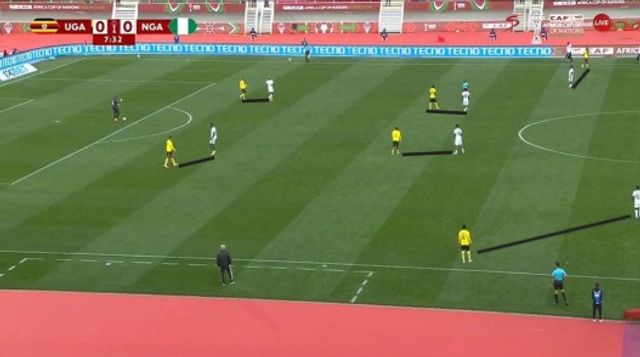
Nigeria's intense high man-oriented press against Uganda’s early build up
Uganda countered with a high-intensity 4-1-4-1/4-2-3-1 press against Nigeria's 4-2-4/4-4-2 mid-build, aiming to disrupt and regain centrally, but Nigeria bypassed this via diagonals from Bassey to Chukwueze on the right as an exit route.
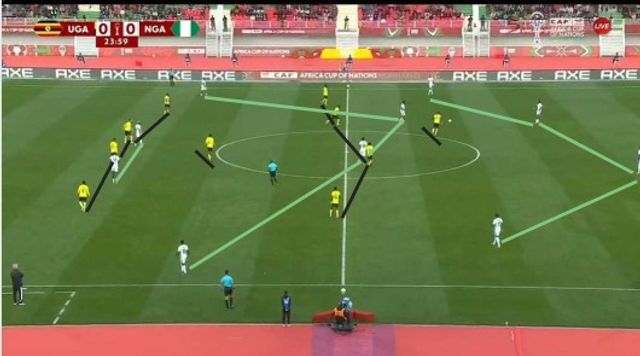
Uganda's disciplined 4-1-4-1 out-of-possession mid-block against Nigeria's 4-4-2 build-up
Key moments punctuated the half's tactical battle.
In the 26th minute, Onyango made a great save from Onuachu's shot after Osimhen controlled a long ball, but seconds later, Onuachu scored following Dele-Bashiru's underlapping run and cutback from Onyemaechi's setup on the left half-space.
Dele-Bashiru's delayed run drew Onyango off his line, allowing Onuachu to slot into an empty net for 1-0 - a turning point exposing Uganda's vulnerability to quick interchanges. Nigeria's center-backs stepped aggressively to deny Mutyaba half-turn receptions between the lines, limiting Uganda's creativity.
The Super Eagles exited Uganda's press via wide areas, with Simon and Chukwueze drawing defenders in 1v1s to create space, then crossing for Onuachu's hold-up to set up Osimhen or vice versa.
By minute 40, Nigeria's wide players delivered early crosses targeting aerial threats in the box, while Uganda earned near-box free-kicks but saw Nigeria defend resolutely.
Near the half's end, Onuachu dropped centrally for link-up, enabling wide exploitation of flanks.
Uganda's left-flank transitions showed ambition but met Nigeria's disciplined defense. Nigeria dominated with 66% possession, two shots on target (1.33 xG), while Uganda had six shots but none on target - highlighting their inefficiency despite numerical shot advantage.
The second half began with Uganda's double substitution: Salim Magoola replaced the injured Onyango in goal, and Allan Okello plus Steven Mukwala came on for Mutyaba and Omedi to inject creativity and depth.
Nigeria subbed the yellow-carded Bassey for Chidozie Awaziem to maintain defensive stability.
Uganda ramped up high-intensity pressing, forcing Nigeria into long balls, but the Super Eagles responded with switches through Dele-Bashiru to wide sides, particularly Chukwueze on the right.
Okello added overloads on Uganda's left with Mukwala and Kayondo, creating numerical advantages, but disaster struck in the 56th minute: Magoola received a straight red for handling outside the box on Osimhen's run from Chukwueze's deep pass.
Alhassan was sacrificed for third-choice keeper Nafian Alionzi in the 59th - a critical turning point reducing Uganda to ten men and disrupting their momentum.
Nigeria capitalized immediately: in the 62nd, a quick throw-in saw Chukwueze drive right and feed Onyedika, who slotted past Alionzi for 2-0.
Uganda shifted to long distributions forward, but Nigeria extended the lead in the 67th - Onyedika's second from Chukwueze's low cutback after Onuachu's deep drop and pass, with Uganda's defense flat-footed. Uganda adopted a 4-1-3-1 out of possession to stem the tide, while Nigeria's full-backs pushed high, leaving just two center-backs in rest defense for a 4-3-3 settled attack.
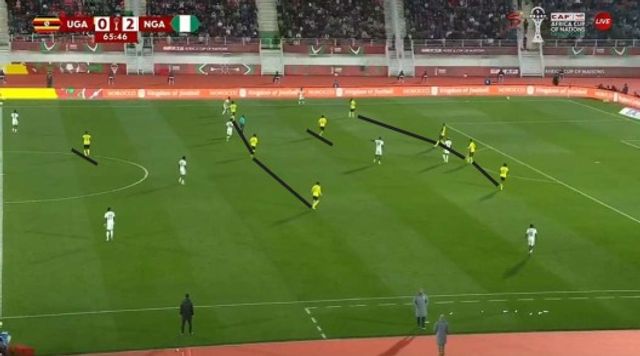
Uganda's adaptive 4-1-3-1 out-of-possession mid to low block after Magoola's red card
Uganda pulled one back in the 75th: Mato's great run and finish over Uzoho from Okello's pass made it 1-3, a consolation highlighting their attacking transitions persistence. Nigeria transitioned to game management from the 78th, circulating slowly in a 4-3-3 to overload wide areas and control possession, sealing the win.
Player performances were defining: Nigeria's Chukwueze starred with assists and runs, Onyedika's brace showcased midfield threat, and Onuachu's link-up (goal, hold-up) was pivotal.
For Uganda, Kayondo's marauding and Okello's creativity shone, but Magoola's goalkeeping error and the red card proved costly. Tactics-wise, Nigeria's low build-up, diagonal bypasses, and wide exploitation overcame Uganda's high press and left overloads, with the red card as the ultimate pivot.
This 3-1 result underscores Nigeria's clinical edge and adaptability, while Uganda's bravery in transitions offered glimpses of potential despite the defeat.