


TACTICAL ANALYSIS: Key areas that could decide Mozzart Bet Cup semifinal clash between Bandari and Police FC


.jpg)



Reading Time: 6min | Fri. 15.05.26. | 19:46
The decisive battle could emerge around Police’s central midfield pair against Bandari’s rotating attackers
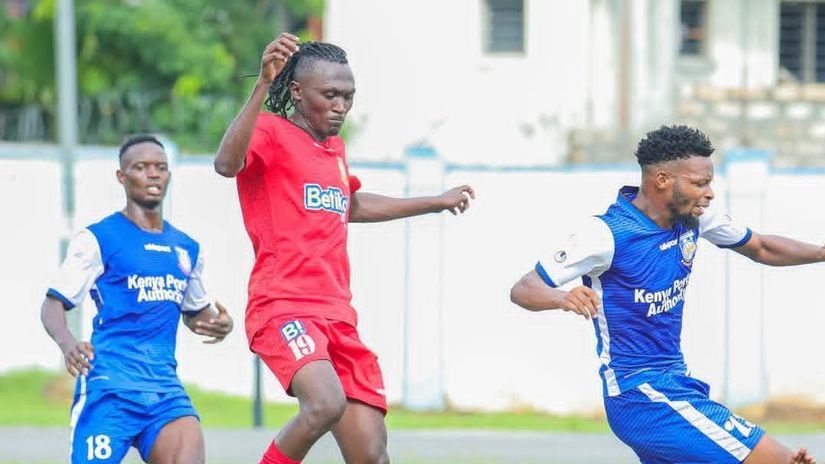
The Mozzart Bet Cup semi-final at the Nyayo National Stadium presents a potentially fascinating structural clash between two tactically distinct units.
Kenya Police FC will look to extend their unbeaten run against a highly direct and versatile Bandari FC.
Download our MozzartSport App For More News
Kenya Police arrive at the semi-final with a clearer defensive identity and more stable game-state control, but the tactical tension in this match comes from how differently the two sides interpret directness.
Police use direct play selectively and often as a game-management mechanism after establishing territorial control, whereas Bandari build their entire attacking structure around accelerating access into the final third through early deliveries, second balls and aggressive wide support.
The result should be a match shaped less by sterile possession and more by territory, aerial duels, rest-defence organisation and how efficiently each side attacks transitional spaces after long sequences of contested balls.
Police are likely to begin in their familiar 4-4-2 mid-block structure without the ball, defending with relatively compact vertical spacing and a medium defensive line designed to protect central access rather than aggressively compress the pitch.

Their defensive behaviour is particularly geared towards denying progression through the half-spaces.
The two banks remain narrow, the pivots protect the corridor in front of the centre-backs, and their pressing triggers are highly specific rather than constant.
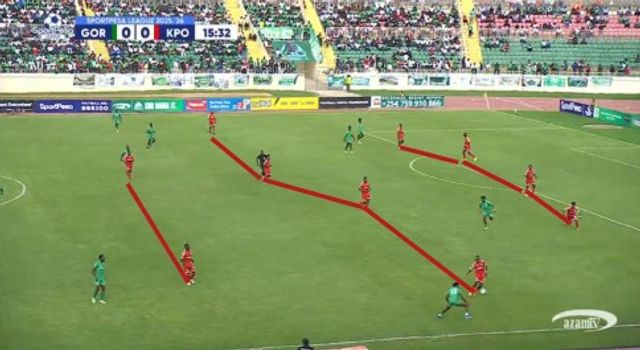
Opposition pivots dropping onto the defensive line or wide midfielders receiving deep-facing play are often cues for Police to jump aggressively, especially through the nearest striker and wide midfielder.
The intention is to funnel circulation wide where they trust their box defending and aerial coverage.
That was evident against Gor Mahia, where they consistently absorbed wide deliveries without allowing clean cutback access or secondary central receptions around the penalty spot.
In possession, Police build with a flat three inside the first phase, using Daniel Ogembo between the centre-backs as an auxiliary distributor to create a numerical superiority against a front two press.
The objective is not prolonged circulation but to bait the first pressing line before releasing diagonals into advancing full-backs or wide runners.
Their centre-backs, particularly Abud Omar and Kevin Ouma are encouraged to step into space and break lines directly with clipped diagonals.
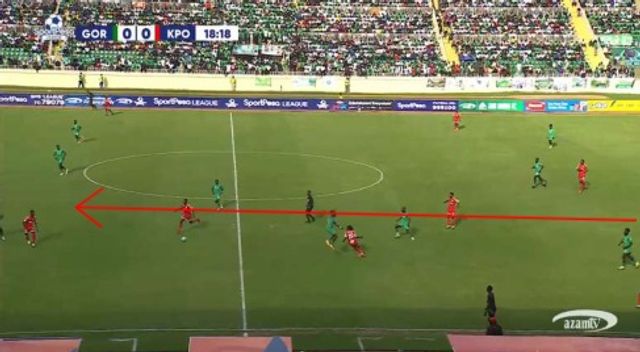
Once the ball reaches advanced wide zones, the attack becomes cross-oriented and heavily geared towards second-phase chaos around the box.
Their set-piece structure mirrors that same logic.
Delivery quality is consistently aggressive towards crowded zones.
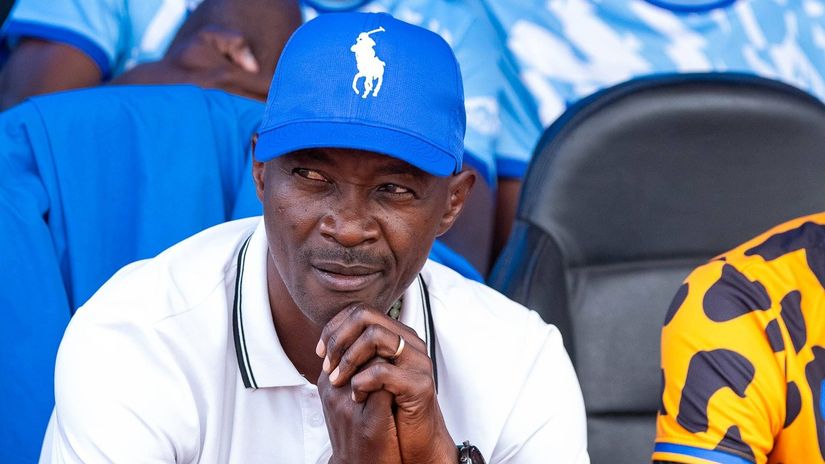
Four set-piece goals in the last five matches is not simply variance; it reflects a side deliberately engineering unstable defensive moments.
Bandari’s structure is more elastic but also less controlled.
Their nominal shape often resembles a 4-4-2, yet in possession it morphs depending on where Frank Ouya positions himself.
Ouya regularly drops into the half-spaces to receive direct passes from the goalkeeper or full-backs, allowing runners beyond him to attack depth.
This creates staggered forward lines rather than a fixed strike partnership.
Against KCB, Amza frequently moved from the left into central support zones behind Ouya, while William Wadri drifted between interior and wide channels to manipulate defensive references.
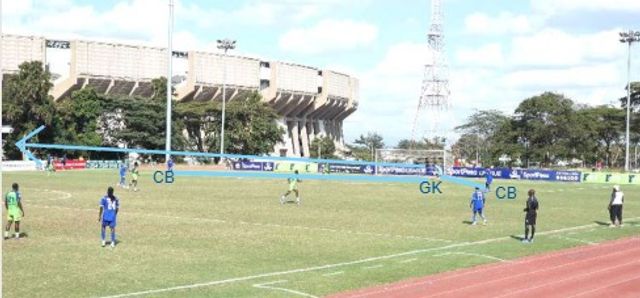
Their first phase similarly uses a three-man platform with the goalkeeper between the centre-backs, but unlike Police, the intention is usually to provoke pressure only briefly before going long early.
Allaine Ngeleka’s distribution is central to this approach because Bandari rely heavily on accurate direct balls into contested zones.
The most aggressive feature of Bandari’s system is their full-back positioning.
Erickson Mulu on the left advances extremely high and Abdallah Hassan effectively behaves like a winger from right-back.
This creates width and crossing volume, but it also stretches their own rest defence.
Because the full-backs push simultaneously, the covering distances for the remaining defenders become large if possession is lost centrally.

That vulnerability could become decisive against Police, whose preferred attacking mechanism involves quick diagonal progression into wide areas immediately after recovering possession.
Police can hurt Bandari most clearly in transition after regains in midfield.
Bandari’s wide structure leaves space behind the full-backs, especially if wingers have drifted inside during attacks.
Police’s diagonal passing from centre-back into advancing runners is specifically suited to exploiting those channels before Bandari can reset their defensive line.
If Marvin Nabwire or Charles Ouma and the two cetreacks can secure second balls after Bandari’s direct attacks break down, the immediate release into the vacated full-back zones could force Shariff Majabe into uncomfortable lateral defending situations rather than the aerial duels they prefer.
Police are less dangerous against settled blocks than they are attacking disorganised defensive shapes, so transitional timing matters.
The second avenue for Police is through sustained territorial pressure generated by set plays.
Bandari’s defensive structure has physical centre-backs, but their issue is less first-contact defending and more second-phase organisation after the initial clearance.
Their aggressive full-back positioning can leave weak edge-of-box coverage, and Police are particularly effective at attacking chaotic rebounds.
The hybrid zonal-man scheme Police use defensively also suggests they place significant training emphasis on dead-ball organisation generally.
Repeated set-piece sequences could tilt the match territorially even without open-play dominance.
.jpg)
Bandari’s clearest attacking route lies through manipulating Police’s compact mid-block horizontally before attacking the half-spaces around the centre-backs.
Police compress centrally extremely well, but their structure can become vulnerable if the ball is switched quickly after the first line shifts towards one flank.
Because their wingers tuck inside to deny interior access, rapid circulation from one wide channel to the opposite side can isolate full-backs defending large spaces.
Bandari’s winger-full-back combinations are built for exactly that scenario.
If a winger drifts inside and combines with Ouya between the lines, the weak-side full-back can arrive aggressively onto switches before early deliveries enter the box.
Ouya’s movement itself presents another tactical problem for Police.
Their centre-backs are aggressive stepping out into half-space receptions, but that aggression carries risk against forwards who deliberately vacate the highest line.
If Ouya drags one centre-back forward and Bandari immediately attack the space behind with runners from wide or from Amza’s secondary movements, Police’s rest defence could become stretched vertically for one of the few times in the match.
The danger is particularly acute during transitional moments when Police’s full-backs have advanced and the midfield line has not fully recovered compactness.
The key structural strength of Police is their spatial discipline without the ball.
They rarely allow central progression into dangerous receiving zones and their aerial security inside the penalty area is among the strongest in the domestic game.
Their weakness, however, lies in how much they depend on compactness remaining intact.
Opponents who circulate quickly enough to stretch the block laterally can create isolation scenarios against the full-backs, especially if the near-side winger is late recovering.
Their build-up also becomes more predictable once they abandon shorter progression for longer restarts in the second half, reducing their capacity to sustain possession under pressure.
The decisive battle could emerge around Police’s central midfield pair against Bandari’s rotating interior attackers.
Marvin and Kusi (and also Charles) are crucial not only for defensive screening but also for securing second balls after aerial contests.
If they dominate those recoveries, Police can sustain territorial pressure and repeatedly expose Bandari’s transitional weaknesses.
If Wadri and Ouya manage to pull them into unstable pressing exchanges, Bandari will gain access into the half-spaces that Police normally seal off.
The other defining duel is likely to be Police’s full-backs against Bandari’s wide overloads.
If Police can force Bandari into predictable crossing positions, they will trust their centre-backs to clear repeatedly.
But if Bandari can manipulate the block with switches before delivering, they can disrupt the spacing that underpins Police’s defensive system.
Ultimately, this match is a contest between Police’s controlled, trigger-based organization and Bandari’s high-variance directness.
The side that best manages the chaos of set-pieces, set-piece transitions and maintains a disciplined rest defense will find themselves in the final.