


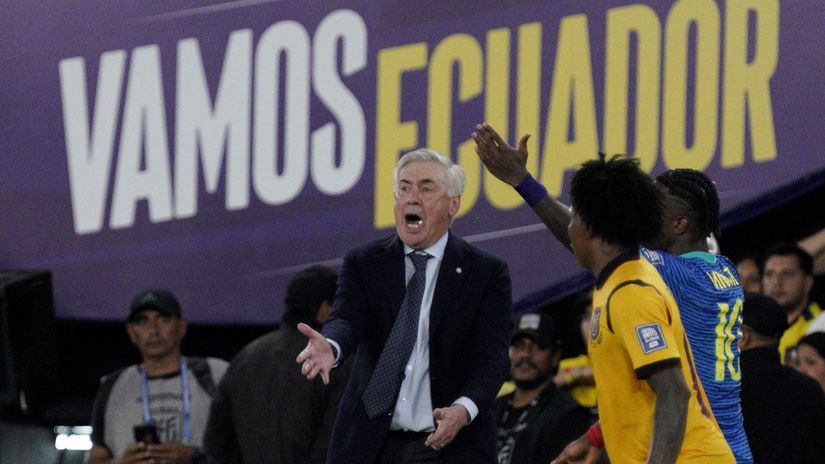
Welcome to the jungle Don Carlo

.jpeg)

Reading Time: 4min | Fri. 06.06.25. | 10:53
Former Real manager only drew 0-0 in Ecuador on his debut for Brazil
Welcome to the South American football jungle, Carlo! But not the one with pine trees and mountain streams, but the kind where, at 30 degrees Celsius and 90% humidity, people sing the national anthem before the match as if going to war, and after 90 minutes leave their soul and bloodied socks on the pitch. Brazil scraped out a point in Guayaquil against Ecuador (0–0), but don’t be fooled by the scoreline—the Italian coach’s squad was closer to defeat than to victory in this Matchday 15 of World Cup qualifying.
❗️🗣️ Carlo Ancelotti on the draw in his Brazil debut: "I don't want to make excuses, but the pitch was not in good condition. It was not easy to play with on pitch." pic.twitter.com/IlsddWFTd1
— The Touchline | Football Coverage (@TouchlineX) June 6, 2025
Carlo Ancelotti’s debut on Brazil’s bench didn’t come with glamour or goals, but it had all the other things South American qualifiers are known for—sweat, fire, and a pressure-cooker atmosphere under the floodlights. In the cauldron of Guayaquil, in front of nearly 60,000 fans, the Selecao remained unbeaten (0–0), but that’s about it. Ecuador was more precise, more combative, and more aggressive, while Ancelotti’s team looked like someone still learning the language of the South American qualification zone.
In Guayaquil, Brazil didn’t dominate possession, nor did they have more shots, corners... In fact, they weren’t better than Ecuador in any aspect—and once again, they lacked the grit to "battle" their opponent. The hosts tightened the noose and regularly created chances, and had their attack been just a bit sharper, Ancelotti might have tasted defeat right from the start. As it is, with one point in hand and a lump in the throat, Brazil returns home unbeaten, but unconvincing. It won’t take Ancelotti long to realize that in South America, points aren't won with a sparkling European coaching resumé or elite reputation. This qualifying zone doesn’t recognize "suits" and "elegance"—it demands scraped knees from sliding tackles and lungs full of air, no matter the altitude.

On his debut, Ancelotti’s Brazil looked like someone stepping into the “underground” of qualifying for the first time, and the performance was no better than under Dorival Junior. Ecuador’s players flew around the pitch, tackled as if their lives depended on each ball, and the stadium pressure got to the referee, the visitors, and a coach used to the refined surroundings of the Bernabeu—not the boiling pot of Guayaquil. The humidity was so thick it could’ve been "cut with a knife," and while the altitude wasn’t as high as Quito’s, it still brought that typical lung-tightening fatigue. No breath, no time, no mercy. In 90 minutes of football, Brazil created only one real chance—Vinícius Junior’s shot from inside the box in the 22nd minute, which Ecuador’s goalkeeper Gonzalo Valle saved. Even Brazil’s starting lineup didn’t strike fear—far from any Brazilian side of past decades. Ancelotti lined up Alisson in goal, Marquinhos and Gabriel (from Lille) at center-back, Vanderson (Monaco) and veteran Alex Sandro (now at Flamengo) as full-backs. The midfield was Casemiro, Bruno Guimaraes, and Gerson (Flamengo), with Vinícius and future Chelsea player Estevão on the wings, and Richarlison up front. Later, Matheus Cunha, Gabriel Martinelli, Andrey Santos, and Andreas Pereira came off the bench.
The five-time world champions didn’t try too hard to score—instead, they focused more on keeping their net untouched. Ecuador, on the other hand, played at a similar rhythm, knowing that with 24 points, they are in a fantastic position and only a miracle could stop them from reaching their fifth World Cup. Ecuador fielded several standout players—Chelsea midfielder Moisés Caicedo, an excellent center-back duo in PSG’s Willian Pacho and Bayer Leverkusen’s Piero Hincapié, and full-backs Pervis Estupiñán (Brighton) and Joel Ordóñez (Club Brugge). Ecuador has all the potential to be one of the pleasant surprises at the 2026 World Cup in the U.S., Mexico, and Canada. For Carlo Ancelotti, this was his first brush with a reality far removed from the atmospheres of Milan, London, or Madrid. This draw wasn’t just a cold shower, but a warning of what is likely to be the hardest job of his career. Because Brazil is no longer a fearsome team, but one that is lost. A team without identity, without style, and without authority on the field. And Ancelotti, one of the most decorated managers in the world, now has to find a way to turn this broken puzzle into a team that not only qualifies for the 2026 World Cup—but wins it. That, without hesitation, is the goal he himself has set.