


 S. Ochieng
Scandal free Olympics for Kenya as Tergat captains team to second term at NOC-K

.jpg)

Reading Time: 6min | Sun. 26.12.21. | 09:00
Team Kenya scooped ten medals in Tokyo to finished as top ranked African nation.
Following the successful completion of the delayed Tokyo 2020 Olympic Games that had to overcome a myriad challenges, Team Kenya once again emerged as the top nation from the African continent after a scoop of 10 medals – four gold, four silver and two bronze all panned from athletics.
While it was a sight to revel at as Kenya’s national anthem reverberated the entire Tokyo National Stadium when the great Eliud Kipchoge and Peres Jepchirchir fittingly received their Olympic marathon gold medals in the closing ceremony, it only meant one thing back in the country afterwards – the end of a term to all the officials of the National Olympic Committee of Kenya (NOC-K).
.@EliudKipchoge recently won gold at the Tokyo Games becoming the 3rd marathoner to win back-to-back titles. His new documentary, Kipchoge: The Last Milestone, will be released today in the U.S.
— SportTechie (@SportTechie) August 24, 2021
He is our latest Athletes Voice guest, read his story 🔎https://t.co/i5vxHKVqdJ pic.twitter.com/t9ydG8VfZO
Customarily, the election cycle of the Olympics body is four years, usually held after the celebrations of the Games of that particular Olympiad. And with fall of curtains in Tokyo, it was time up for candidates who had served for the last four years, unless of course delegates opted to renew their mandates.
Eventually, after all the ruckus, there would be no changes in the top position as Paul Tergat had no opposition in the forthcoming elections. Before that though, let us take a little trip down memory lane on how the Olympic Kenya committee navigated the year 2021.
Preparations build up
With all the damning scandals that had hogged all the country’s limelight right after the Rio 2016 Olympics, arguably one of Kenya’s best outing at the Summer Games, all the eyes were solely on how the Tergat led body would navigate the challenge of sending Team Kenya to Japan.
On going Team Kenya training sessions in pre- performance anxiety awareness, managing emotions and maintaining concentration during the pre-camp training in Kurume City, Japan. #TeamKenya #YouAreTheReason @OlympicsKe @JoeOkudo pic.twitter.com/QJTThMnn6I
— AMB.(Dr.) Amina C. Mohamed (@AMB_A_Mohammed) July 15, 2021
A task that had been made even harder by the novel Covid-19 pandemic which ravaged worldwide and had brought elite sporting activities to its knees, especially in the country.
In Rio, Kenya’s performance was marred by scandal and frustration. Two coaches were sent home over doping. The team’s sponsor, Nike, raised concerns over uniforms that never reached the athletes. Sprinter Carvin Nkanata was barred from competing over an accreditation mishap and javelin maverick Julius Yego, almost missed his flight to the games because Kenyan authorities apparently had not organized his travel.
Former cs for sports and Kenya's ambassadors to Australia Hassan Rojo will today be sentenced for his role in the Rio Olympics scandal worth 55 million shillings and will earn the title for the first public official to be sentenced by the economic crimes court.#KomeshaUfisadi
— BRAD (@I___amBrad) September 17, 2021
It was not the first time that mishaps at athletic competitions prompted a national debate. Missing athletic kit, accreditation, and poor morale were also problems at the London Olympics in 2012. With all the blame see sawing between the government and NOC-K and no one accepting the blame at the time, President Uhuru Kenyatta chipped in amidst rage from the sporting fraternity.
“The problems which frustrated many sportspeople on international assignment go a long way to erode incentives for our athletes to proudly turn up in Kenyan colors and win. They should be, and will be a thing of the past very shortly. We will ensure that lessons are learnt, questions are answered, action is taken and full accountability achieved,” the head of state remarked at the time.
On the backdrop of that failed past in the last two editions of the Games, pressure was right up NOC-K’s shoulders to deliver.
Tokyo Games
Everything appeared to be going well from the onset. Respective trials had been held without much ado, sponsorships were obtained and outcasts were deservingly given a chance back to the team even. Basically, a lot was in order. But like a haunted past, things could have easily fallen out of hands very quickly with just days to the official start of the games.
On June 2, Kurume City - the place that was to cater for the delegation's meals, accommodation, local travel and training venues before travelling to the Olympics opening ceremony – allegedly pulled out of an earlier agreement with Kenya to host a pre-games camp, sending hitherto made plans into disarray.
Kurume City pulls out of hosting Kenya's pre-Olympic training camp. According to the the Japan Times at least 100 municipalities have pulled out of hosting teams for training camps with around 51 days to the Olympics.
— Celestine Karoney (@cjkaroney) June 2, 2021
Luckily, just a day later, sports cabinet secretary Ambassador Amina Mohammed came to the rescue of NOC-K stating that that would not be the case as the government managed to seal the deal prior to information sent out by acting secretary general Francis Mutuku back then.
“Following an intervention by the Cabinet Secretary, Ministry of Sports, Art, Culture & Heritage Hon. Amb. Amina Mohamed, the Kenyan Embassy in Japan and the Japanese Embassy in Kenya Kurume City has agreed to go ahead with the scheduled pre games training camp for Team Kenya as scheduled,” a statement from NOCK stated.
CS Amina @AMB_A_Mohammed has refuted claims of cancellation of Pre-Olympics Training Camp contract with Kurume City. She has reaffirmed the travel schedule for Team Kenya from the 5th July 2021 to Kurume for Pre-Olympics Training Camp. @JoeOkudo @SonoftheSoilOne @HonSKachapin pic.twitter.com/0WyfoFkEi9
— Ministry Of Sports, Culture & Heritage (@moscakenya) June 3, 2021
With the reprieve, teams flew out in batches to Japan owing to the virus. Despite mining three fewer medals compared to the Rio Olympics, the Tokyo delegation managed to top the charts in Africa again.
Post Olympics/ Concerns as NOC-K goes to polls
Eventually the term had ended and NOC-K was set to be plunged into elections, not smoothly though.
On the day of elections, December 9 2021, Centre for Corporate Governance (CCG), the body mandated to oversee the polls, was accused for showing bias by only meeting the current office bearers instead of meeting all the aspirants by Moses Mbuthia who was vying for the treasurer position.
Voter bribery, delay in the release of the voting delegates list, failure to do adequate document verification and rigging of elections were among some of the issues raised.
Seems NOC-K elections was a continuation of the current office holders terms for the next four years. Interesting that none of the incumbents lost. Negotiated democracy? #NOCKElections https://t.co/cpOsjCXoaq
— Warothe Kiru (@warothe) December 9, 2021
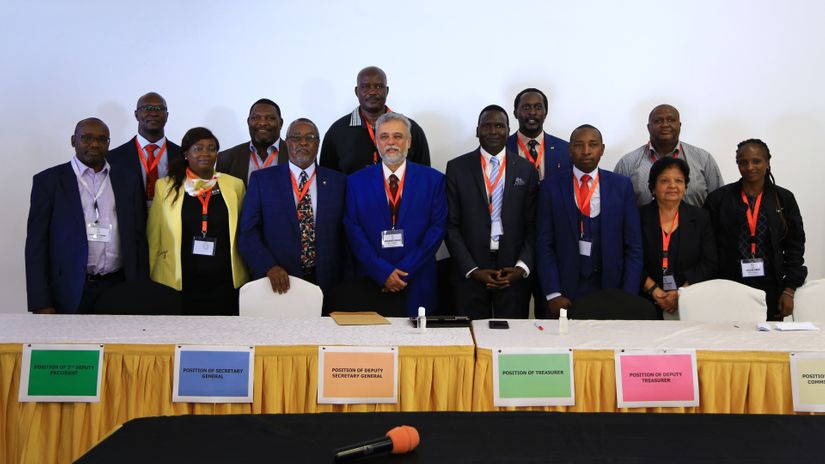
In the end, the elections took place. Tergat successfully securing another four year term after being unrivalled. Also elected unopposed, were Humprey Kayange, former Shujaa captain and 2021 World Rugby Hall of Fame inductee, and world 5,000m champion Hellen Obiri who were elected as the male and female athlete’s representatives.
Dr. Paul Tergat takes his certificate having retained his position as President, NOC-K. pic.twitter.com/AdJWwMtjw9
— TeamKenya (@OlympicsKe) December 9, 2021
Francis Mutuku, who was serving in an acting capacity was elected the Secretary General after winning 18-5 against Andrew Mudibo of Kenya Table Tennis who was the closest challenger.The incumbent Francis Kanyiri received only two votes.
Shadrack Maluki retained his seat as the 1st Deputy President, getting 18 votes against John Kilonzo of Kenya Rugby Union who received five votes while Col. Rtd Nashon Randiek got four votes.
Waithaka Kioni also returned as 2nd Deputy President after defeating athletics legend Tegla Leroupe 22-5.
Eliud Kariuki also retained his position as the treasurer after trouncing Moses Mbuthia 20-7 and will be deputized by John Ogola who floored Kenya National Paralympic Committee boss Agnes Oluoch 22-5.
Athletics Kenya’s Nairobi Chairman Barnaba Korir and Kenya Basketball Federation chief Paul Otula joined NOC-K for the first time as Winnie Kamau of swimming retained her spot as the three Committee Members.
Paurvi Rawal wins Women Representative in the ongoing NOC-K elections.#nockelections pic.twitter.com/vwdWxwZuAx
— TeamKenya (@OlympicsKe) December 9, 2021
Paris 2024 here we come.