


TACTICAL ANALYSIS: How Rulani Mokwena's MC Alger out thought and out ran Al Hilal

.jpg)
.jpg)
.jpg)


Reading Time: 6min | Sat. 07.02.26. | 22:00
From the opening moments it was clear that Rulani Mokwena’s side intended to impose control through structure, pressing, and positional fluidity.
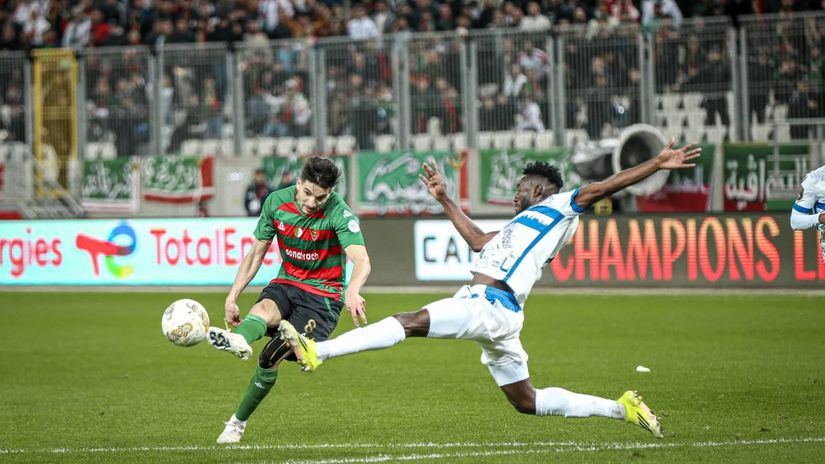
MC Alger and Al Hilal Omdurman approached Friday's CAF Champions League contest with contrasting tactical identities, and from the opening moments, it was clear that Rulani Mokwena’s side intended to impose control through structure, pressing, and positional fluidity.
Follow our WhatsApp channel for more news
MC Alger were set up nominally in a 4-3-3 on paper, but in reality, their shape morphed constantly depending on the phase of play.
Alexis Guendouz started in goal behind a back four of Yakoub Gassi at right-back, Marwane Khelif on the left, and a central pairing of Abdelkader Menezla and Ayoub Abdellaoui.
In midfield, Benkhemassa Mohammed and Mohamed Zougrana operated as the two central midfielders, alternating between deeper and higher positions, while Oussama Benhaoua played as an advanced midfielder but regularly dropped into deeper zones to support build-up.
The front three was where the real tactical complexity emerged, with Moslem Anatouf on the right, Zinedine Ferhat on the left, and Chahreddine Boukholda functioning as a false nine rather than a fixed striker.
Al Hilal, meanwhile, lined up in a more conventional 4-2-3-1. Farid Ouedraogo was in goal, protected by a back four of Steven Ebuela at right-back, Ernest Luzolo at left-back, and centre-backs Mohamed Ereng and Mustafa Karshoum.
Walieldin Khidir and Salah Adil formed the double pivot in midfield, tasked with shielding the back line and initiating build-up, while Abdelrazig Omer operated slightly ahead of them.
The attacking width came from Adama Coulibaly on the right and Jean Claude Girumugisha on the left, with Mohammed Abdel Rahman leading the line.
From the opening exchanges, MC Alger showed a clear intention to attack through the half-spaces rather than relying solely on wide crosses.
Boukholda’s false nine movements were crucial here, as he repeatedly dropped into midfield, dragging central defenders with him and opening channels for Anatouf and Ferhat to run beyond the defensive line.
This positional rotation disrupted Al Hilal’s defensive structure early, especially when combined with Benhaoua’s willingness to drop deep and overload central zones.
Al Hilal, by contrast, were more direct in possession, often opting for long balls from restarts and transitions, looking to exploit space down the flanks through Girumugisha and Coulibaly.
Out of possession, MC Alger immediately established an aggressive high press.
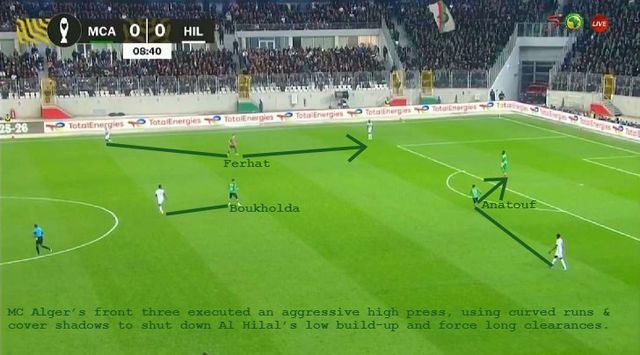
Anatouf, starting from the right wing, played a key role in triggering the press, using curved runs to close down the goalkeeper while blocking passing lanes into midfield.
This forced Al Hilal to either go long or circulate possession wide.
Al Hilal responded by adopting a compact 4-4-2 mid-block out of possession, with the wide players dropping alongside the midfielders to close interior channels and deny MC Alger central progression.
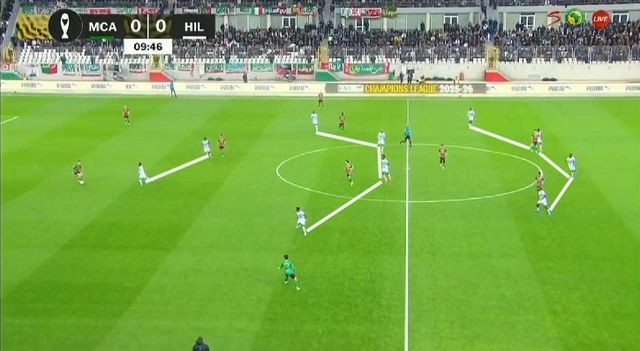
However, the compactness of this block also meant that once the press was broken, MC Alger could attack space quickly.
By the 11th minute, MC Alger’s pressing structure began to pay dividends.
A poor first touch from an Al Hilal defender under pressure led to a turnover in a dangerous area. Zinedine Ferhat, receiving the ball early and facing goal, showed excellent composure by carrying the ball forward and drawing the goalkeeper off his line.
Instead of forcing a shot, he released a perfectly weighted pass to Anatouf, who finished into an empty net.
The goal was a direct consequence of coordinated pressing, intelligent decision-making in transition, and the positional freedom afforded to the wide players.
Following the opener, MC Alger continued to emphasise verticality in their attacking play. They repeatedly attempted passes through Al Hilal’s defensive lines, targeting runners moving beyond the back four.
A key tactical detail was how MC Alger’s forwards actively worked to pin Salah Adil and Walieldin Khidir, preventing the double pivot from dropping freely to assist in the build-up.
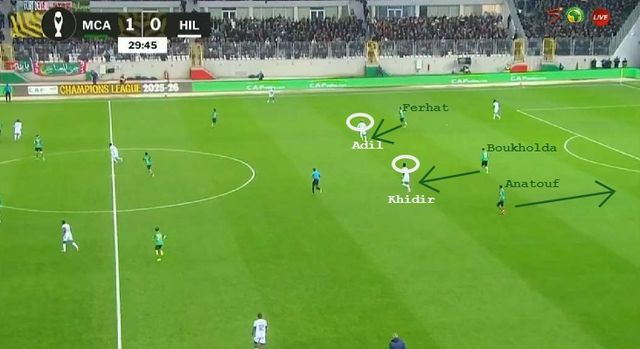
Boukholda’s false nine role was central to this, as he often positioned himself between the lines, acting as a bounce player and releasing teammates with quick through balls into space.
MC Alger also looked particularly dangerous in transition moments.
Quick one-and two-touch combinations allowed them to break lines rapidly, while Gassi’s overlapping runs from right-back added an extra layer of width and unpredictability.
Boukholda frequently orchestrated these moves, receiving between the lines and directing play toward advancing runners.
Al Hilal struggled to track these movements, especially when their full-backs were caught high or isolated.
As the first half progressed, Al Hilal began to find more joy through Girumugisha, who became their primary attacking outlet.
Long diagonal passes and switches of play were used to bypass MC Alger’s press and isolate defenders in wide areas. Despite this, MC Alger’s defensive organisation remained strong.
Their out-of-possession structure often resembled a 4-1-3-2 high press shifting to a 4-4-2 mid-block, with Benkhemassa holding centrally while the front five pressed aggressively, cutting off central passing lanes and forcing play wide.
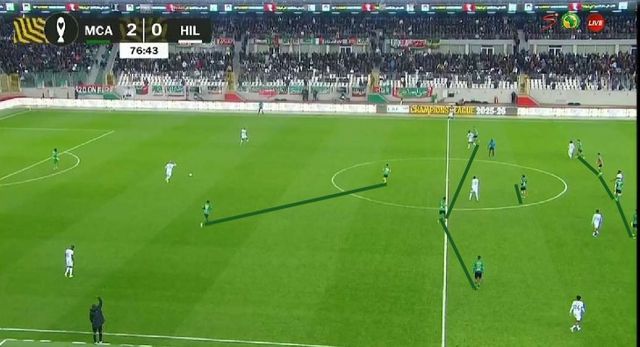
Al Hilal increasingly resorted to high balls over the top, particularly toward the flanks, but penetration remained limited. Just before halftime, MC Alger doubled their lead through a moment of individual quality.
Zinedine Ferhat, receiving a through pass from Boukholda on the left side, cut inside, displaced Mohamed Ereng with a sharp change of direction, and unleashed a thunderous curling strike.
The goal encapsulated MC Alger’s attacking principles: positional rotation, exploitation of half-spaces, and decisive execution in the final third.

The second half saw Al Hilal attempt to reset the game through early substitutions.
Adetunji, Mbareck, and Kane were introduced, with Girumugisha, Walieldin, and Coulibaly withdrawn as the visitors effectively reshaped their entire forward line.
MC Alger also made an adjustment, replacing Boukholda with Naidji, signalling a slight shift away from the false nine dynamic toward a more direct reference point.
Tactically, MC Alger leaned into verticality even more after the break. Long balls into wide areas for Anatouf and Ferhat became more frequent, particularly as Al Hilal pushed higher up the pitch.
Despite this, MC Alger maintained their aggressive pressing approach, targeting the ball carrier high in the opponent’s half and stepping onto the pivots more assertively.
Al Hilal continued to go long from the goalkeeper, often aiming for Mbareck Salem on the right to stretch MC Alger’s defensive line.
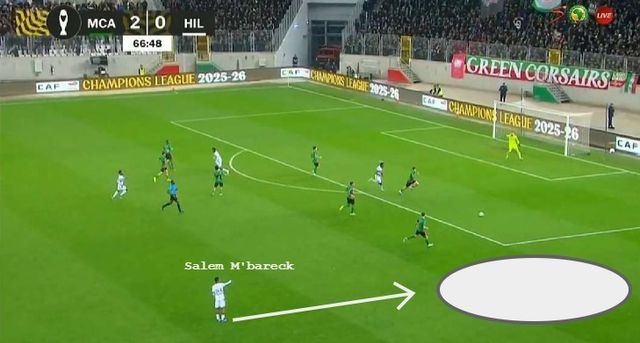
Around the 62nd minute, MC Alger made further changes, withdrawing Anatouf and Ferhat for Kipré Junior and Bangoura.
These substitutions shifted the attacking profile toward players more comfortable holding the ball and slowing the tempo, helping MC Alger manage possession and control phases of the game.
Defensively, their out-of-possession structure reduced Al Hilal to circulating the ball wide without meaningful penetration.
However, Al Hilal eventually found a breakthrough through improved central progression.
In the 78th minute, Mbareck Salem timed a ghosting run perfectly behind MC Alger’s defensive line and finished clinically to make it 2-1.
The goal highlighted a rare lapse in MC Alger’s defensive compactness, as the midfield line failed to track the late runner.
In the closing stages, Al Hilal pushed relentlessly, particularly through set pieces, with corners posing a brief threat. However, execution let them down, and MC Alger held firm during added time.
Ultimately, the match was defined by MC Alger’s tactical superiority for large stretches, their structured pressing, intelligent positional rotations, and ability to exploit transitions, while Al Hilal’s late resurgence came too late to overturn a disciplined and well-organised performance.