


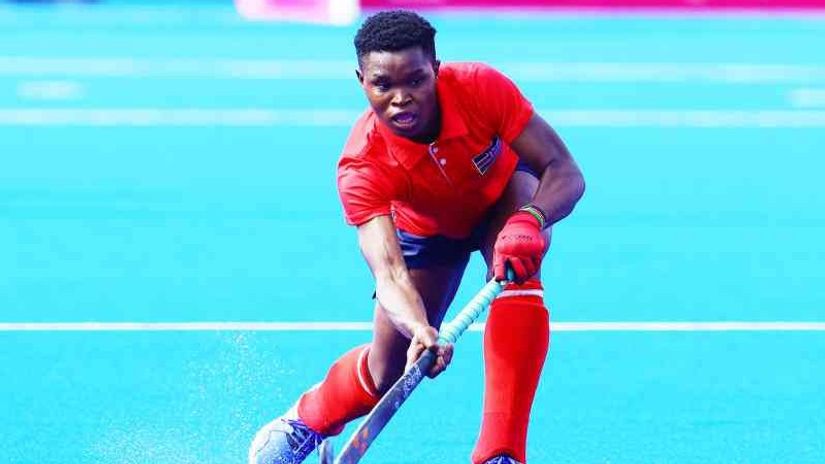
'We look like a village team' - Maureen Okumu opens up on struggles in Kenyan women’s hockey




.jpg)



Reading Time: 4min | Tue. 25.11.25. | 15:51
Okumu’s interview makes it clear that the battle is not only on the field - it is off it, too
Maureen Okumu, a Kenya international with the national women’s senior hockey team and a key player for Blazers Hockey Club, has opened up on the state of women’s hockey in Kenya.
In a candid interview with Sporty FM, she revealed serious challenges around facilities, funding, and preparation, issues she says are hindering the national team's competitiveness.
Okumu was blunt about the deteriorating condition of City Park Stadium, the country’s national hockey venue.

“We have no facilities to play the leagues, train as the national team, and City Park Stadium is worn out.
No improvement has been made since I started playing on that field,” said Okumu, adding that it has been over ten years since she first stepped on that turf and that now the surface is “unplayable.”
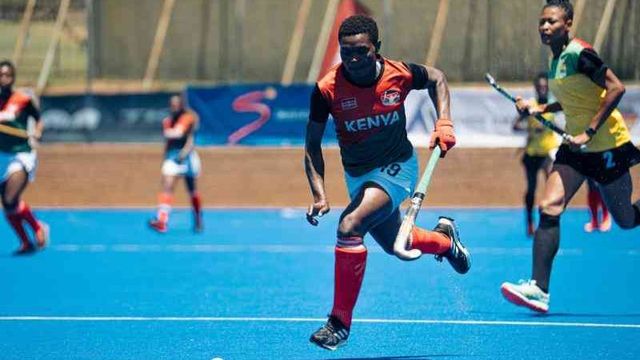
Her concerns resonate with long-standing criticism of the stadium. Since 2018, Kenya Hockey Union (KHU) officials have been planning for the renovation of the stadium, warning that poor drainage and a worn turf were making it unsafe and especially vulnerable during the rainy season, and recently, for the past two years, matches in the KHU leagues have been shifted away from City Park.
Inequality in Preparation and Resources
Okumu did not shy away from discussing gender inequities within sports in Kenya. She compared the women’s national hockey team to the Harambee Starlets and said that, unlike other national teams, they lack basic support.
“We don’t have specific training kits; everyone comes to training with their own kits, and that makes us look like a village team.”
She also spoke about how the team often gets fully kitted only shortly before competitions, a delay she argues undermines performance because players need time to adapt to their gear.

Another key challenge Okumu highlighted is adaptation to turf surfaces abroad. Teams in Kenya primarily train and play on murram, she explained, which is vastly different from the smooth artificial turf used in international competitions.
According to her, players need at least four days on turf before they can adjust properly, a luxury they rarely have.
This sentiment is echoed in broader technical assessments of Kenyan hockey; training on non-artificial surfaces can hamper the development of key skills, especially ball control and speed, which are essential on turf.
Financial Challenges and Pay Discrepancies
Financial support has also been a major sticking point, according to Okumu. She revealed that at the last Africa Cup of Nations in Egypt, each player was paid Ksh85,000.
More worryingly, residential camps are rare, she said the only time they stayed together was before the 2022 Commonwealth Games, and again before the 2024 Olympic Qualifiers in South Africa, when they flew in eight days early to adjust. That early arrival, she said, made a tangible difference in their performance.
While other national teams secure international friendly matches ahead of major tournaments, Okumu said the Kenya national hockey teams often play only locally with club-assembled squads - familiar opposition that offers little challenge or growth.

“Before going for competitions, we often play friendly matches locally and that doesn’t build us,” she added.
In contrast, teams such as South Africa reportedly benefit from exposure to European-style friendlies, giving them an upper hand.
But despite this, Okumu expressed pride in how Kenya competed in the recent Africa Cup of Nations - the team drew against South Africa, a marked improvement over earlier losses like the heavy defeat at the Commonwealth Games.
A Call for Change
If given the power, Okumu said her priority would be rehabilitating the playing field. “We really need a good playing surface to compete with other countries; the upcoming generations also need a good field.”
She framed her plea in terms of equality and opportunity, with the right support, her generation and those that follow could succeed on the global stage. “If you are given all support and necessary facilitation, then it’s upon you to succeed,” she said.
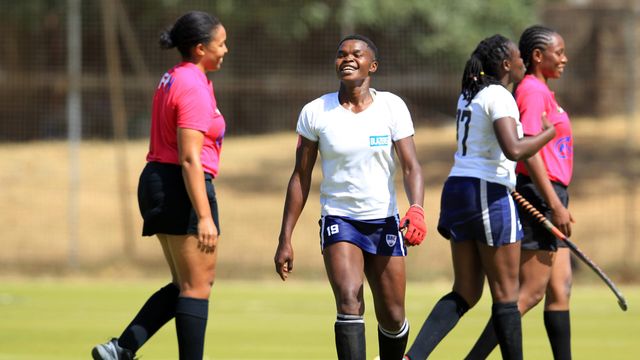
Okumu’s concerns are supported by recent statements from the Kenya Hockey Union (KHU). In October 2025, KHU president Nahashon Randiek acknowledged that the worn-out condition of City Park Stadium continues to hamper preparations.
He noted that although there had been a proposal to build a new turf (with 60% funding offered by the International Hockey Federation), government approval had delayed the project.
Okumu’s interview makes it clear that the battle is not only on the field - it is off it, too. Without serious investment in facilities, equitable support, and international exposure, the Kenyan women’s hockey team risks being held back, not by talent, but by the very system meant to lift them.
She has featured for the national team 28 times, won 14 matches with the team and scored four goals.