


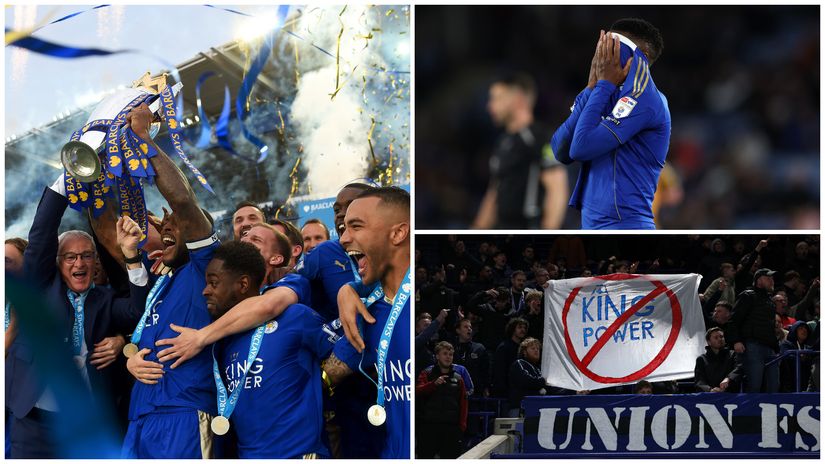
FALSE 10: Too Close to the Sun








Reading Time: 6min | Sat. 25.04.26. | 14:42
If you celebrated Leicester’s Premier League title ten years ago as if it were your local club, a decade later you’re probably feeling an equal amount of sadness…
There is an old story—about Icarus, a boy who flew too high. Carried by freedom and intoxicated by the feeling of rising above everything he had ever known, he defied the limits set before him. But the closer he moved toward the sun, the weaker his wings became—until, in a single moment, they gave way. The fall was inevitable.
Yet it was never just a story about falling. It was a story about a rise so extraordinary, so breathtaking, that it almost demanded a price.
And that is why it has never belonged to mythology alone.
Because football, more than anything else, understands both the rise and the fall. It understands what it means to soar beyond expectation—and what it means to lose everything you once touched. And no club in the modern era has lived through both extremes as vividly, as brutally, as Leicester City.
In 2016, they were Icarus—fearless, unstoppable, existing above logic and beyond belief. They flew higher than anyone thought possible, turning the impossible into reality with every step. But the years that followed brought the other side of the myth—the part where height comes at a cost, and the fall becomes unavoidable.
And that’s when you realize—this story was never just about winning.
It was about how high you can fly… before you begin to fall.

There are titles—and then there are moments when football stops being a sport and becomes something deeper, something that lingers. The spring of 2016 was exactly that. While giants trembled under pressure and elite dressing rooms suffocated in expectation, Leicester City moved quietly through the chaos—unflashy, unpolished, and without traditional superstars, yet driven by something far rarer: unshakable belief.
Under Claudio Ranieri, Leicester didn’t just play football—they rebelled against it. Against logic, against history, against everything the game was supposed to be. It was a team built from the overlooked and underestimated: Jamie Vardy scoring goals that defied probability, Riyad Mahrez gliding past defenders like poetry in motion, and N'Golo Kante covering ground as if the laws of physics simply didn’t apply to him.
Three defeats. Eighty-one points. Champions of the Premier League.
But the numbers were never the story. Leicester didn’t win because they were stronger—they won because they believed more, ran more, fought more, and risked more than anyone else. It wasn’t just a season; it was a rebellion.
A decade later, that same club feels like a fading echo of its former self. The euphoria is gone, the miracles have vanished, and in their place stands the cold, unforgiving reality of the table. Leicester City are no longer chasing titles, nor even dreaming of Europe. They are not fighting for survival at the top anymore—because the story has already turned heavier than that.
This is no longer a decline. This is a collapse.
It didn’t happen overnight, but when it arrived, it came all at once. On the pitch, the 2025/26 season marked a historic low—defensive chaos, a flood of conceded goals, and a team that looked lost week after week. Off the pitch, the damage cut even deeper. Behind the romantic image of a fallen champion stood a far harsher reality: a club whose leadership, once praised for precision and vision, began making decisions that slowly eroded its very foundation. The model that once uncovered hidden gems became inconsistent—and then ineffective.
Years of aggressive spending without sustainable balance, combined with the financial shock of relegation, left the club dangerously exposed. Revenues collapsed while commitments remained, and the gap between ambition and reality became impossible to ignore. The consequences came in the form modern football fears most—breaches of financial regulations.
The punishment was brutal: a six-point deduction. Not symbolic, not negotiable—decisive. The appeal was rejected, and in a league where survival is measured in inches, those six points became more than numbers. They became a verdict.
Yet even that was only part of the unraveling. Behind the scenes, instability spread as recruitment failed and key players were sold—not as part of a long-term vision, but out of necessity. Managers came and went, each bringing new ideas, new systems, and even more confusion. What once felt like unity began to look like disintegration, and inevitably, form followed the chaos.
By 2026, Leicester were collecting only a fraction of the available points. Defeats piled up, confidence evaporated, and matches began to feel decided before they even kicked off. Then came the moment that sealed everything—a 2:2 draw against Hull four days ago that didn’t feel like just another result, but like a final line. The point that mathematically confirmed the inevitable: relegation.
Not just from the Premier League. Not just from relevance.
But into League One.
This isn’t a slump. This is a free fall—and perhaps the most painful part is that they no longer resemble Leicester. Because once, this club knew exactly what it was. Now, it looks like a club trying to remember.
There is something almost poetic in the ruthlessness of this story. The club that once proved the impossible is possible is now proving how fragile everything truly is. From 5000:1 outsiders to counting every point just to survive, from champions of England to the third tier within a decade—this isn’t the romantic version of football. This is the real one: a story not just about glory, but about consequences, about how success, if not protected, can quietly decay into collapse.
Leicester City in the 21st century:
— The Athletic | Football (@TheAthleticFC) April 21, 2026
🏆 February 2000: Leicester City beat Tranmere Rovers at Wembley to win the League Cup for the third time in their history
🗓️ May 2000: Leicester City finish eighth in the Premier League
🇪🇺 September 2001: Leicester City are knocked out of the… pic.twitter.com/rVg8j9AaYb
And yet, something remains.
Because when people speak about the greatest stories in sports history, they won’t begin with relegation—they’ll begin with 2016. With a team that ran harder, believed deeper, and played braver than anyone before them. They’ll begin with Leicester City.
Maybe that’s the only comfort left. Because some stories aren’t remembered for how they end, but for what they once were—and perhaps for what they could be again.
Football has a strange way of circling back on itself, of offering second chances where none seem possible, of rewriting endings just when a story feels finished. So what remains now isn’t just memory, but belief—the same irrational, stubborn belief that once carried Leicester City to the summit of English football.
Only this time, the stage is different, the lights are dimmer, and the path is longer. But the idea remains unchanged: that one day, somewhere else—maybe not in the Premier League, maybe not under the same spotlight—we might find ourselves watching them again. Not just surviving, but chasing something, fighting for a title, writing a new chapter no one saw coming.
And maybe, just maybe, we’ll believe again.
Because if Leicester once taught the world anything—it’s that miracles don’t ask for permission.
They just happen.
By: MIHAJLO ZLAJIC
PREMIER LEAGUE - MATCHDAY 34
Friday
Sunderland - Nott. Forest 0-5 (0-4)
/Hume 17 og, Wood 31, Gibbs-White 34, Jesus 37, Anderson 90+5/
Saturday
Fulham - Aston Villa IN PROGRESS
17.00: (1.50) Liverpool (4.80) Crystal Palace (6.40)
17.00: (2.45) West Ham (3.45) Everton (3.05)
17.00: (4.30) Wolverhampton (4.10) Tottenham (1.75)
19.30: (1.50) Arsenal (4.30) Newcastle (6.50)
Monday
22.00: (1.90) Man.Utd. (3.85) Brentford (3.80)
***odds are subject to change***