


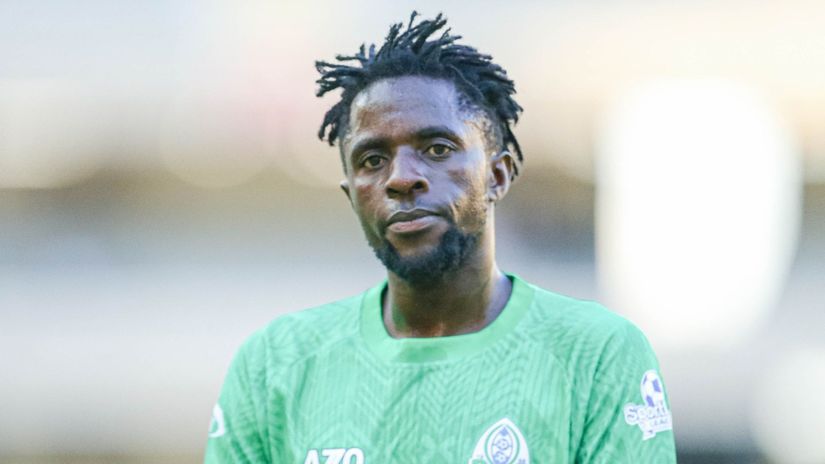
PLAYER ANALYSIS: A look at two options Gor Mahia can utilise to replace Austin Odhiambo






.jpg)
Reading Time: 5min | Sat. 17.01.26. | 17:33
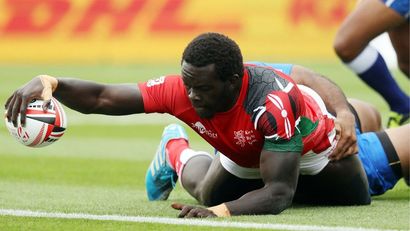
Odhiambo was not simply Gor Mahia’s most creative presence - he was the conductor of tempo, spacing, and connectivity across all phases of play, ultimately, Gor Mahia cannot replace Austin - they must evolve beyond him
The departure of chief creator Austin Odhiambo represents more than the loss of a gifted footballer for Gor Mahia; it marks the removal of a structural pillar around which much of the team’s attacking and transitional identity was built.
Follow our WhatsApp channel for more news
Odhiambo was not simply Gor Mahia’s most creative presence - he was the conductor of tempo, spacing, and connectivity across all phases of play.
As the team now navigates a post-Austin landscape, the challenge is both tactical and conceptual: how to replace not just output, but function.
.jpg)
Operating primarily as an advanced attacking midfielder, Austin’s style of play blended technical mastery with spatial intelligence.
He functioned between the lines, constantly scanning, adjusting body orientation, and positioning himself in pockets that destabilised opposition mid-blocks.
His ability to drift laterally into half-spaces or wide corridors allowed Gor Mahia to overload flanks without sacrificing central presence, often morphing the attacking shape from a nominal 4-2-3-1 into a fluid 3-2-5 during sustained possession.
In essence, he gave Gor Mahia positional superiority, qualitative superiority, and decisional superiority - all three pillars of elite attacking football.
Narrowing the Focus: Ben Stanley vs Jackson Dwang

As Gor Mahia recalibrates, two internal solutions have emerged: Ben Stanley Omondi and new signing Jackson Dwang. Both offer value - but in very different ways.
Stanley is the closest stylistic approximation to Austin in possession. Comfortable as a No.10 or interior midfielder, he thrives in link-up play and spatial manipulation.
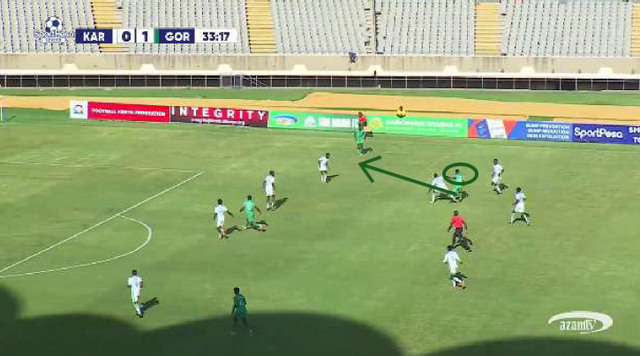
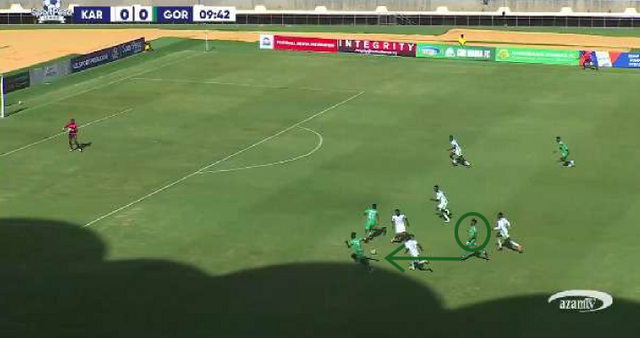 Pressure attraction & release: Stanley draws pressure onto himself before quickly teeing up the free wide player, accelerating Gor Mahia’s transition from regain into attack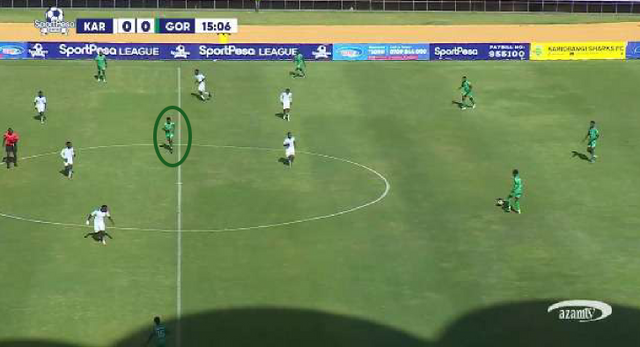
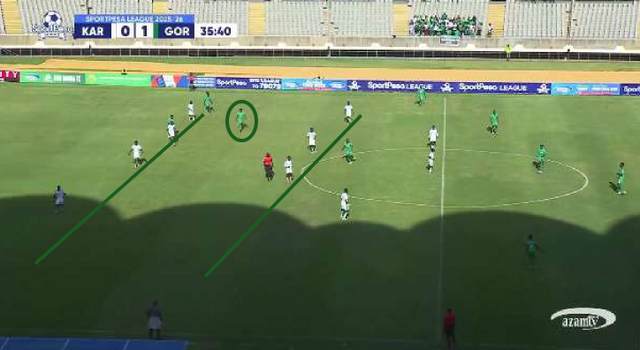 Between-the-lines positioning: Stanley intelligently occupies pockets between opposition defensive and midfield lines, offering a progressive passing option and enabling central access in advanced phases
His tendency to drift wide draws fullbacks out of position, opening central lanes for runners. In advanced phases, Stanley excels at late box arrivals, attacking second balls and edge-of-area spaces with intelligent timing.
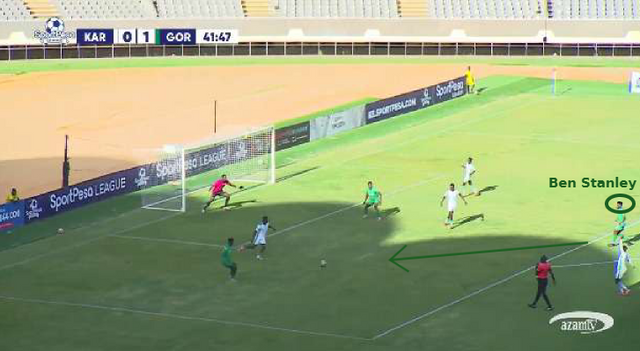
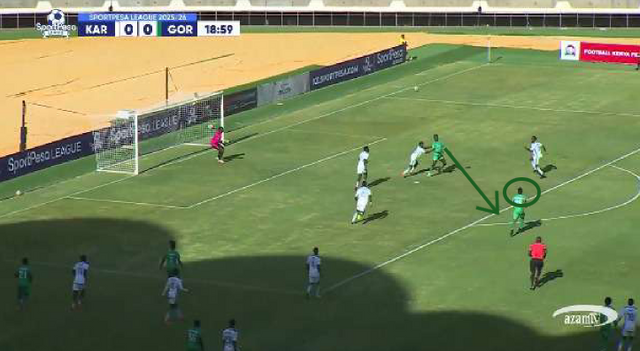 Late box occupation: Ben Stanley times delayed runs to the edge of the box during wide attacks, exploiting space ahead of a retreating defense to attack cutbacks and capitalize on loose balls, rebounds, or ricochets - as illustrated by his recent goal against Kariobangi Sharks
While his chance creation volume does not fully replicate Austin’s, his finishing efficiency provides a compensatory threat.
However, Stanley’s limitations are equally important. His aerial presence is minimal, requiring greater box occupation from wingers and fullbacks.
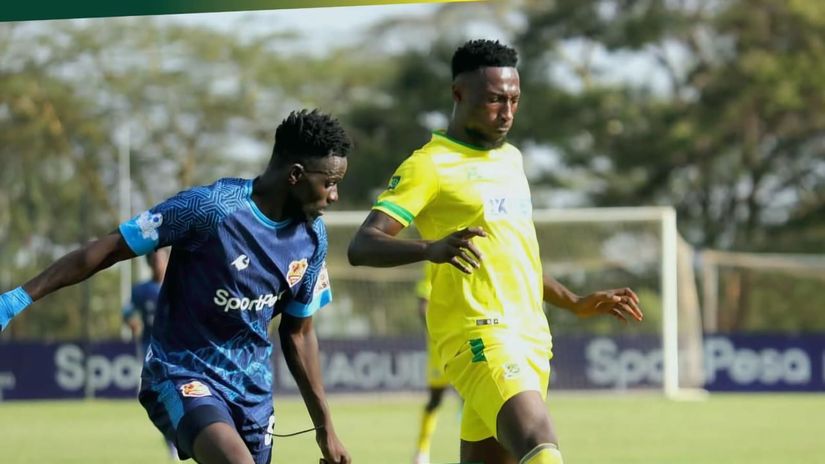
Under intense counter-pressing, his ball retention can falter, and he must improve his consistency in occupying pockets between compact defensive lines.
Out of possession, he is disciplined in rest-defense scenarios, often dropping to balance the structure when a fullback advances, and offers a bit more to Austin’s intensity in the first pressing wave.
Jackson Dwang
Dwang, by contrast, represents a shift in emphasis rather than a like-for-like replacement.
His profile is rooted in defensive robustness, physicality, and tactical discipline. Comfortable both as a deep-lying playmaker and an advanced midfielder, Dwang thrives in high-intensity, transition-heavy games.
His body orientation when pressing, ability to cut passing lanes, and willingness to step out aggressively make him a stabilising presence in defensive transitions.
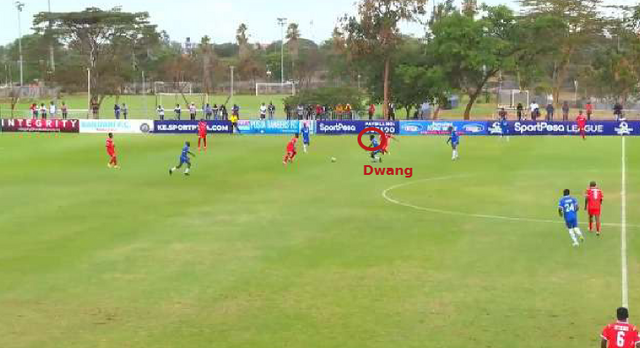 Dwang curves his pressing run with a closed body orientation, immediately engaging the ball carrier on loss of possession to delay progression and force play away from central lanes
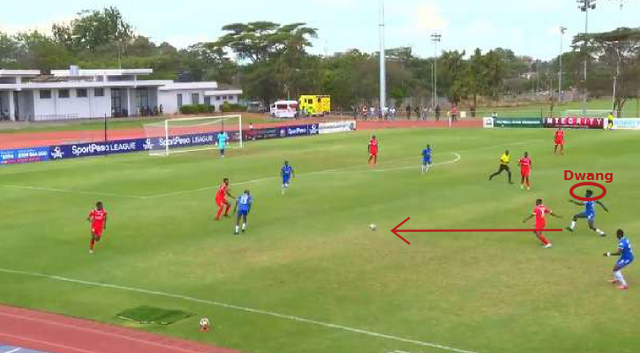 Immediate counter-press: Dwang steps out aggressively to engage the intended receiver, denying time and space on first touch and enabling quick regains immediately after loss of possession
In possession, Dwang offers control rather than incision. His passing range is solid - particularly in switching play and recycling possession - and his set-piece delivery adds value.
However, his limited goal threat and less refined final-third decision-making mean Gor Mahia lose central creativity when he operates as the primary advanced midfielder.
Match Evidence: Declining Creativity and Structural Shifts
Recent matches underline these dynamics. In the 0–0 stalemate against Shabana FC, Gor Mahia’s attacking fluency declined sharply after Stanley’s injury-induced withdrawal and Dwang’s introduction.
The team struggled to access central zones, relying instead on lateral circulation with little penetration.
Against Murang’a Seal, Gor Mahia’s difficulties were even more pronounced. After falling 2-0 behind, the introduction of Morrison shifted the attacking approach toward direct balls from deep into wide areas.
While this increased tempo, it highlighted a loss of midfield control. The absence of central progression and line-breaking passes - once Austin’s hallmark - forced Gor into reactive rather than proactive football.
Tactical Implications
The primary concern post-Austin is the erosion of Gor Mahia’s central dominance. Without a player who can simultaneously resist pressure, create chances, and initiate counter-pressing, the team risks becoming predictable.
Defensive transitions, in particular, are more vulnerable, with reduced compactness and delayed pressure after turnovers.
Physically, neither Stanley nor Dwang fully matches Austin’s blend of agility, balance, and endurance across phases.
This necessitates collective adaptation: wingers assuming greater goal-scoring responsibility, midfielders attacking half-spaces more aggressively, and fullbacks timing overlaps with greater precision.

Adaptation Over Replacement
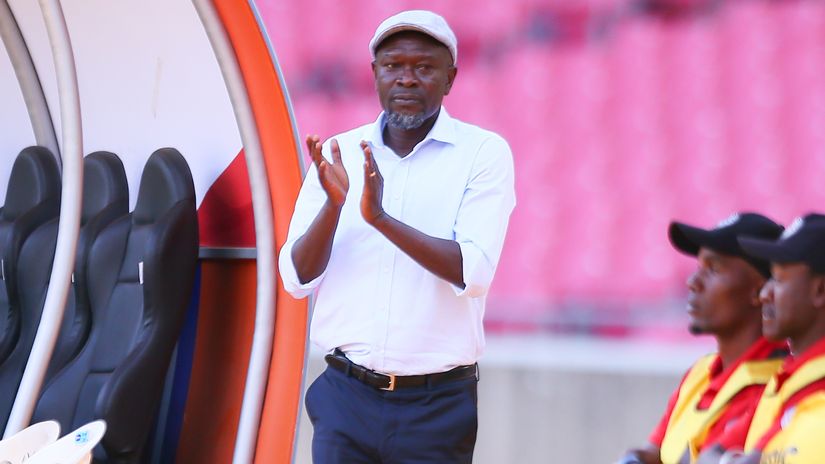
Ultimately, Gor Mahia cannot replace Austin Odhiambo - they must evolve beyond him. Under Charles Akonnor, the choice between Stanley and Dwang reflects a broader tactical decision: control versus security.
Stanley sustains possession-based fluency; Dwang enhances defensive stability and pressing structure.
Success will depend not on finding a new Austin, but on redistributing his responsibilities across the collective. Intelligent rotation, cohesive movement, and refined pressing triggers must now define Gor Mahia’s identity.
In that adaptation lies the true test of Akonnor’s tactical acumen - and the club’s resilience in transition.