


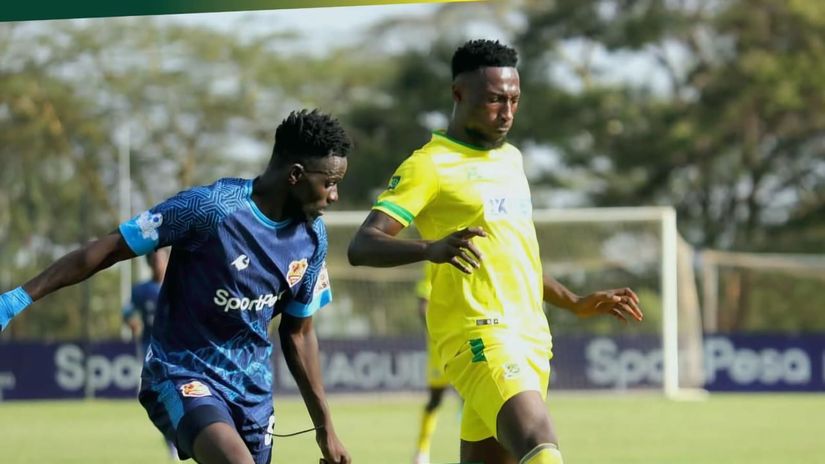
TACTICAL ANALYSIS: How Murang'a Seal extended unbeaten run to 10 games against Mathare United


.jpg)
.jpg)
Reading Time: 6min | Wed. 14.01.26. | 12:07
This analysis explores how Murang’a Seal’s build-up mechanisms, midfield overloads, and counter-attacking clarity ultimately overcame Mathare United’s wing-oriented attacking plan and second-half structural gamble
Murang’a Seal secured a composed 2-0 victory over Mathare United, extending their unbeaten run to 10 matches in a contest defined by structure, intelligent rotations, and superior game-state management.
While the scoreline suggests comfort, the match itself evolved through distinct tactical phases, particularly shaped by Mathare’s second-half aggression and Murang’a Seal’s adaptability in transition.
Follow our WhatsApp channel for more news
This analysis explores how Murang’a Seal’s build-up mechanisms, midfield overloads, and counter-attacking clarity ultimately overcame Mathare United’s wing-oriented attacking plan and second-half structural gamble.
From the outset, the contrast in tactical identities was clear. Mathare United began in a 4-3-3 structure, with Kevin Ouru in goal and a back four of Fidel Otieno, Sammy Imbuye, Ian Omondi, and Junior Nyawir.
In midfield, Mohamed Kilume and Brian Ochieng formed a double pivot, while Brian Ouru operated ahead of them as an advanced midfielder, drifting laterally to find pockets between the lines.
New signing Michael Oduor and talisman Musa Masika held the width on the right and left respectively, with Dennis Okoth leading the line.
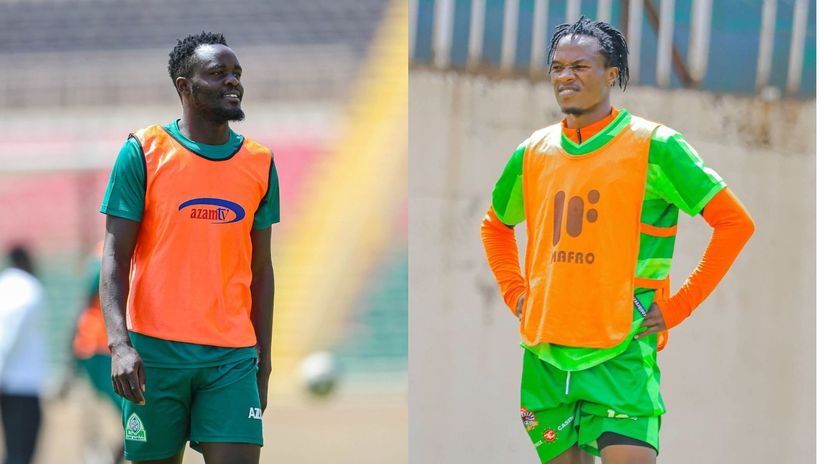
Murang’a Seal, under Osborne Monday, maintained their familiar 3-5-2, with Mustapha Oduor in goal, a back three of Dennis Munyovi, Paul Ngugi, and Tony Musa, wing-backs Price Musebe and Victor Haki providing width, with Telvin Maina and Michael Owen controlling central progression.
Ahead of them, Paul Osama and Joe Waithira operated as inside forwards behind nominal striker Francis Siololo.
In possession, Mathare United were deliberate and methodical, circulating the ball slowly across the back line as they searched for moments of penetration.
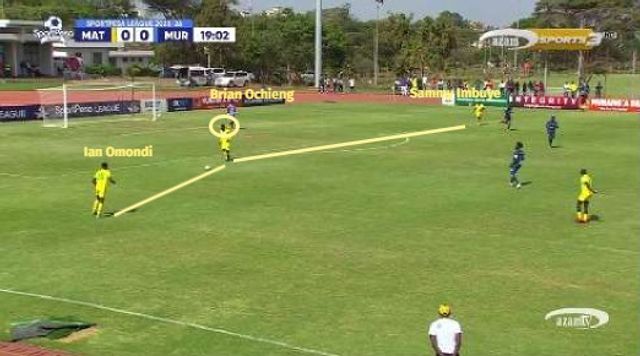 Brian Ochieng’ drops between the centre-backs to support circulation in the first phase, patiently waiting for the right moment to break lines with a forward pass
Their attacking emphasis leaned heavily toward the left flank, where Junior Nyawir consistently pushed high to provide overlaps and underlaps beyond Musa Masika.
This created an asymmetrical attacking structure, further reinforced by Brian Ouru drifting toward the right half-space, allowing Oduor to remain deeper and support circulation rather than attack the last line.
The intention was clear: dominate wide areas, deliver crosses early, and stretch Murang’a Seal horizontally.
Out of possession, however, Mathare reverted to a 4-4-2 mid-block, with Brian Ouru stepping alongside Okoth to form the first line.
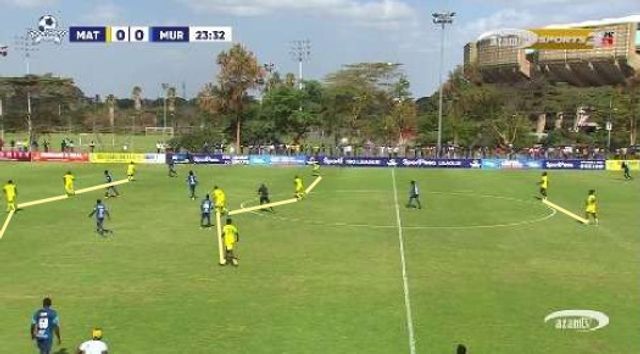 Mathare United’s 4-4-2 out-of-possession shape
This defensive approach aimed to screen central access but allowed Murang’a Seal’s back three time on the ball.
That decision would prove costly. Murang’a Seal were comfortable accepting this invitation, calmly building from the back with either the goalkeeper positioning himself between the split centre-backs or Telvin Maina dropping into the first line to form a situational back four.
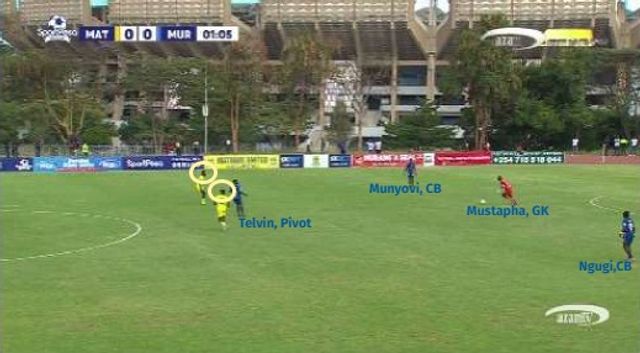 Telvin Maina drops to engage and lure Mathare’s two-man press, with the goalkeeper forming the base between the centre-backs to bypass the first line of pressure in the low build-up phase
Murang’a Seal’s build-up was defined by third-man principles and positional rotations, particularly during the second phase.
As Mathare’s midfield line held its shape, Murang’a created numerical superiority centrally, drawing pressure before exploiting the spaces between Mathare’s lines.
Siololo frequently dropped off the front line, using subtle layoffs and back-heel passes to set advancing runners free.
Osama, Waithira and Akwanyi timed their movements intelligently, attacking the spaces vacated by Mathare’s full-backs and centre-backs when they stepped forward to engage.
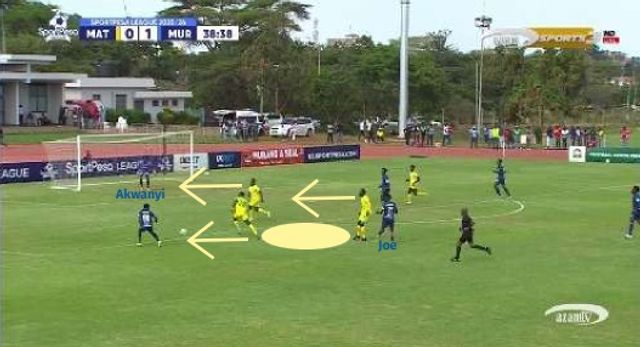 Victor Akwanyi and Joe Waithira combine on the left to disrupt the defensive line, dragging players wide and exploiting Fidel’s advanced right-back positioning through intelligent movement, intricate combinations, and cutbacks
This pattern culminated in the opening goal in the 28th minute. The move originated on Murang’a Seal’s right side, with Osama involved in the build-up before Siololo dropped deep to link play.
His deft back-heel displaced multiple defenders, allowing Waithira to drive forward and slip a pass into the path of Akwanyi, who finished clinically. The goal was not a moment of individual brilliance alone, but the product of repeated structural stress applied to Mathare’s man-oriented defensive responses.
.jpg)
Defensively, Murang’a Seal were equally impressive. Despite Mathare’s insistence on wing play, particularly through Masika and Nyawir, Murang’a’s back three and wing-backs defended crosses with composure.
The compactness of their central defenders ensured that deliveries from wide areas were met with numerical security, limiting Mathare’s chances to low-quality efforts.
The second half introduced a clear shift in game state. Mathare United made attacking substitutions, introducing Eli Asieche and Donald Ange, and began to press higher up the pitch.
Structurally, they transitioned into a box/diamond midfield, withdrawing their wingers early and allowing both full-backs to push aggressively forward.
This adjustment increased central numbers and improved second-ball recovery, enabling Mathare to sustain pressure and circulate possession more freely into wide zones.
Between minutes 60 and 66, Mathare produced their strongest spell. Mustapha Oduor was forced into two sharp saves from Nyawir and Okoth, while Nyawir later struck the bar with a back-post header.
Asieche also came close with a well-executed free kick that crashed off the crossbar. During this phase, Mathare’s midfield overloads temporarily disrupted Murang’a Seal’s rhythm, allowing them to dominate territory and tempo.
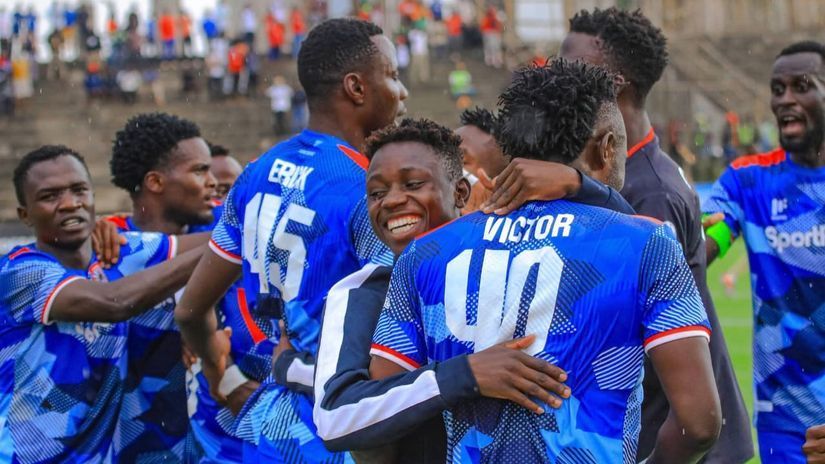
However, this aggressive adjustment came with a significant trade-off. By pushing both full-backs high simultaneously, Mathare left vast spaces in transition, particularly behind Nyawir and Fidel Otieno.
Murang’a Seal recognised this immediately. Michael Owen began playing quicker forward passes on regains, targeting Lucas Maina and Mark Mwaniki, who had been introduced off the bench.
Murang’a no longer sought prolonged possession; instead, they prioritised verticality and speed in transition.
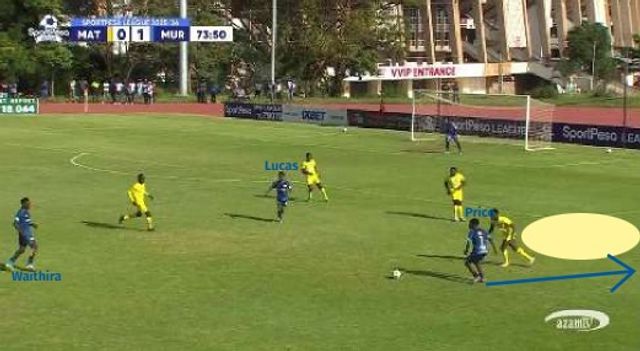
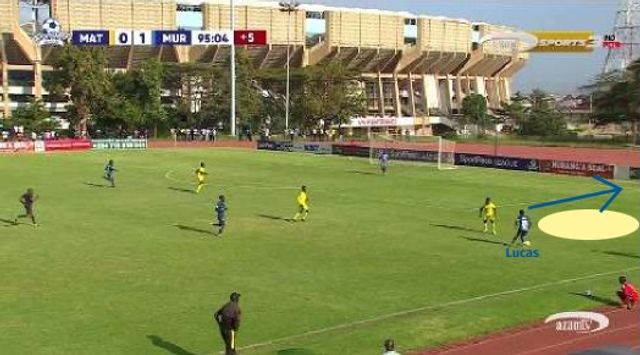 Murang’a Seal consistently targeted the space behind Nyawir as he pushed high from left-back, with Lucas Maina drifting into that channel - a pattern that directly led to their second goal
As the match entered its final stages, these spaces became increasingly exploitable.
Long balls bypassed Mathare’s advanced midfield, forcing recovery runs from centre-backs and exposing the lack of rest-defence. Joe Waithira nearly capitalised on one such moment in added time, finding himself one-on-one before a last-ditch recovery intervention.
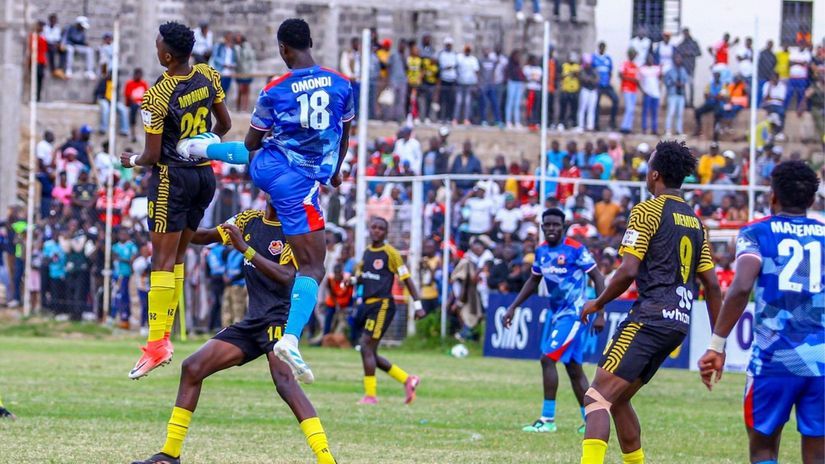
The decisive second goal arrived in the dying moments and perfectly encapsulated Murang’a Seal’s in-game management.
Lucas Maina drew pressure on the right flank, attracting multiple defenders before releasing Jackson Imbakha into space outside the box. With Mathare’s midfield stretched and defensive line retreating, Imbakha struck a powerful long-range effort to seal the match.
Two substitutes combined, exploiting the very structural risks Mathare had introduced in their pursuit of an equaliser.
In conclusion, this was a match decided not by dominance alone, but by clarity of structure, adaptability, and superior understanding of game state.
Murang’a Seal remained faithful to their positional principles, built intelligently through midfield overloads, and adjusted seamlessly when Mathare altered their approach.
Mathare, by contrast, showed bravery and attacking intent, but their structural gamble ultimately exposed them to the very transitions Murang’a Seal are best equipped to punish.
The result reinforces Murang’a Seal’s growing tactical maturity under Osborne Monday and highlights why they continue to be one of the most coherent collective units in the league.