


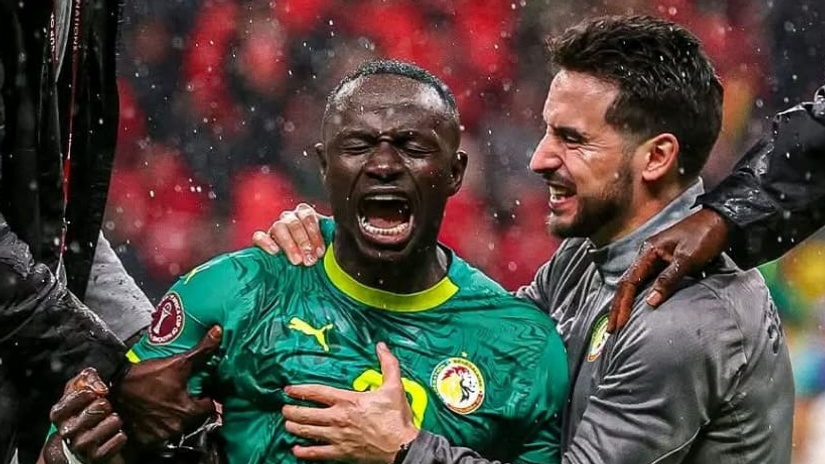
TACTICAL ANALYSIS AFCON 2025:How Senegal overcame theatrics to clinch title on Moroccan soil

.jpg)
Reading Time: 5min | Tue. 20.01.26. | 19:55
Now that the dust has settled, the sideshows seem to have taken centre stage but in the active minutes where the beautiful game was played, a tactical chess match ensued. In this tactical analysis piece we set out to understand it
In one of the most bizarre endings to a football match, Senegal claimed a tense and dramatic AFCON 2025 final triumph over hosts Morocco at the Stade Prince Moulay Abdallah in Rabat, in a contest shaped by tactical discipline, intelligent pressing, and key decisions in critical game moments.
Now that the dust has settled, the sideshows seem to have taken centre stage but in the active minutes where the beautiful game was played, a tactical chess match ensued. In this tactical analysis piece we set out to understand it.
Follow our WhatsApp channel for more news
After ninety minutes without a goal and having survived a late penalty scare, the Teranga Lions finally made the breakthrough in extra time through Pape Gueye, deciding a final that swung between Morocco’s territorial dominance and Senegal’s clinical use of transition situations.
Senegal began the contest in a 4-3-3 structure that prioritised balance between control and transition threat.
Edouard Mendy marshalled the goal behind a back four of Antoine Mendy at right-back, El Hadj Malick Diouf on the left, with Mamadou Sarr and Moussa Niakhaté as the central defensive pairing.
In midfield, Idrissa Gana Gueye anchored as the deepest pivot, Pape Gueye operated as a box-to-box presence with license to advance, while Lamine Camara provided mobility and link play.
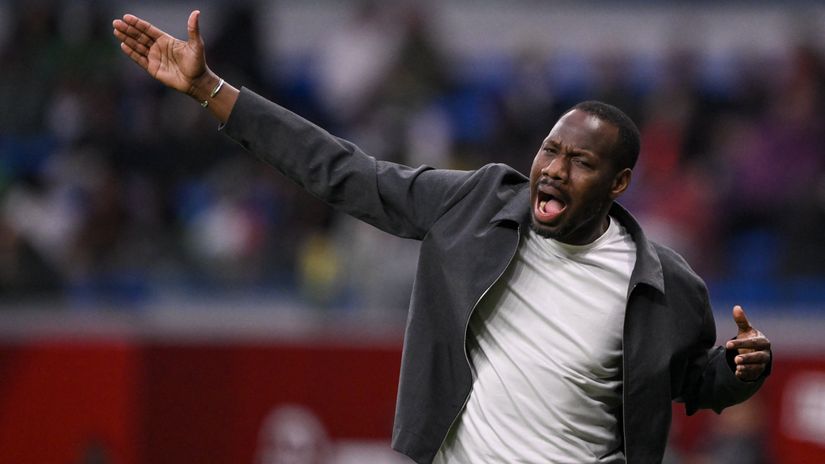
The front three saw Sadio Mané stationed on the left, Iliman Ndiaye on the right, and Nicolas Jackson leading the line, creating a front unit capable of both pressing and attacking space in transition.
Morocco, by contrast, adopted a more fluid interpretation of their base structure. Nominally starting in a 4-1-2-3, the Atlas Lions frequently morphed into a 3-1-6 or 3-2-5 in possession.
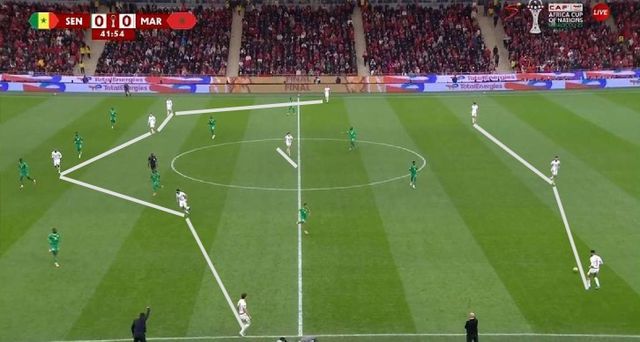
Yassine Bounou guarded the posts, with Achraf Hakimi and Noussair Mazraoui as full-backs who aggressively advanced in possession.
Adam Masina and Nayef Aguerd formed the central defensive base, while El Aynaoui functioned as the deep-lying pivot ahead of the back line.
Bilal El Khannous and Ismael Saibari acted as advanced interiors, Brahim Díaz and Abdessamad Ezzalzouli provided width, and Ayoub El Kaabi led the line.
These structures framed Morocco as the proactive side, intent on compressing space and pinning Senegal deep.
Out of possession, Morocco’s defensive scheme revolved around a 4-1-4-1 mid-block that could quickly jump into aggressive high pressing.
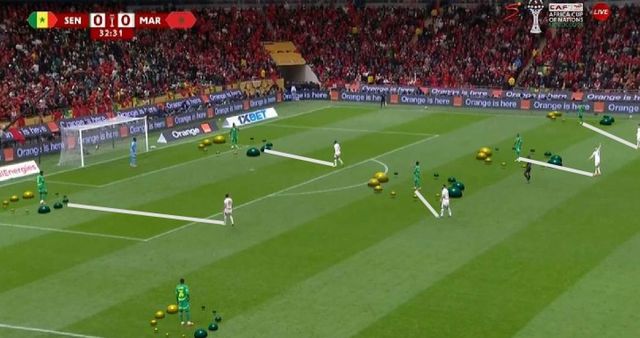
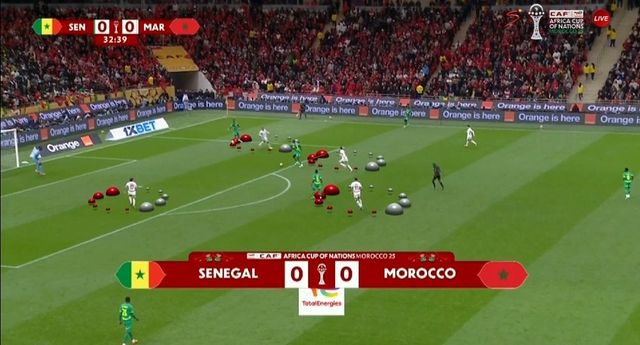
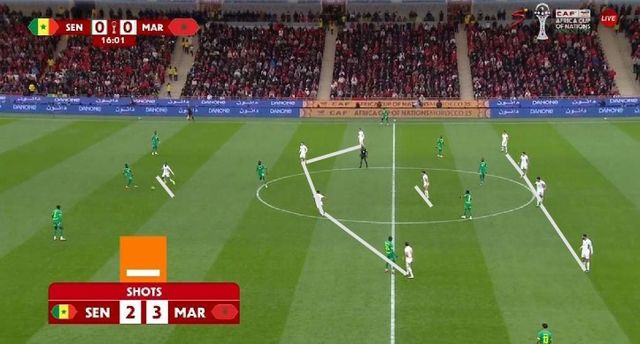
Their approach was not purely zonal; it carried strong man-oriented references, particularly in midfield.
El Kaabi was tasked with shadow-marking Senegal’s deep pivot when he dropped, while Saibari and El Khannous jumped aggressively onto Senegal’s centre-backs during build-up phases.
This pressing logic sought to disrupt Senegal’s first phase and force longer, more direct distributions that Morocco’s high defensive line could attack.
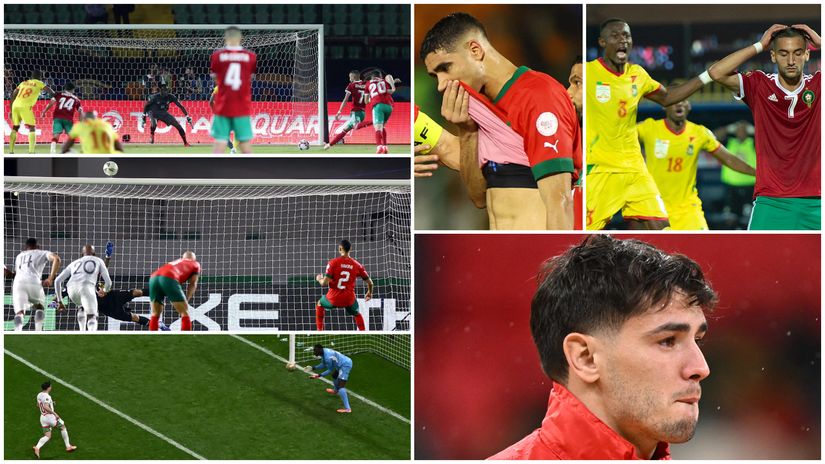
The risk, however, lay in the space left behind that line - an issue Senegal repeatedly attempted to exploit.
Senegal’s build-up structure was pragmatic rather than expansive.
Pape Gueye frequently dropped alongside the centre-backs to create numerical superiority against Morocco’s first press, while El Hadj Malick Diouf pushed high on the left to stretch Hakimi’s attempted advanced positioning.
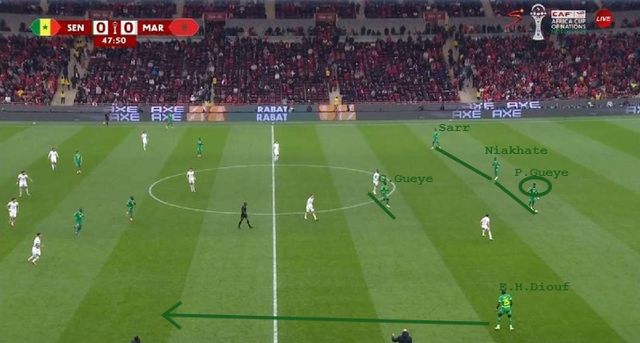
These movements forced Morocco’s defenders to make decisions: step out aggressively or hold the line.
Senegal’s rotations were designed to bait pressure centrally before switching quickly to wide areas, particularly targeting Mané against Hakimi’s vacated space early on.
The cause-and-effect was clear - Morocco’s aggressive press created the very channels Senegal wanted to attack in transition.
The recurring structural weakness Senegal aimed to exploit was Morocco’s high defensive line combined with full-backs committed high up the pitch.
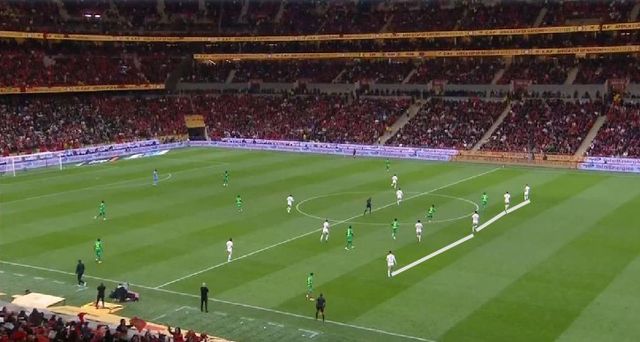
Early chances reflected this dynamic. Within five minutes, a delivery from a corner found Gana Gueye at the back post, forcing an excellent save from Bounou.
Later, Jackson slipped Ndiaye through behind the defence, again testing Morocco’s recovery speed.
These moments were not isolated; they were repeated stress tests of Morocco’s defensive spacing, using direct balls and quick combinations as proof of concept rather than isolated events.
Key zone domination became a subtle but decisive theme. Morocco focused heavily on wide progression, often protecting the flanks through aggressive full-back positioning and inside-forward support.
This, however, intermittently exposed central corridors and half-spaces. Saibari, for Morocco, thrived by drifting intelligently into these pockets, receiving between Senegal’s defensive lines and progressing play.
Conversely, Senegal sought to draw Morocco wide before attacking centrally or diagonally into the channels. The pattern was consistent: wide engagement led to central or blind-side exposure, producing higher-quality chances.
Pressing and build-up disruption were central to the match’s rhythm. Morocco’s press was notable for being led not by El Kaabi but by the advanced interiors, with curved runs designed to block central passing lanes and force play wide.
Senegal responded with a 4-4-2 out-of-possession shape, using Lamine and Jackson to screen passes while springing traps when Morocco circulated laterally.
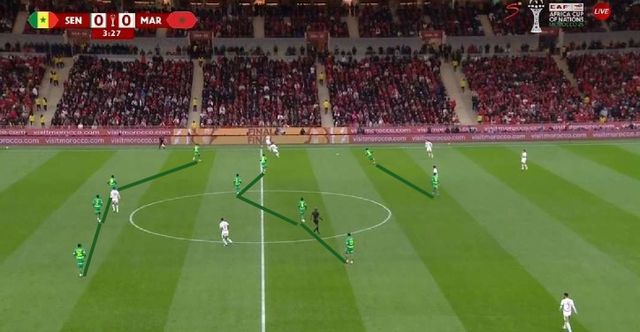
Pressing triggers were clear - sideways passes to full-backs prompted aggressive jumps, leading to several turnovers and transitional moments for both sides.
Rest-defence played a critical role in limiting counters. Senegal’s possession structure always left Sarr, Niakhaté, and a holding midfielder behind the ball, ensuring compact distances to counterpress immediately upon loss.
This proximity stifled Morocco’s ability to launch clean transitions, forcing them instead into longer balls that Senegal could contest.
Morocco, meanwhile, relied on their high line and aggressive stepping out by centre-backs, which succeeded in compressing space but left them vulnerable when bypassed.
The second half saw clear tactical evolution. Senegal increasingly dropped into a 5-4-1 low block when defending deeper phases, prioritising compactness and transition threat over sustained possession.
Morocco responded by targeting blind-side crosses and back-post runs, with El Khannous and Ezzalzouli combining to stretch Senegal’s defensive line. Chances followed - El Kaabi’s miss from a low cross and Aguerd’s header off the bar in extra time - but Senegal’s defensive organisation and Mendy’s composure held firm.
Substitutions further altered the dynamic. Senegal’s shift to a back five solidified their defensive base late on, while Morocco’s changes aimed to overload wide areas with fresh legs and crossing volume.
Yet these adjustments came with trade-offs: increased attacking numbers reduced Morocco’s rest-defence security. It was in extra time, following a turnover forced by Mané in midfield, that Senegal capitalised.
A swift sequence through Gana Gueye ended with Pape Gueye’s thunderous strike - an archetypal example of transition efficiency punishing structural overcommitment.
In conclusion, this AFCON final was decided not by sustained dominance but by tactical clarity under pressure.
Senegal combined flexible defensive structures, intelligent pressing triggers, and ruthless exploitation of Morocco’s high line to secure victory. Morocco controlled territory and tempo for long stretches but were undone by their own structural risks and missed chances.
Senegal’s triumph was a testament to game-state awareness, rest-defence discipline, and the ability to strike decisively when margins are thin - hallmarks of champions on the continental stage.