


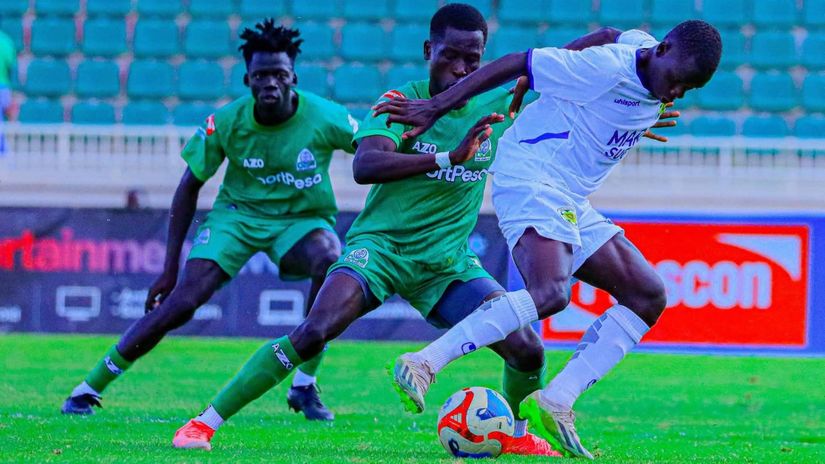
TACTICAL ANALYSIS: Gor Mahia"s tactical domination of Mara Sugar FC

.jpg)

Reading Time: 5min | Tue. 20.01.26. | 16:30
The match evolved into a clear demonstration of how positional play, transitional control, and in-game adaptation can tilt a fixture decisively
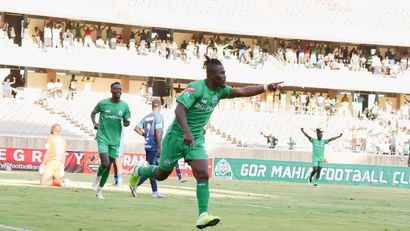
Gor Mahia delivered a composed and tactically assured performance to see off Mara Sugar with a 3-0 victory. From the opening stages, Gor Mahia imposed control through intelligent spacing, wide combinations, and disciplined midfield occupation, forcing Mara Sugar into a reactive role for long stretches of the contest.
The match evolved into a clear demonstration of how positional play, transitional control, and in-game adaptation can tilt a fixture decisively.
Follow our WhatsApp channel for more news
Gor Mahia began in a 4-2-3-1/4-3-3 structure with Gad Mathews in goal, a back four of Paul Ochuoga, Mike Kibwage, Sylvester Owino, and Bryton Onyona, and a double pivot featuring Alpha Onyango as the deeper controller alongside Jackson Dwang, who operated with more freedom to advance.
Ahead of them, George Amono played as the advanced midfielder, while Shariff Musa and Ebenezer Adukwaw on wide areas formed the attacking line around the striker, Felix Oluoch.
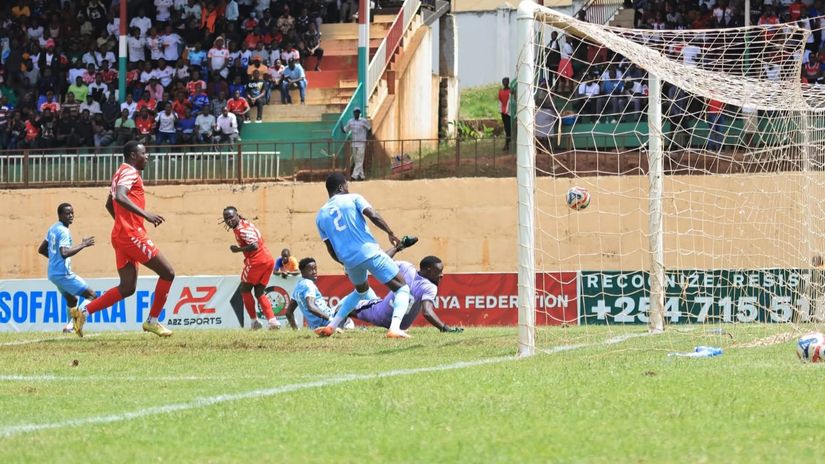
Mara Sugar, by contrast, set up in a 4-3-3 with Evans Omondi in goal, a conventional back four of Joseph Okwenda, Nassor Shikokoti, Robinson Musungu and Jim Owili, a midfield trio anchored by Kelvin Mwavali and Haruna Thomas, and Silas Oningo positioned higher between the lines behind Alex Imbusia flanked by Timothy Ndayala and Aineah Ndete.
Out of possession, Mara Sugar’s defensive approach in the first half leaned towards a loose mid-block with limited collective pressing.
Imbusia often acted as the lone pressing trigger, attempting to disrupt Gor’s first phase, but without consistent support behind him.
This created a disconnect between Mara’s lines, particularly when Gor circulated the ball patiently at the back.
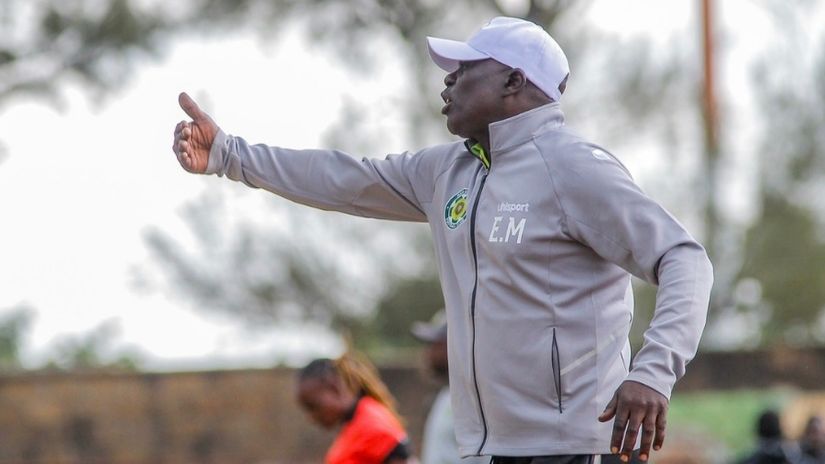
Gor, meanwhile, defended with a relatively high line and were aggressive in aerial duels, which proved decisive in nullifying Mara Sugar’s frequent long-ball restarts and second-ball attempts.
In build-up, Gor Mahia displayed clear structural flexibility. While nominally in a back four, their possession shape often morphed into a situational back three.
When Ochuoga advanced aggressively from right-back, Kibwage or Alpha Onyango would slide across, maintaining balance to the right side, while Sylvester Owino held the left side.
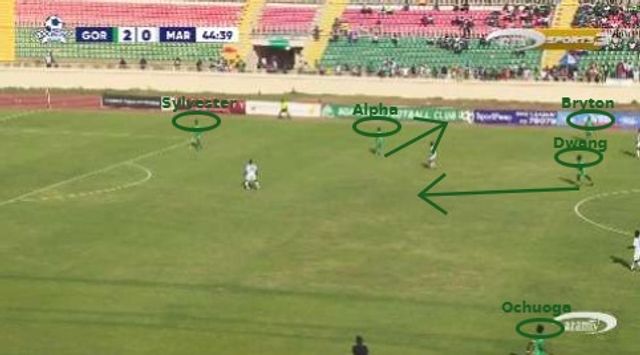
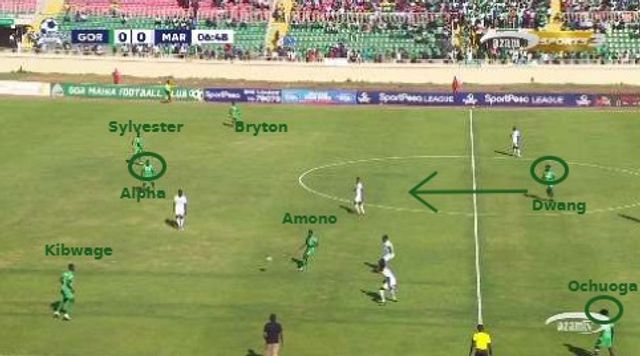
This adjustment eventually allowed Gor to push both fullbacks high, stretch Mara Sugar horizontally, and maintain security against counters.
Dwang’s tendency to drop into deeper pockets created numerical superiority in midfield, enabling Gor to bypass Mara’s first line of pressure with ease.
A recurring attacking theme was Gor Mahia’s left-sided overload. Bryton Onyona pushed high to combine with Shariff Musa, while Amono or Dwang drifted across to add an extra body between the lines.
This concentration of numbers on the left consistently forced Mara Sugar to shift across, opening up space on the opposite flank.
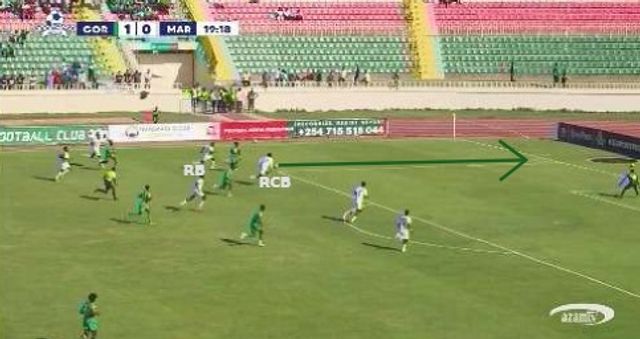
Gor exploited this by switching play quickly to the right, where Adukwaw or Ochuoga could receive in isolation. Mara Sugar maintained a relatively high defensive line without sufficient pressure on the ball.
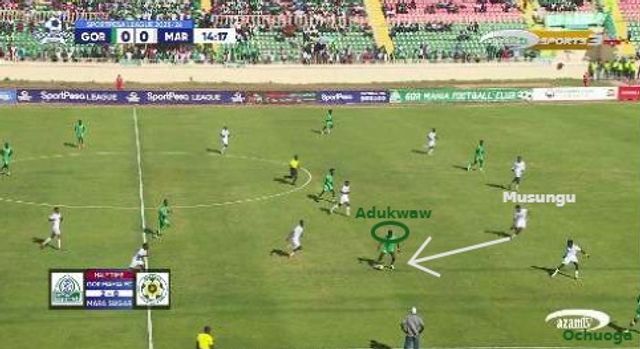
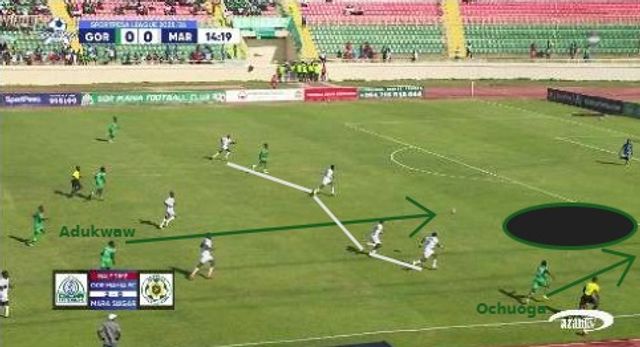
The opening goal in the 14th minute encapsulated this logic which seemed to work on the left wing: Adukwaw dropped into the right half-space approaching midfield to receive, drew a defender, and released Ochuoga on the overlap, whose cross was finished by Felix Oluoch.
Mara Sugar’s main offensive threat came from set-pieces and transitional moments.
Harun Thomas frequently looked to exploit the space left by Ochuoga’s advanced positioning, targeting the channel behind Gor’s right-back with early long passes to Aineah Ndete.
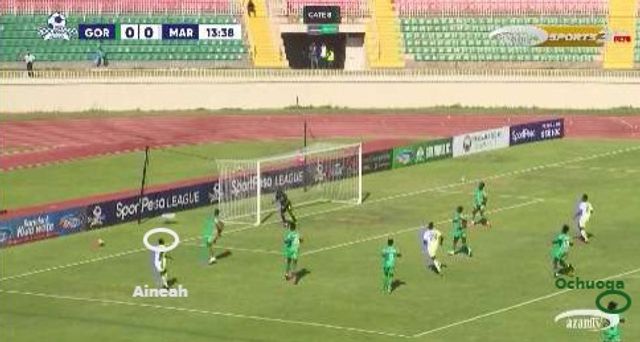
However, Gor’s rest-defence structure - anchored by Alpha Onyango and supported by disciplined centre-back positioning - limited the effectiveness of these transitions. Gor consistently won first contacts and reacted quicker to loose balls, preventing Mara from sustaining pressure.
The second goal further highlighted Gor’s exploitation of structural weaknesses. Dwang’s intelligent movement into the left half-space drew markers, and his delayed cutback found Shariff Musa, who had timed his run into the box perfectly to finish in the 29th minute.

Again, the chance originated from wide progression and poor defensive spacing from Mara.
As the first half progressed, Gor tightened their control. Alpha Onyango acted as a deep-lying playmaker, dictating tempo and switching play, while Dwang’s dropping movements overloaded Mara’s midfield line.
Gor’s intensity in duels also forced Mara Sugar into fouls, disrupting any rhythm the visitors attempted to build.
In the second half, Mara Sugar adjusted by pressing higher and switching to a clearer 4-4-2 out-of-possession structure.
The front two attempted to screen Alpha Onyango, forcing Gor to build more directly and pushing Dwang deeper to assist progression.
This change reduced Gor’s short build-up options but did not fundamentally alter the balance of the game. Gor responded intelligently by dropping their wingers deeper to aid second-phase build-up and by targeting quick counter-attacks once possession was regained, particularly through the explosive Shariff Musa.
Mara Sugar’s substitutions around the hour mark added energy, and their off-ball compactness improved, with closer distances between lines.
However, they still lacked creativity in the final third and struggled to create clear chances. Gor, by contrast, managed the game state expertly, slowing the tempo, circulating possession, and waiting for moments to attack decisively.
In the closing stages, Gor became more conservative with their fullbacks, prioritizing rest-defence and relying on early crosses rather than sustained overlaps.
This approach paid off in the 86th minute, when Jackson Dwang delivered a deep pass to release a late runner from the right. Assifuah’s intelligent movement dragged defenders away, allowing Kapen to arrive unmarked and finish first time to seal the match.
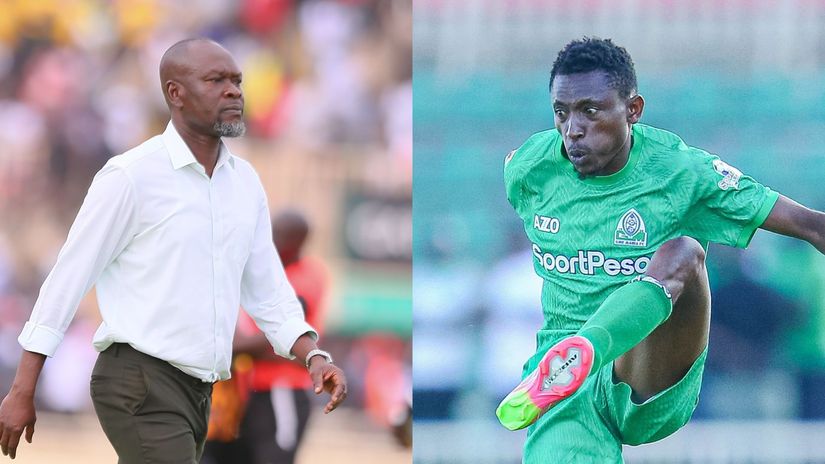
Eventually, Gor Mahia’s consistent exploitation of wide areas, control of second balls, and ability to alter tempo once ahead ensured Mara Sugar were rarely allowed to build sustained pressure.
While the visitors showed brief improvements after adjusting their pressing structure in the second half, their inability to create numerical or positional superiority in advanced zones limited their threat.
Gor Mahia’s dominance was therefore not only reflected in the scoreline, but in their control of space, rhythm, and transitions.