


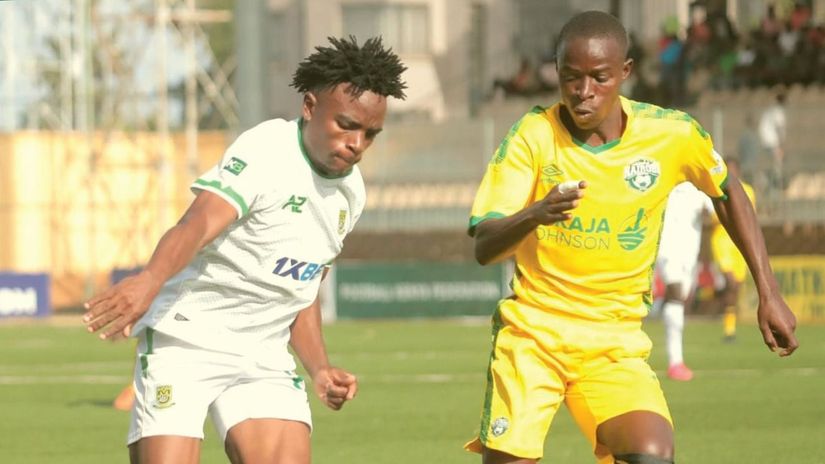
TACTICAL ANALYSIS: How John Kamau’s shrewd substitutions helped Mathare regain control, beat Nairobi United

.jpg)




Reading Time: 5min | Fri. 05.12.25. | 19:44
Mathare ultimately sealed a 1–0 away victory through Paul Kinyanjui’s late strike, but the scoreline alone barely captures the complex tactical dynamics that shaped the match
The clash between Nairobi United and Mathare United unfolded, with rich tactical battle defined by structural adaptability, high-risk pressing and shifting control patterns being witnessed in both halves.
Mathare ultimately sealed a 1–0 away victory through Paul Kinyanjui’s late strike, but the scoreline alone barely captures the complex tactical dynamics that shaped the match.
Both sides operated primarily from a 4-3-3 base structure yet interpreted it in very different ways, leading to a matchup of contrasting principles.
From kickoff, Nairobi United adopted a clear 4-3-3, with Kevin Oduor in goal and a back four of Wafula David, Lennox Ogutu, John Otieno, and the ultra-progressive left-back Kevin Osanya.
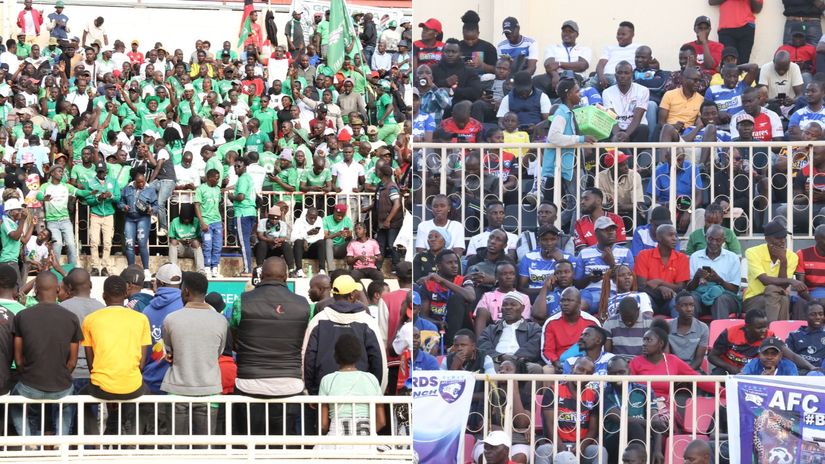
In possession, their structure resembled a 2-3 base in early phases, with deep midfielder Brian Mzee operating as a single pivot responsible for screening transitions but also helping form the buildup triangle behind advancing interior midfielders.
Mzee’s positional discipline allowed Lesley Owino and Enock Machaka to take up advanced roles between the lines, frequently drifting into half-space lanes to create overloads with the wingers or rotate with the striker in shadow pockets.
![Bajaber scores on debut for Simba as Yanga's Abuya bags Man of the Match award [VIDEO]](https://cdn3.mozzartsport.co.ke/upload/825x464/News/Image/2025_12/1764910257447_Untitled_design_-_2025-12-05T074949.333.jpg)
Out wide, Majaliwa Charo and Shami Mwinyi provided the team’s key mechanisms for progression.
They dropped intelligently to connect with the fullbacks, especially Osanya, whose marauding surges often formed the basis for Nairobi’s left-side overloads.
Meanwhile, striker Frank Ouya acted as a classic linking nine: receiving under pressure, rolling defenders, and guiding possession into wide or half-space channels.
These connections allowed Nairobi to repeatedly access the half-spaces, particularly through Ogutu’s diagonal forward passes – an important recurrent pattern that helped them bypass Mathare’s first pressing line.
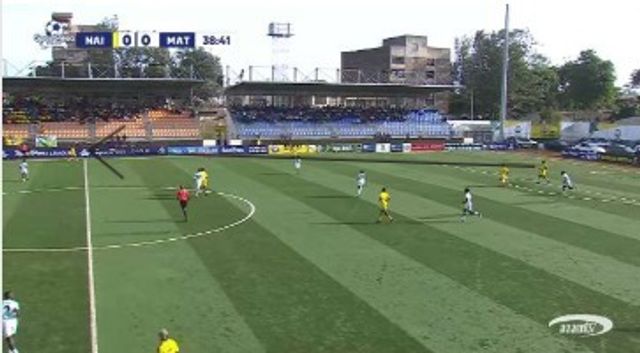
Lennox Ogutu repeatedly broke lines with direct diagonal switches into wide areas, targeting winger runs to exploit space behind Mathare’s press.
Defensively, Nairobi oscillated between a 4-1-4-1 high press and a 4-4-2 mid-block, depending on the phase.
Their pressing triggers were primarily horizontal passes into Mathare’s fullbacks or moments of heavy touch from goalkeeper Kevin Ouru.
When set in the 4-4-2, Nairobi’s wingers narrowed to protect central lanes while denying easy switches; this helped compress Mathare’s early attempts at wide overloads.
Mathare United also set up initially in a 4-3-3, but theirs was a far more fluid interpretation.
In deep buildup, pivot Brian Ochieng regularly dropped between centre-backs Ian Omondi and Francis Kayugi, enabling both fullbacks – Fidel Otieno on the right and Herit Mungai on the left – to push very high or invert into the half-spaces to receive behind Nairobi’s first press.
This allowed Mathare to form a 3-2 base that progressed the ball with patience and numerical superiority.
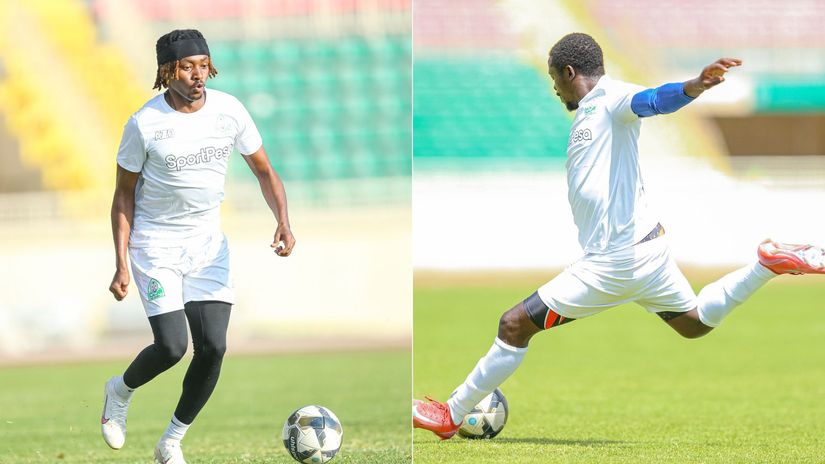
Above the pivot, Mohamed Kilume provided control and distribution before his injury-induced withdrawal in the 37th minute.
His influence was crucial: he consistently found solutions through pressure, broke Nairobi’s second line, and allowed advanced midfielder Brian Ouru to take positions between the lines or drop deeper to overload midfield.
Their wide progression relied heavily on 3v2 overloads, particularly early down the right, but Nairobi recognized the threat quickly and collapsed space aggressively, preventing Mathare from generating high-quality chances.
Still, Mathare’s high defensive line, man-oriented press, and shadow-marking schemes remained the standout tactical feature of the first half.
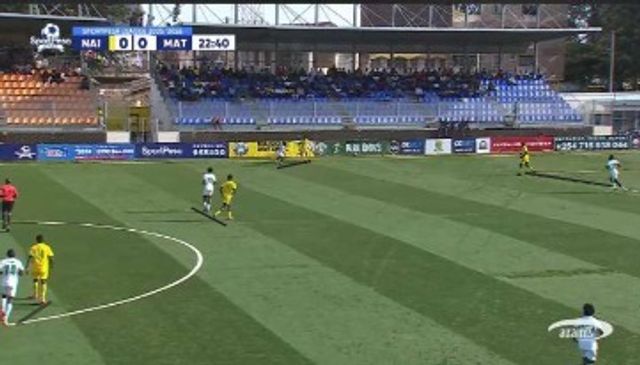
Mathare United’s high, aggressive man-oriented press - led by Denis Okoth their striker curving his run to cut the RCB’s passing lane while initiating pressure on the goalkeeper - created a synchronized trap that repeatedly disrupted Nairobi United’s buildup.
Their synchronised forward press forced Nairobi’s attackers into deeper zones, reducing vertical threat and enabling Mathare to regain possession in favourable areas.
Crucially, the high line also served as a spatial control mechanism: frequent offsides disrupted Nairobi’s rhythm and prevented them from launching runners behind the defence.
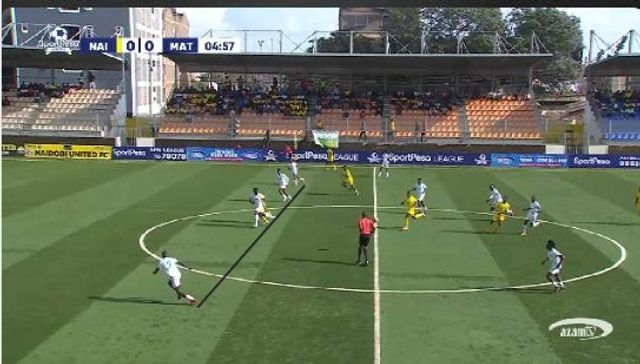
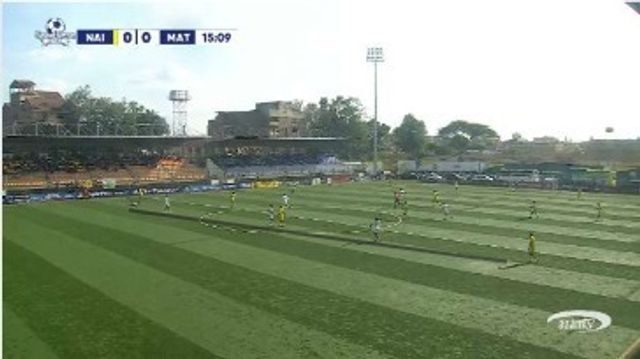
Mathare United’s highly synchronized high defensive line repeatedly caught Nairobi United’s forwards offside, at times pushing as far as the halfway line to compress space and maintain territorial control.
In defending corners they used a hybrid marking system with two split zonal markers in near post and one guarding the goalmouth with man markers tracking runners and potential aerial targets, Musa Masika remained high, while Kinyanjui positioned to both guard short options and support transition opportunities.
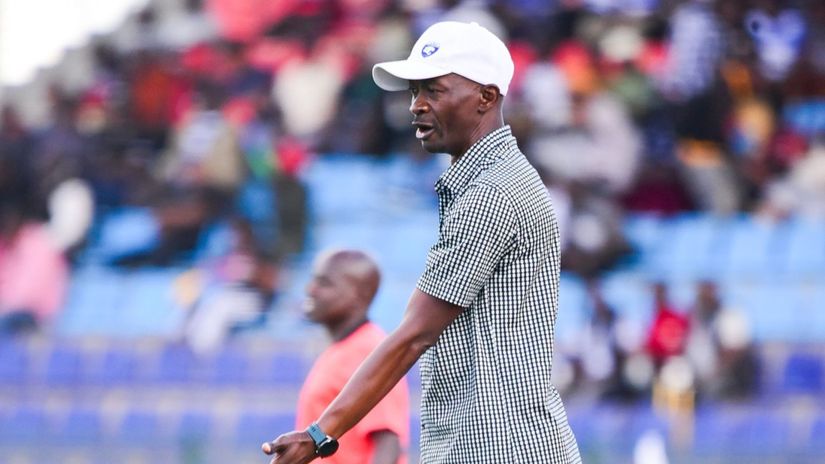
After Kilume’s exit, Mathare shifted into a 3-4-3/3-2-5 in possession and a 4-2-4 out of possession.
The fullbacks increasingly operated in the half-spaces, wingers held extreme width, and the pivot continued dropping to create the first line of three.
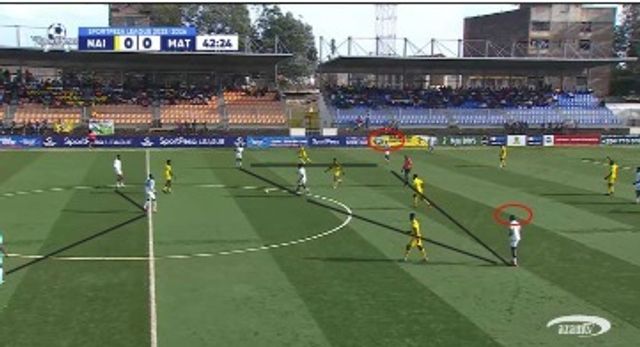
Mathare’s advanced-possession structure morphed into a 3-4-3, with Brian Ochieng dropping between the centre-backs, fullbacks pushing and inverting into the half-spaces, and wingers stretching play by hugging the touchline.
This adjustment increased their ability to circulate possession but slightly reduced their central control since Kilume’s vertical passing was no longer available.
Still, the structure created new pathways down the flanks, particularly toward Kinyanjui and Masika, whose wing rotations added unpredictability.
The second half opened with Mathare immediately seeking faster transitions, mostly channeled through the right wing.
Nairobi responded with attacking substitutions (Michael Karamor and Dancan Omalla), attempting to inject directness and stretch Mathare’s defensive line.
For a period, Mathare struggled to rebuild from the back, lacking the midfield stability they enjoyed, with Kilume initially and facing increasing pressure in deeper zones.
The game rebalanced after Mathare’s double substitution in the 68th minute: Sammy Imbuye replaced Mungai and Donald Ange coming in for striker Dennis Okoth.
These switches triggered structural adjustments: Fidel Otieno shifted from right-back to left-back, Imbuye moved to right-back, and with Ange adding hold-up presence, Mathare regained their attacking foothold around minute 70.
Their rest-defense improved, and they once again accessed wide channels with clarity.
The decisive moment arrived in the 82nd minute.
A seemingly routine sequence turned dangerous when Nairobi centre-back John Otieno miscued a clearance from a Masika pass.
The loose ball fell to Kinyanjui, who capitalized clinically: Nairobi United 0–1 Mathare United.
Chasing the game, Nairobi United committed numbers forward and relied heavily on Omalla’s long throws, creating chaotic moments in the Mathare penalty area.
Quick-fire transitions also offered half-chances, but Mathare’s compact penalty-box defending and disciplined high line held firm.
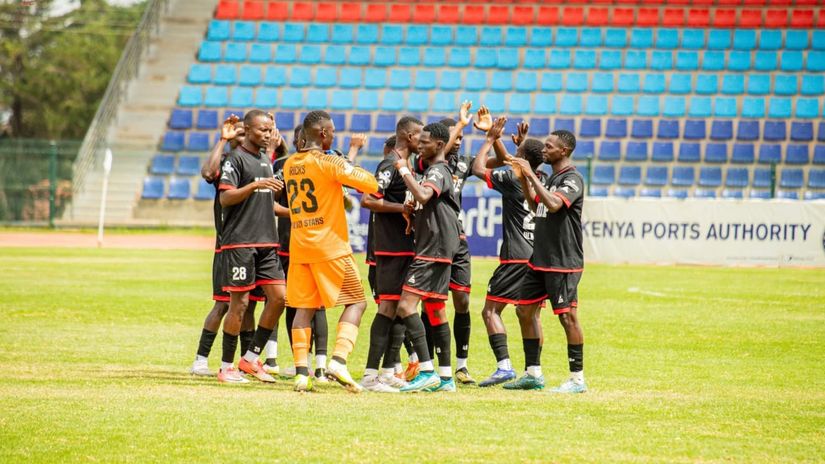
In the end, Mathare United’s blend of structural fluidity, aggressive pressing, coordinated high line, and wide transitional threat earned them a valuable win.
Nairobi United played with control and tactical maturity but were undone by a late defensive lapse and Mathare’s capacity to adapt their structure effectively across phases.