



TACTICAL ANALYSIS: How Nairobi United suffocated Bandari under Dandora sun to claim third win of season

.jpg)




Reading Time: 5min | Wed. 05.11.25. | 19:03
When possession was lost, Bandari transitioned into a 5-4-1 low block, trying to compress central spaces
Under the afternoon sun, Nairobi United produced a tactically disciplined, and energetic, display to defeat Bandari FC 3–1 in a 2025 FKF Premier League clash at Dandora Stadium.
Both teams came into the encounter aiming to assert their tactical identity.
Nairobi United sought to continue their organised, high-tempo approach under their evolving 4-3-3 system, while Bandari hoped to dominate possession and exploit the half spaces, with their technical midfielders.
What unfolded was a fascinating tactical duel defined by structure, pressing triggers, and intelligent space occupation - with Nairobi United ultimately prevailing through superior in-game adaptability and transition play.
Follow our WhatsApp channel for more news
Nairobi United began in a 4-3-3 structure, displaying excellent organization from the outset.
Bernard Jairo started in goal behind a backline of:Yusuf Mainge, Prince Buregeya, John Otieno, and Kevin Otiende.
In midfield, Brian Mzee anchored as the primary pivot, providing balance and cover, while Lesley Owino and Enock Machaka played more advanced roles - the latter being the creative link between midfield and attack.
The front three of Dancan Omalla, Ovella Ochieng, and Michael Karamor offered dynamic movement across the attacking third.
Bandari mirrored the same 4-3-3 formation with Levis Opiyo in goal, Omar Rajab and Joseph Onyango as fullbacks, and a center-back pairing of Andrew Juma and Shariff Amubwombe.
In midfield, Clifford Otieno Ouma sat deepest as a pivot, flanked by Geoffrey Ojunga and Tsuma Said, while Hassan Abdala, David Sakwa, and Ngamchiya Amza formed the front three.

From the first whistle, Nairobi United’s tactical plan was clear: minimise build-up risks and attack directly into half spaces.
Their early phases involved short exchanges between the center-backs and the goalkeeper before hitting long diagonals toward the wingers and their striker.
This approach pinned Bandari’s fullbacks deep and disrupted their pressing rhythm.
The opening goal came in the sixth minute, a reward for Nairobi United’s set-piece proficiency.
After consecutive corners, Buregeya rose highest to head home, capitalising on Bandari’s zonal confusion inside the box.
This was a hallmark of Nairobi United’s rehearsed set-play system - using targeted deliveries and blocking runs to create separation in the central zones.
Karamor’s movement between the lines was instrumental; he frequently dropped into the half spaces to link play and allow Ovella and Omalla to attack the vacated channels.
Meanwhile, Machaka thrived as the advanced playmaker, providing vertical passes and late arrivals into the box.
Bandari, on their part, sought to build from the back in a 3+1 structure - with Ouma dropping between the center-backs and the goalkeeper joining as an extra outfield player.
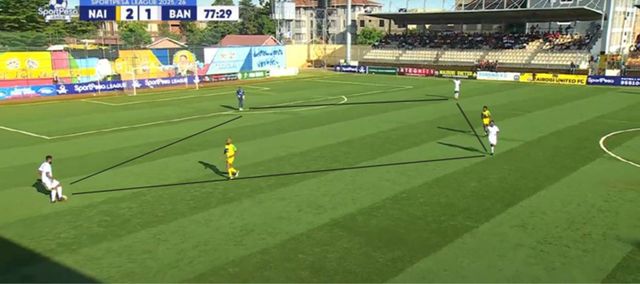
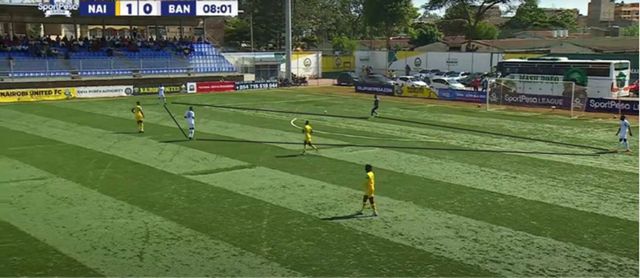
Bandari’s 3+1 build-up shape - Clifford Ouma dropping between the centre-backs with the goalkeeper stepping in to create a plus-one in the first line of circulation.
Their progression was methodical but often slowed by Nairobi United’s compact pressing block.
When possession was lost, Bandari transitioned into a 5-4-1 low block, trying to compress central spaces, but struggled to contain Nairobi’s fluid rotations.
Their equalizer came against the run of play in the 38th minute, when Ojunga struck from distance after Tsuma drew a defender out of position, creating a gap through which the ball bounced past the goalkeeper.
Before halftime, Nairobi United continued to threaten with wing switches and early crosses, while Bandari relied on long goal-kicks and diagonal restarts to bypass pressure.
The first half ended 1–1, though Nairobi United’s intensity and structural discipline hinted that more was to come.

Nairobi United made a key change at halftime, introducing Kevin Oduor in goal for the injured Jairo, but maintained their shape.
Bandari sought to establish more control in the final third through shorter combinations in the half spaces instead of early crosses.
However, Nairobi United’s defensive structure evolved smartly into a 4-1-3-2/4-4-2 mid-block, allowing them to close down passing lanes while maintaining counter-attacking potential.
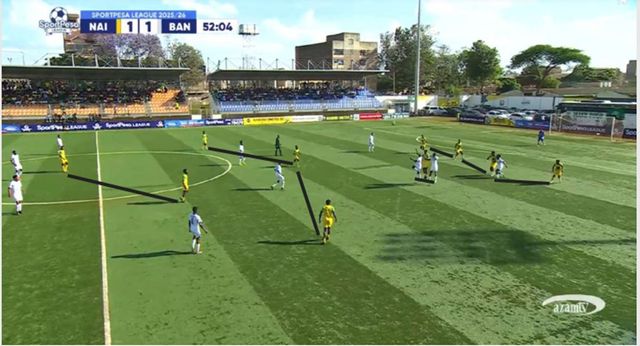
Nairobi United’s defensive shape morphed into a compact 4-1-3-2/4-4-2 mid-block, effectively sealing central lanes while staying primed for quick rapid transitions.
Their pressing triggers were clear - once the ball was played to a Bandari midfielder facing his own goal, the nearest Nairobi player jumped to press, supported by compact lines behind.
This created turnovers and rapid transitions.
In the 53rd minute, the hosts regained the lead.
After a sharp attacking sequence, Omalla drew the goalkeeper off his line with a close range shot, leading to a handball from Juma at the goal mouth.
Machaka calmly converted the resulting penalty in the 55th minute to make it 2–1.
Bandari attempted to respond by creating third-man runs and passing triangles in and around the half spaces/wide areas, seeking to pull Nairobi’s defenders out of position.
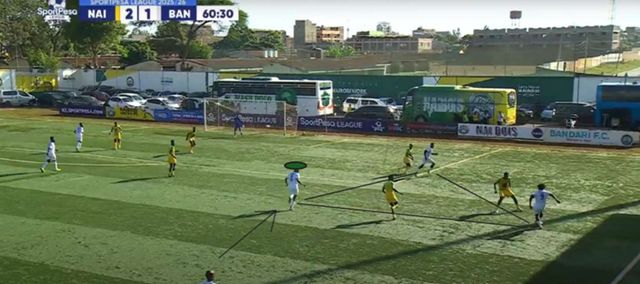
Bandari created dynamic passing triangles in the wide and half-space zones, with their fullback making continuous under lapping runs to facilitate third-man combinations in the final third.
Their fullbacks pushed high, and Clifford Ouma often dropped into the backline to balance the shape.
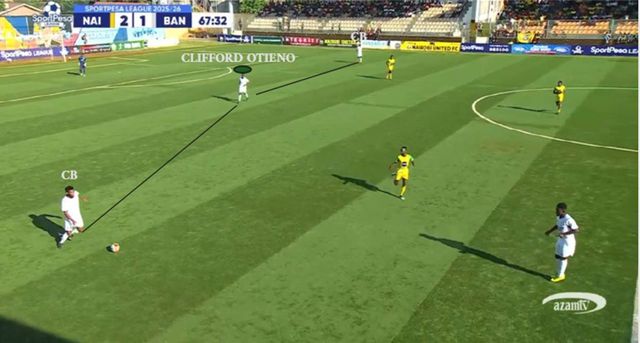
Bandari’s fullbacks advanced high up the pitch, while Clifford Ouma dropped into the backline to maintain structural balance during build-up.
However, Nairobi’s disciplined back four, aided by Mzee’s intelligent screening, repeatedly closed down spaces and forced Bandari wide.
The introduction of Shami Mwinyi in the 70th minute for Karamor added fresh dynamism up front.
Mwinyi’s profile - pacey and direct - perfectly exploited Bandari’s high defensive line.
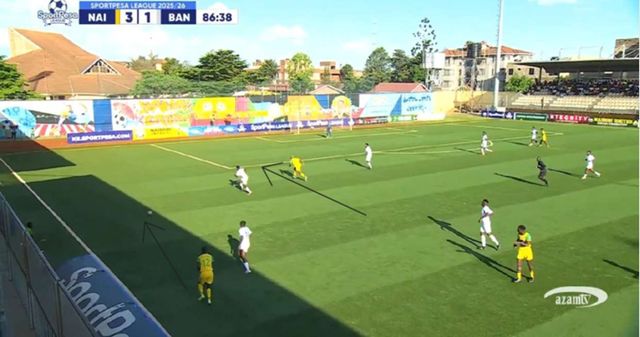
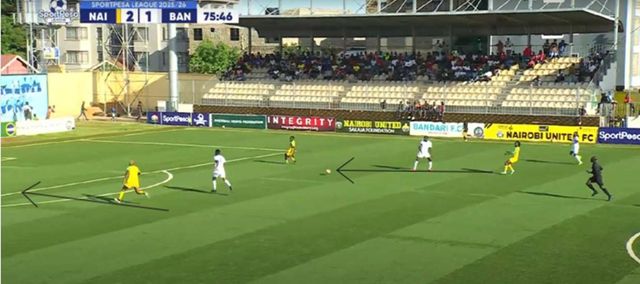
Shami’s well-timed vertical and horizontal runs disrupted Bandari’s defensive shape, stretching their backline after clever setups from his teammates.
Within moments, he had two shots saved in succession by Opiyo, demonstrating the danger he posed in transition.
As the game wore on, Nairobi United’s shape compacted further into a narrow 4-4-2, focusing on counter-attacking through Omalla and Mwinyi.
.jpg)
The third and decisive goal arrived in the 85th minute - a superb transition move with Omalla’s back-heel pass to Mwinyi, who cut inside from the left before finishing with precision into the far corner.
It ended 3-1 to Nairobi United, with both sides having displayed moments of quality, but Nairobi United capitalized on key opportunities to maintain control of the game.
Bandari enjoyed decent spells of possession and created chances through wide combinations, but lapses at the back proved costly.

In the end, Nairobi United’s efficiency in front of goal and better game management made the difference in a competitive clash.