


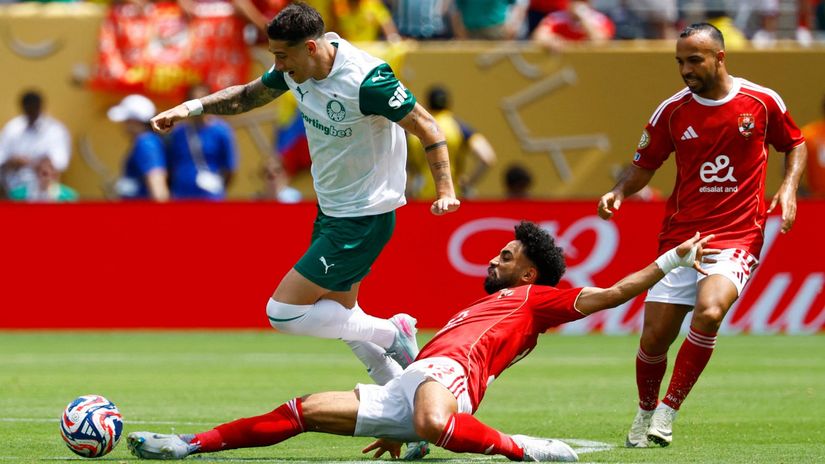
TACTICAL ANALYSIS: How Palmeiras stormed past possession-heavy Al Ahly

.jpg)
.jpg)
.jpg)



Reading Time: 5min | Sat. 21.06.25. | 16:34
In tactical terms, this was a game of contrasts. Al Ahly controlled the ball but failed to control space or threat
Al Ahly’s hopes of progressing from Group A in the FIFA Club World Cup suffered a significant setback following a 2-0 defeat to Brazilian record champions Palmeiras.
Follow our WhatsApp channel for more news
Despite enjoying 65% of the possession, Jose Riveiro’s side found themselves tactically outmanoeuvred by Abel Ferreira’s Palmeiras, who executed a calculated and disciplined game plan centred around defensive compactness, spatial control, and transition-based attacking.
Tactical Setups and Philosophies
Al Ahly adopted a 4-2-3-1 structure in their starting shape, but as has become characteristic of possession-based systems, the shape transformed during different phases of play.
In the attacking phase, Al Ahly morphed into a 3-2-5 configuration, a structure designed to facilitate positional play, vertical progression, and final-third overloads.
Palmeiras, on the other hand, deployed a pragmatic approach. While they nominally lined up in a 4-3-3, they ceded possession by design, recording just 35% of the ball.
Rather than build from the back, Ferreira instructed his team to go direct, aiming to exploit spaces behind Al Ahly’s high defensive line and take advantage of transitions.
Al Ahly’s Build-Up Mechanics
The record African champions' build-up structure was deliberate and layered. In the first phase, the centre-backs split wide while the ball-side fullback stayed deep to form a situational back three.
This was aimed at providing numerical superiority against Palmeiras’ first pressing line. When both fullbacks advanced simultaneously, Marwan Ateya, primarily a central midfielder, dropped into the backline—usually into the right-back position—to support the build-up and offer balance in rest defence.
The midfield structure was equally dynamic. With Ateya dropping deep, Mohamed Romdhane, who began the game as a central attacking midfielder, dropped alongside Emam Fathy to form a temporary double pivot.
This allowed Zizo, initially positioned on the right wing, to move inside and receive the ball between the lines, acting as a secondary playmaker.
This kind of rotational movement, aimed at fluidity and vertical occupation, gave Al Ahly strong control in central zones. However, Palmeiras’ low block and disciplined spatial management ensured that Al Ahly’s possession remained largely sterile.
The 0.10 xG (expected goals) from just four shots highlighted the difficulty Al Ahly had in creating quality chances despite their dominance on the ball.
Palmeiras’ Defensive Strategy
Palmeiras’ game plan was built around deliberate off-ball compactness and counter-attacking threat. They allowed Al Ahly to have possession but forced them into wide and deep zones, where their circulation was less threatening.
Ferreira’s side did not press high or attempt to contest central build-up areas aggressively; instead, they used a mid-block, covering central lanes and waiting for opportunities to pounce in transition.
Key to this defensive strategy was the management of Trezeguet, Al Ahly’s most direct and explosive attacker.
The Brazilian side made a conscious effort to contain the former Aston Villa winger by forcing him wide and onto his weaker foot. He was closely tracked and denied the opportunity to cut inside, rendering his threat marginal.
Palmeiras’ most intense defensive attention was reserved for Estevao, their own teenage star who drew double and sometimes triple coverage from Al Ahly.
Despite Al Ahly’s tight marking, Estevao’s technical quality and quick feet remained a constant worry—his ability to take on defenders 1v1 and either whip in crosses or cut inside on his stronger right foot made him the focal point of Palmeiras’ attacking transitions.
Transition Moments and Goals
The match hinged on two moments that exemplified Palmeiras’ tactical efficiency. The first was an own goal by Abou Ali in the 59th minute, which came as a direct consequence of Al Ahly’s high defensive line on set-pieces.
Their intent was to give the goalkeeper clearer sightlines and freedom to attack the delivery, but the downside was the backpedalling defending, which made it difficult to react to dynamic aerial challenges. The misjudged clearance under pressure typified the risks associated with this approach.
The second goal arrived via Flaco Lopez, a product of Palmeiras’ direct attacking transitions. With Al Ahly committing numbers forward and their structure stretched, Palmeiras countered rapidly through central channels.
.jpg)
The goal underscored the vulnerabilities in Al Ahly’s rest defence, especially when their midfield was caught in high zones and unable to recover.
Set-Piece Strategies
Al Ahly also attempted to leverage set-pieces to force opportunities. They crowded the penalty area during corners, aiming to exploit their physicality, but Palmeiras managed to match them aerially and maintained a disciplined marking scheme that minimised second-ball threats.
On the other end, Palmeiras kept their deliveries dangerous by targeting the space behind Al Ahly’s high line, putting pressure on the goalkeeper and defenders to deal with balls while retreating.
Overview
In tactical terms, this was a game of contrasts. Al Ahly controlled the ball but failed to control space or threat. Their positional rotations and possession mechanics demonstrated technical sophistication, but lacked the incision and vertical threat required to trouble a disciplined defensive unit.
Palmeiras, on the other hand, showcased the effectiveness of well-organised, transition-based football. Their efficiency in creating meaningful opportunities with limited possession, as shown by their xG of 1.42 compared to Al Ahly’s 0.10, was decisive.
As the group progresses, Al Ahly now find themselves at the bottom of Group A, with their final fixture against FC Porto becoming a must-win.
For Jose Riveiro, the challenge lies in balancing structural dominance with penetrative threat. Possession must now translate into chances, or Al Ahly’s campaign could end earlier than expected.