


TACTICAL ANALYSIS: How Spain Controlled, Suffocated, and Conquered Argentina in the 2026 World Cup Final




Reading Time: 6min | Wed. 22.07.26. | 12:18
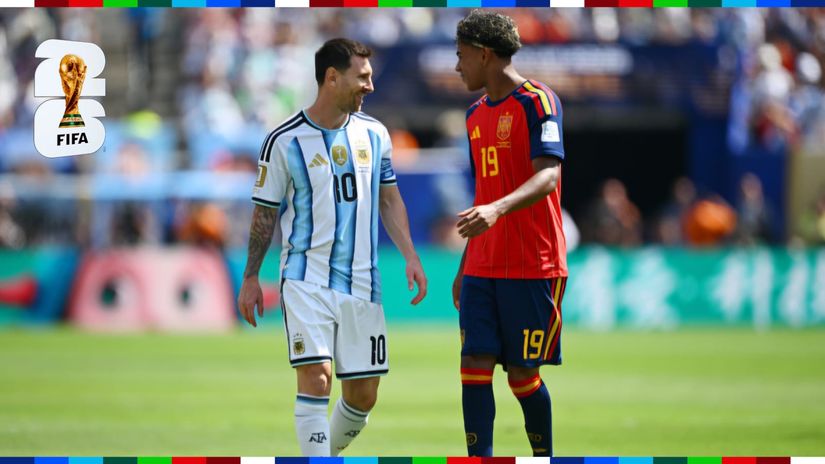
Spain captured their second men’s World Cup trophy with a dramatic 1-0 extra-time victory over Argentina, mirroring their iconic 2010 triumph in Johannesburg through an unyielding commitment to positional football
The 2026 FIFA World Cup final in New Jersey did not deliver an open, end-to-end goal fest, but rather an absolute masterclass in structural dominance, spatial control, and positional superiority.
Download Our MozzartSport App For More News
Spain captured their second men’s World Cup trophy with a dramatic 1-0 extra-time victory over Argentina, mirroring their iconic 2010 triumph in Johannesburg through an unyielding commitment to positional football.
While Spain came to dictate terms, Lionel Scaloni’s Argentina arrived intent on disrupting, frustrating, and surviving.
Ultimately, Ferran Torres’s late strike in the second half of extra time - becoming just the fifth substitute to score in a World Cup final - sealed a tactical conquest where field tilt, counter-pressing, and structural stability systematically dismantled a dogged, aggressive opponent.
Tactically, Luis de la Fuente lined up Spain in a flexible 4-1-2-3 base shape. Unai Simón started between the posts behind a back line featuring Pedro Porro, Pau Cubarsí, Aymeric Laporte, and Marc Cucurella.
Rodri anchored the midfield as the single pivot, flanked by Fabián Ruiz while Dani Olmo roamed behind a front line featuring Lamine Yamal on the right,
Álex Baena on the left and Mikel Oyarzabal operating centrally. In possession, this structure transformed dynamically into a 3-1-6 or 2-3/2-4 build-up matrix, designed to stretch Argentina's back line while locking down rest-defense zones.
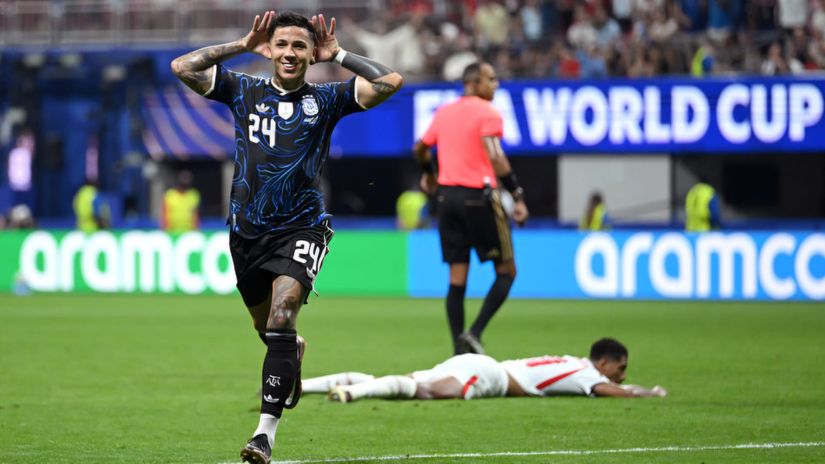
Argentina deployed a traditional 4-4-2 base formation. Emiliano Martínez marshaled a defensive line consisting of Gonzalo Montiel, Cristian Romero, Lisandro Martínez, and Nicolás Tagliafico.
The midfield bank saw Rodrigo De Paul and Enzo Fernández operating alongside Alexis Mac Allister, with Nicolás González deployed wide on the left to assist Tagliafico defensively.
Up front, Julián Álvarez partnered Lionel Messi. Out of possession, however, Argentina’s shape morphed into an aggressive, man-oriented mid-to-high block, while in possession they occasionally attempted to build in a 4-3-3 or a 4-box-2 setup with an 8 dropping deep alongside the 6.
Argentina’s defensive scheme was built around high physical intensity and man-oriented jump triggers. Out of possession, Scaloni instructed his side to go man-to-man in advanced areas to prevent Spain from executing clean central progression.
The core mechanism relied on central jumps: Alexis Mac Allister jumped out of the midfield line to lock onto Rodri, while Argentina’s aggressive center-backs - primarily Cristian Romero - stepped far out of the defensive line to engage Mikel Oyarzabal or Dani Olmo the moment they dropped deep.
Argentina accepted the physical toll of this approach, committing 25 fouls throughout the contest to break Spain's rhythm - the most by any team in a World Cup match since their own 2022 final against France.
Conversely, Spain maintained a largely zonal defensive structure with a +1 numerical superiority in the back line.
Spain’s frontline locked on man-to-man high up the pitch, ensuring Argentina’s spare man was consistently isolated on the far side and rendered inaccessible due to aggressive shadow-marking.
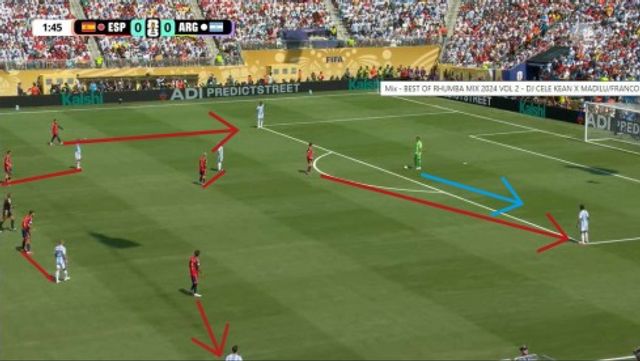
By controlling spaces rather than chasing individual opponents, Spain restricted Argentina to zero shot attempts across the entirety of regulation time.
Spain’s progression from Phase 1 was a masterclass in structural manipulation. When building from the back, Spain’s center-backs moved wide to maximize their field of view and passing angles. De la Fuente utilized two main build-up variations to bypass Argentina’s press:
- The 3-1-6 Progression: Rodri would drop directly into the backline between Cubarsí and Laporte or alongside them, pushing Fabián Ruiz into a lone deep pivot role. Simultaneously, one full-back pushed high into the attacking line on a different vertical plane than the winger, while the opposite full-back tucked inside.
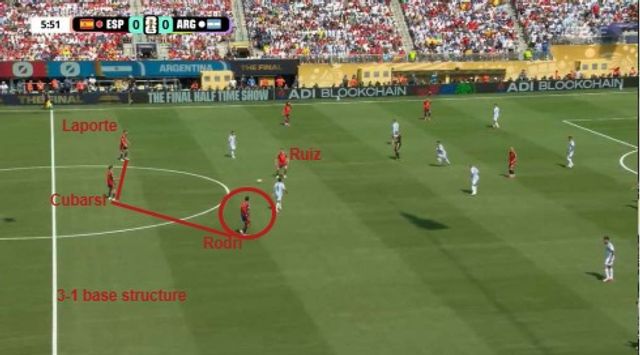
- The 2-3 Inverted Base: Both full-backs tucked into the half-spaces alongside Rodri, creating a dense central wall that forced Argentina’s wide players to narrow their defensive focus.

The key rotational mechanism involved Mikel Oyarzabal and Dani Olmo. Oyarzabal repeatedly dropped deep into the interior channels to act as a false nine, dragging Cristian Romero or Lisandro Martínez out of the back line.
This created a third-man combination trigger: as Oyarzabal drew the center-back, he executed one-touch layoffs to the roaming Olmo or advancing central midfielders, who then attacked the vacated space in Argentina’s defensive line.
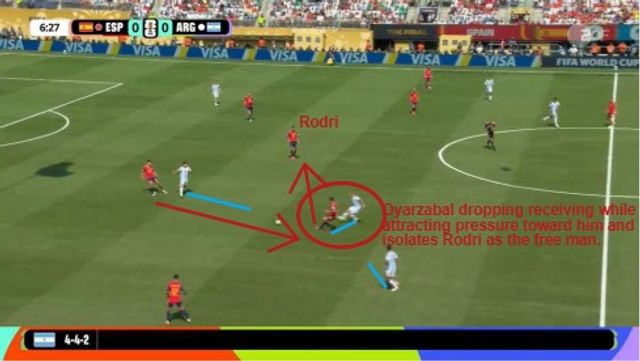
While Argentina’s man-oriented central jumps initially disrupted Spain's flow, it introduced catastrophic structural risk. Every time Romero or Lisandro Martínez jumped into midfield to duel with Oyarzabal, Argentina's back four was reduced to a makeshift three-man line with immense gaps in the channels.
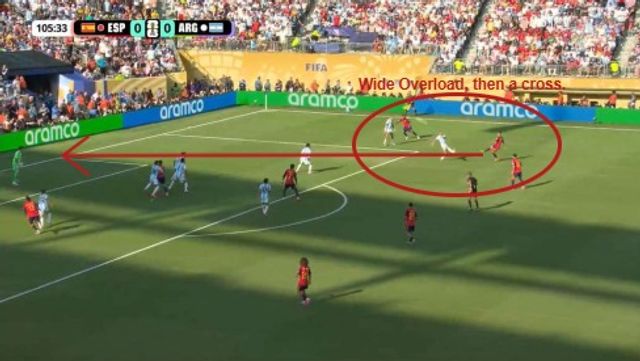
Spain systematically exploited this by overloading the wide areas through Porro and Lamine Yamal, forcing Argentina into desperate aerial and ground duels.
When Argentina tried to escape pressure via direct long balls toward Nicolás González on the inside-left or Julián Álvarez through the inside-right channel, Spain’s rest-defense completely neutralized the threat.
Spain’s 2-3 rest-defense structure - anchored by Rodri and the inverted full-backs - acted as an impenetrable barrier.
The moment Spain lost possession, their immediate counter-pressing suffocated Argentina’s transition triggers before they could sequence 4 or 5 consecutive passes. Rodri continuously shadowed Lionel Messi whenever the Argentine captain drifted centrally, forcing Messi into wider, non-threatening areas where he was deprived of central passing lanes.

The statistical landscape illustrates a night of total territorial and operational dominance by Spain:
Argentina’s offensive paralysis was staggering: Scaloni’s side did not record a single shot until the 26th minute of extra time.
Spain’s +18 shot differential (20 to 2) marks the second-largest gap ever recorded in a World Cup final, behind only West Germany’s +22 against Argentina in 1990.
The game state deteriorated rapidly for Argentina as physical exhaustion set in. Forced substitutions saw both of Argentina’s primary center-backs - Lisandro Martínez and Cristian Romero - leave the pitch due to injuries sustained from relentless jumping and dueling.
Argentina’s lack of pure wide dribblers left them without a reliable out-bullet to relieve pressure. In extra time, De la Fuente introduced Nico Williams and Mikel Merino to inject direct, wide isolation threat and second-ball power.
Argentina’s composure fractured when Enzo Fernández received a second yellow card for a late, cartwheeling challenge on Pau Cubarsí, making him only the sixth player sent off in a World Cup final.
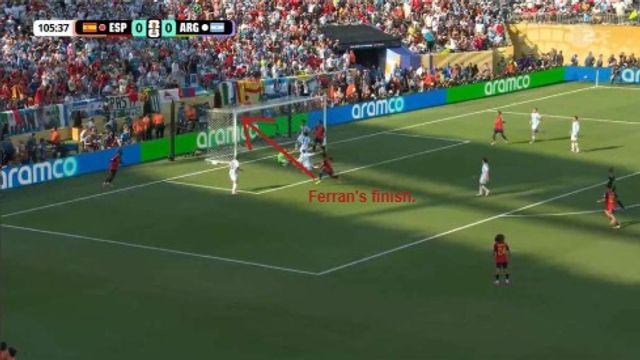
With Messi physically limited off the ball and Argentina effectively reduced to nine functional defenders, Spain broke the deadlock in the second period of extra time.
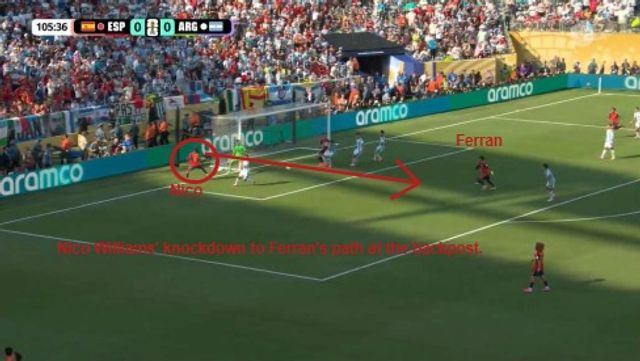
A wide overload allowed substitute Nico Williams to head a cross down into the box, where Ferran Torres lashed the ball home to seal the World Cup trophy.
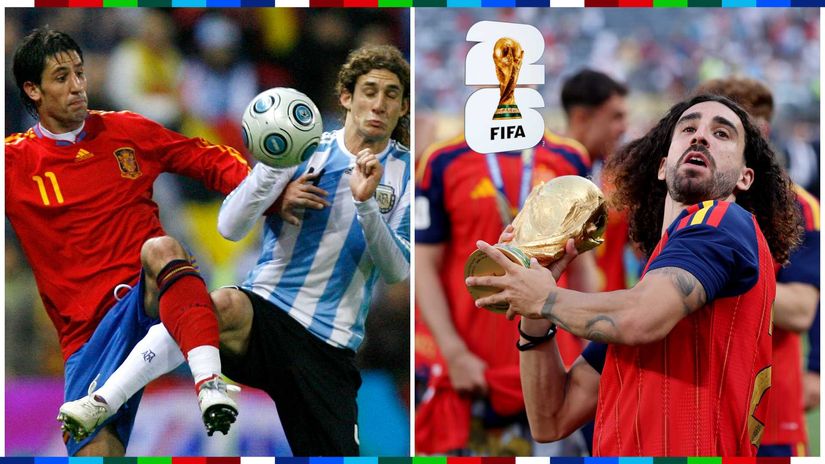
Spain’s victory confirms their status as the preeminent force in international football, becoming only the fourth men's nation to hold both the European Championship and the FIFA World Cup simultaneously.
Their broader tournament metrics reflect historical perfection: de la Fuente’s side never trailed at any point during the tournament, conceded just a single goal across eight matches (0.125 per game), and allowed a microscopic 2.3 total expected goals (0.3 xG per game) - the lowest per-game xG allowed figure ever recorded at a men's World Cup.
Extended to a record-breaking 38-game unbeaten run (W29 D9), Spain’s world title was not achieved through temporary momentum, but through structural mastery, relentless counter-pressing, and unmatched positional superiority.