


TACTICAL ANALYSIS: Inside the Black Star’s win over Panama
.jpg)

.jpg)
.jpeg)
Reading Time: 7min | Fri. 19.06.26. | 13:45
Ghana may need significant improvement in the final third moving forward, but their ability to remain organised, adjust strategically and capitalise on a decisive transitional moment ultimately delivered a priceless victory that could prove crucial in the race for qualification from Group L
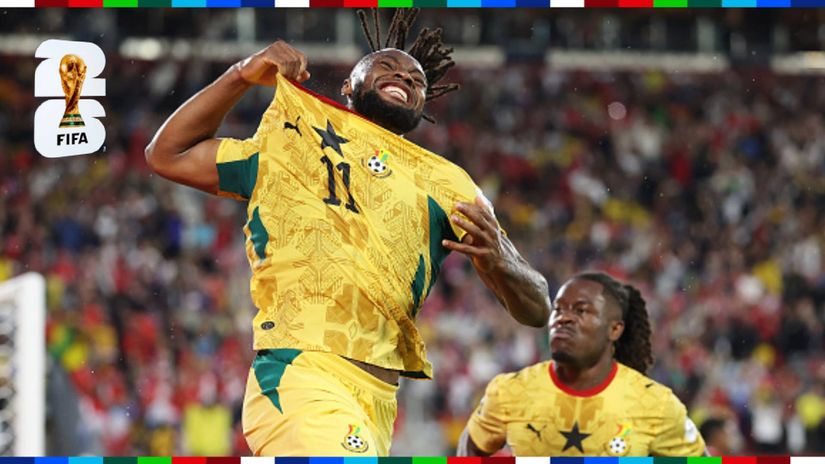
Ghana secured a dramatic 1-0 victory over Panama in their opening Group L fixture, with Caleb Yirenkyi’s stoppage-time winner finally separating two sides that had been locked in a tense tactical battle throughout the contest.
Download our MozzartSport App For More News
In a match where clear-cut opportunities were scarce and both teams struggled for attacking fluency, the Black Stars ultimately found the decisive moment through a devastating transition that punished Panama’s late-game commitment forward.
The result was hugely significant in the context of Group L, especially after England’s victory over Croatia earlier in the group. Ghana entered the game knowing that three points would provide a major boost to their qualification hopes, while Panama viewed the fixture as a realistic opportunity to secure a positive result against one of the group’s direct rivals.
Although Ghana emerged victorious, the tactical story was far more complex than the scoreline suggests.
Ghana began the match in a 4-2-3-1 structure. Lawrence Ati-Zigi started in goal behind a back four consisting of Marvin Senaya at right-back, Jonas Adjetey and Jerome Opoku as the centre-backs, and Gideon Mensah at left-back.
Elisha Owusu partnered Caleb Yirenkyi in central midfield, while Antoine Semenyo operated from the left wing and Ernest Nuamah from the right. Kamaldeen Sulemana played as the attacking midfielder behind Jordan Ayew, who led the line.
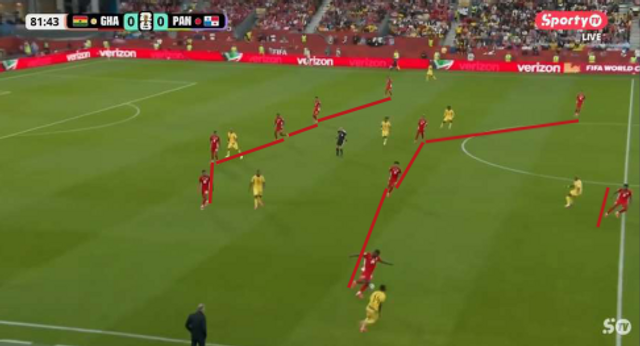
Panama set up in a flexible 3-4-3 that frequently resembled a 3-2-5 in possession and a 5-4-1 out of possession.
Orlando Mosquera was protected by a back three of Jiovany Ramos, José Córdoba and Andrés Andrade.
Amir Murillo and César Blackman provided width from wing-back zones, while Carlos Harvey and Yoel Bárcenas occupied central midfield positions.
Ahead of them, Cristian Martínez and José Rodríguez operated as inside forwards supporting striker Cecilio Waterman.
From the opening stages, Panama’s in-possession structure was the more aggressive of the two.
Their 3-2 base allowed the wing-backs to push high and create a front five across the attacking line.
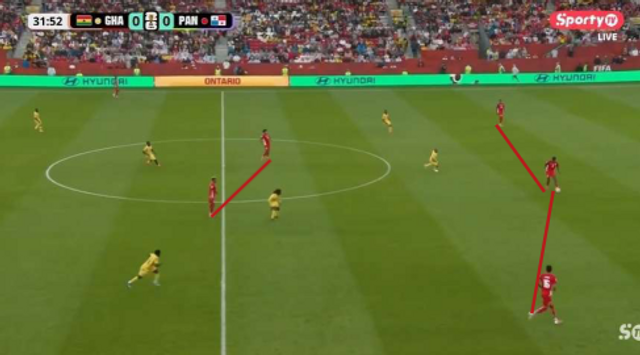
This immediately stretched Ghana’s defensive shape horizontally and created opportunities to attack wide areas. Panama consistently looked to switch play from one flank to the other, attempting to isolate Ghana’s full-backs in one-versus-one situations against advancing wing-backs.
The Central American side’s attacking approach was built around verticality. Rather than circulating possession slowly, they sought direct progression through midfield and early deliveries into dangerous areas from wide areas.
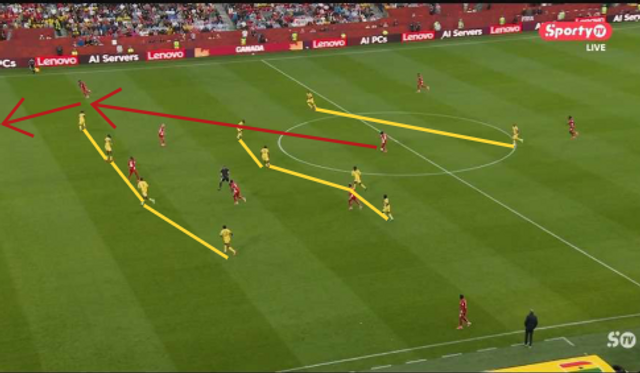
Rodríguez, operating from the left-sided inside-forward position, became an important outlet during these phases in the first half particularly. Panama repeatedly targeted him with forward passes before looking to deliver crosses towards Waterman inside the penalty area.
Their very first major opportunity emerged from precisely this approach, as Amir Murillo delivered an early cross that found Waterman, forcing Ati-Zigi into an excellent save.
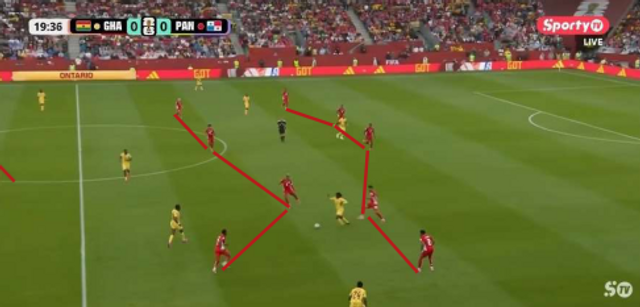
Ghana’s initial defensive structure out of possession resembled a 4-1-4-1 mid-block early on.
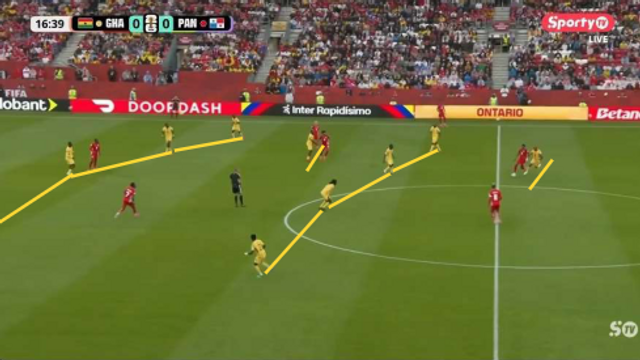
The Black Stars attempted to remain compact centrally while limiting Panama’s access into dangerous central zones. However, Panama’s width and frequent switches of play created problems during the opening exchanges, forcing Ghana’s defensive line to shift laterally on numerous occasions.
A key tactical adjustment arrived after the first-half hydration break. Ghana altered their defensive organization, transitioning into a more aggressive 4-4-2 mid-block.
At times this shape even collapsed into a deeper 5-3-2 structure when Panama sustained attacks.
The change significantly improved Ghana’s defensive coordination. The pressing became more synchronised, with the midfield and defensive lines shifting together rather than leaving gaps between units.
The most important feature of this adjustment was the behaviour of Ghana’s wide midfielders. Whenever Panama’s wide centre-backs received possession, Ghana’s wide players jumped aggressively to engage them.
This pressing trigger disrupted Panama’s build-up rhythm and prevented their back three from comfortably progressing possession into midfield.
Rather than allowing Panama to advance through controlled circulation, Ghana increasingly forced them into quicker decisions and less comfortable forward passes.
Despite this improved defensive organisation, Ghana struggled considerably in possession during the first half.
Their build-up lacked fluidity and they frequently bypassed midfield altogether. Goal-kick situations often saw direct balls launched towards Ayew, who was asked to compete aerially and hold possession higher up the pitch. While this strategy occasionally relieved pressure, it rarely resulted in sustained attacks.
The Black Stars attempted to exploit transitions, particularly through Ernest Nuamah on the right flank. Whenever possession was recovered, Ghana looked to release Nuamah quickly into space before Panama could reorganise defensively. However, the execution was inconsistent, and Panama’s back three generally dealt comfortably with these situations.
As the half progressed, right-back Marvin Senaya began advancing much more aggressively. His overlapping runs provided additional support for Nuamah and gave Ghana a wider attacking presence on the right side.
Nevertheless, the final product remained lacking. Ghana finished the opening period having produced only a single shot, underlining their difficulties in generating meaningful attacking sequences.
While Ghana struggled creatively, Panama continued threatening through their direct vertical approach.
Deep midfield passes frequently targeted forward runs from Martínez and Murillo, while crosses into the penalty area remained a recurring theme.
The movement of Waterman and the inside forwards consistently tested Ghana’s defensive concentration, although excellent interventions from Ati-Zigi prevented Panama from converting their territorial superiority into goals in the first half.
The second half brought immediate changes from Ghana. Ati-Zigi was replaced by Benjamin Asare in goal, while positional adjustments altered the attacking structure.
Sulemana moved to the left wing, Semenyo shifted into the striker role, and Ayew began operating underneath him as an advanced midfielder. The objective appeared to be increasing mobility between the lines and creating more dynamic attacking combinations.
The most significant transformation, however, occurred in Ghana’s defensive behaviour.
The Black Stars became far more aggressive immediately after the restart. Their counterpressing improved noticeably, and they sought to attack quickly whenever possession was regained. Rather than retreating into shape after recoveries, Ghana attempted to exploit transitional moments before Panama could re-establish defensive organisation.
A major tactical shift arrived in the 58th minute when Abdul Fatawu and Brandon Thomas-Asante entered the match. Their introduction fundamentally altered Ghana’s attacking dynamics.
Thomas-Asante’s mobility offered a more natural reference point in attack, while Fatawu provided fresh energy in the wide right area.
Following these substitutions, Ghana increasingly involved their full-backs in advanced phases. Both Senaya and Mensah pushed significantly higher, combining with the wingers and delivering crosses into the penalty area. This wider attacking structure pinned Panama’s wing-backs deeper than they had been during the first half.
As a result, Panama’s ability to sustain attacks diminished because their wing-backs were now spending more time defending.
The impact of Thomas-Asante became immediately evident. His movement across the front line created uncertainty within Panama’s defensive unit and generated Ghana’s best attacking moments.
One notable example arrived in the 64th minute when his delivery from the right found Ayew in a dangerous position, only for a crucial defensive intervention to deny what looked like a potential opening goal.
Panama responded with substitutions of their own, introducing fresh attackers in search of greater penetration.
The arrival of players such as Tomás Rodríguez’s replacement and later Ismael Díaz provided additional attacking thrust. Yet despite these changes, Panama increasingly found themselves in a stretched contest.
The final fifteen minutes saw the match enter a transitional phase where both sides traded attacks.
Defensive structures became less compact as fatigue emerged, creating larger spaces between units. Panama appeared the more likely side to score for periods, but Ghana’s organisation inside their defensive third remained disciplined. Adjetey continued to pose a threat from set pieces at one end while contributing crucial defensive actions at the other.
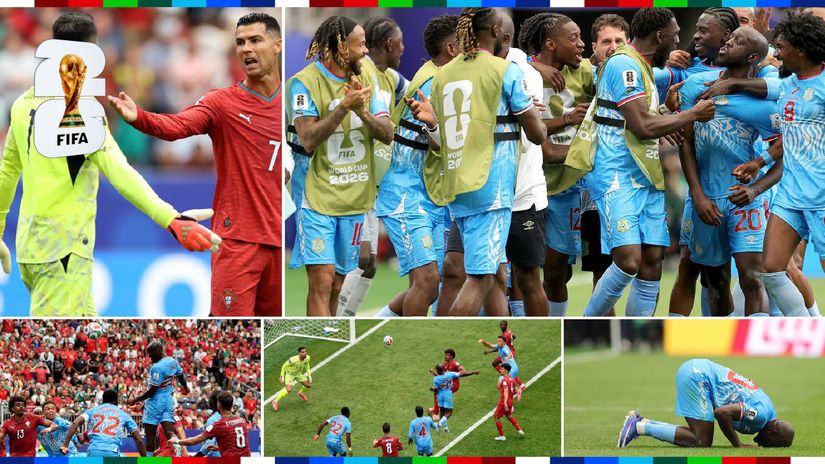
The decisive moment perfectly illustrated the importance of transitional efficiency. In stoppage time, Yirenkyi initiated a counterattack following a Ghana recovery.
The midfielder released Semenyo near the halfway line, and the forward quickly progressed play towards Thomas-Asante in the left wide position.
Rather than slowing the attack, Thomas-Asante drove directly into the final third before delivering a low cross into the six-yard box.
Crucially, Yirenkyi continued his run after starting the move. His late arrival into the penalty area went untracked by Panama’s retreating defenders, allowing him to meet the cross and finish from close range.
The goal was a textbook example of transition football: quick progression, direct running, intelligent movement and precise timing.
Even after conceding, Panama nearly rescued a point. A late set-piece situation saw goalkeeper Mosquera join the attack and win the initial aerial duel before Díaz forced Asare into an excellent save. It was the final act of an intensely competitive tactical battle.
Ultimately, Ghana’s victory was not built upon sustained dominance but rather on tactical persistence and improved second-half adaptation.
Their defensive adjustments during the first half gradually reduced Panama’s effectiveness, while the introductions of Fatawu and Thomas-Asante injected greater dynamism into the attack.
Panama’s verticality, wing-back usage and direct attacking approach caused numerous problems, yet their inability to convert promising situations in the first half particularly proved costly.
From a tactical perspective, the match demonstrated the value of defensive flexibility, game-state adaptation and transitional efficiency.