


TEAM ANALYSIS: Gor Mahia's secret weapon of the modern game that is bringing goals



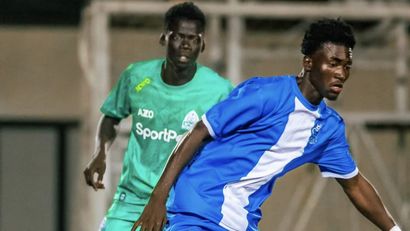

Reading Time: 5min | Fri. 20.02.26. | 19:00
What was once dismissed as a simple restart is now evolving into a carefully choreographed attacking pattern
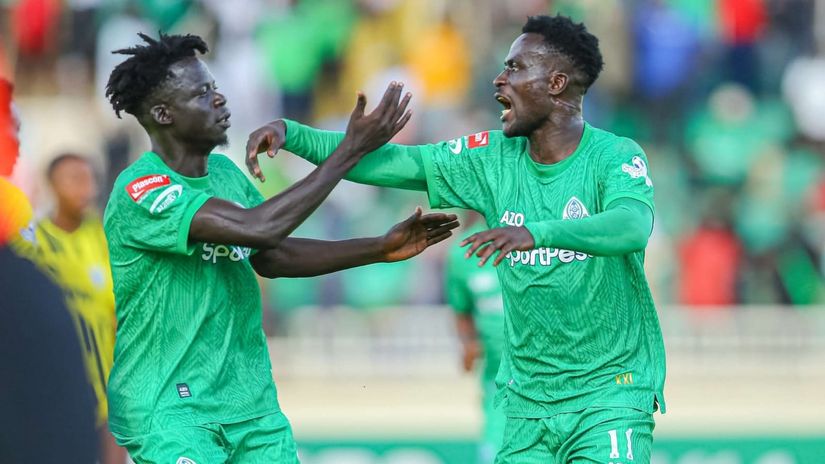
Long throws are quietly becoming a decisive tactical weapon again in the FKF Premier League, and few sides are exploiting them better than Gor Mahia FC.
Follow our WhatsApp channel for more news
What was once dismissed as a simple restart is now evolving into a carefully choreographed attacking pattern.
In a league where marginal gains often separate title contenders from the chasing pack, Gor Mahia have rediscovered the long throw as a repeatable, high-impact mechanism capable of destabilising defensive structures and generating clear scoring opportunities.
Across their last two fixtures, Gor Mahia have scored twice from long-throw situations.
These were not scrappy, random goals born out of chaos alone; they were the product of planning, spacing, timing and coordinated movement.
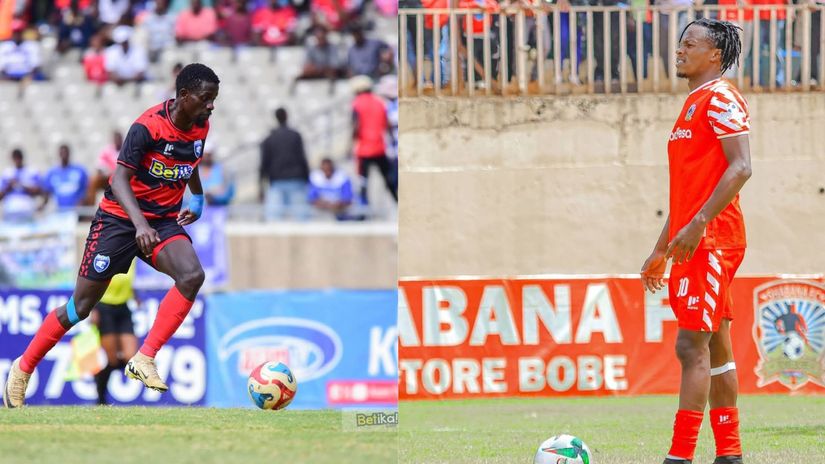
At the centre of this tactical resurgence are Enock Morrison and Samuel Kapen, whose ability to deliver long, flat, torpedo-like throws into high-threat zones has transformed throw-ins in the final third into something resembling a corner kick in motion.
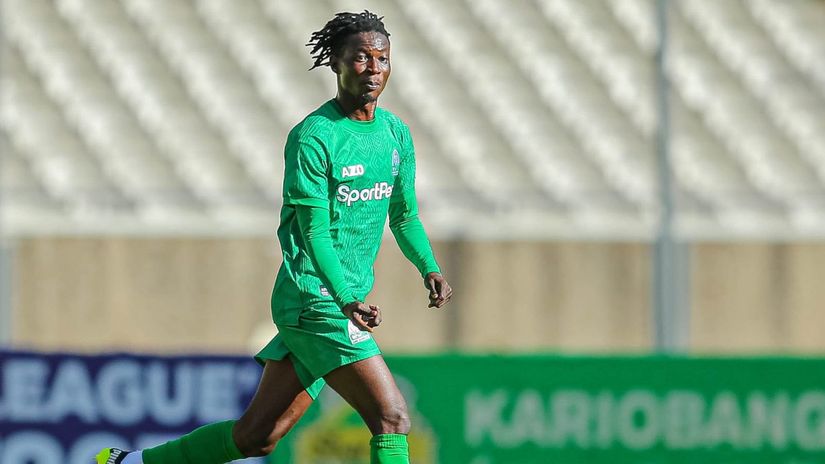
Structurally, the long throw functions as a hybrid between a corner and a crossing free-kick.
When Gor Mahia wins a throw deep in the attacking third, they resist the conventional urge to recycle possession backward.
Instead, they immediately push their centre-backs forward and flood the penalty area.
The broad principle is simple: create chaos, win the first contact, dominate the second ball.
Because a team cannot be offside from a throw-in, attackers are encouraged to move aggressively toward the byline and six-yard box without the usual spatial restrictions that govern open play.
The standard setup revolves around the layered occupation of zones.
Typically, two aerial targets attack the near-post channel.
A central runner times movement toward the penalty spot.
A back-post presence or two wait for flick-ons and rebounds. Another player positions himself on the edge of the box to attack loose balls.
In many cases, Gor Mahia commits two or three players to contest the initial contact and three more to anticipate the second phase.
This numerical density inside the six-yard box forces opponents to mirror defensive corner structures, often bringing all ten outfield players back to defend.
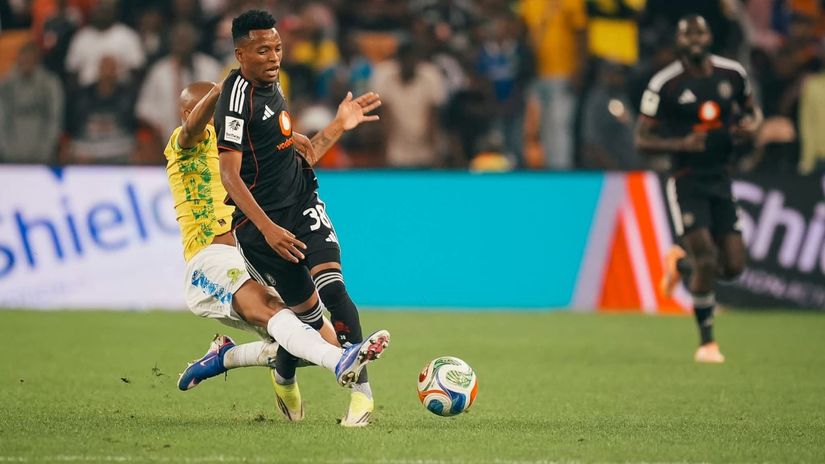
Defensively, opponents tend to replicate their corner routines: best aerial centre-backs in zonal positions close to the goalkeeper, with others man-marking perceived threats.
Yet throw-ins are psychologically and structurally different from corners. The ball arrives flatter and quicker, often within 2.4 seconds of release, leaving less time for adjustment.
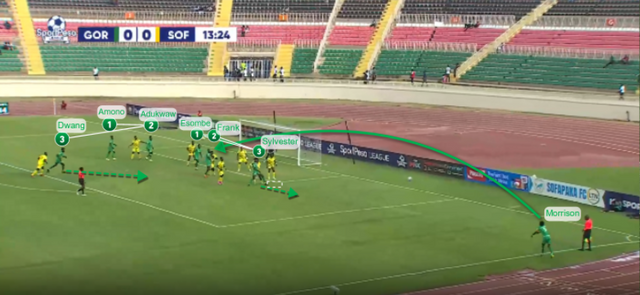
Morrison’s delivery against Sofapaka F.C. perfectly illustrated this.
His throw, launched toward the near corner of the six-yard box with an expected threat value of 0.24, dipped late and forced defenders to retreat while facing their own goal.
What followed was a masterclass in coordinated movement. Sofapaka employed a hybrid of zonal and man-marking, but mismatches in height and positioning were ruthlessly exposed.
Gor Mahia centre-back Sylvester Owino executed a decoy run and block that removed Charles Junior - Sofapaka’s primary aerial defender - from the immediate equation.
This subtle screen created a corridor for Frank Odhiambo, who attacked the ball unchallenged.
With Sofapaka’s other aerially-able enough centre-back Stephen Bonney, stationed zonally near the goal, Odhiambo met the flick and guided it over the goalkeeper for his first goal since returning to K’Ogalo.
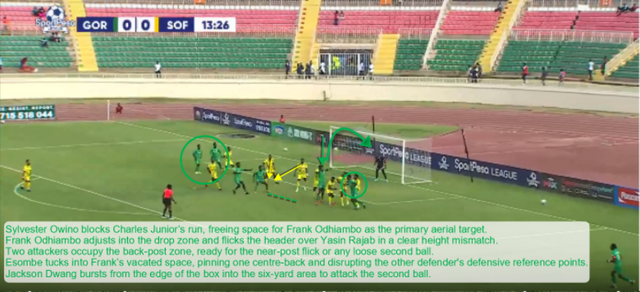
The choreography extended beyond the initial duel. Patrick Esombe’s decoy movement dragged two defenders into indecision.
George Amono and Ebenezer Adukwaw occupied the back-post zone, prepared for a flick-on or spill.
Jackson Dwang, stepping into a role often filled by Alpha Onyango, surged from the edge of the box toward the six-yard line to contest second balls.
The throw created layered confusion - defenders unsure whether to track runners or attack the ball - and that uncertainty proved decisive.
The same principles were evident in the winner against APS Bomet F.C
This time, Samuel Kapen delivered from a similar near-post corridor.
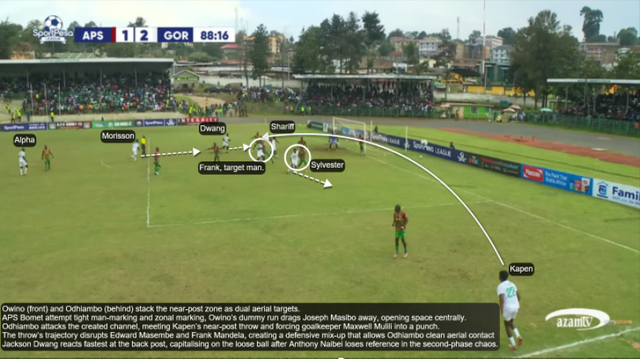
Again, Owino and Odhiambo advanced as dual aerial threats. APS Bomet’s centre-backs, Joseph Masibo and Edward Masembe, attempted tight man-marking, but Owino’s dummy run drew Masibo away, opening space for Odhiambo to attack.
The throw’s trajectory disrupted Edward Masembe’s positioning and caused a mix-up with left-back Frank Mandela.
Odhiambo’s header forced goalkeeper Maxwell Mulili into a punch, and Dwang reacted quickest at the back post to convert the rebound with his marker.
Midfielder Anthony Naibei was caught in a dilemma between securing the ball or picking up his man.
The pattern is unmistakable: win territory, deliver into the near-post drop zone, overload the six-yard box, dominate the second ball.
Even when the first header does not result in a goal, Gor Mahia remain aggressive in the rebound phase.
Dwang’s finish against APS Bomet mirrored the structural intention seen against Sofapaka - chaos engineered, second ball anticipated, defensive reference points lost.
Why is this approach flourishing now? Part of the answer lies in delivery quality.
Morrison and Kapen do not simply throw long; they throw with trajectory control and pace variation.
Their throws arrive flat yet dipping, forcing goalkeepers into awkward decisions: come and claim, stay and react, or punch under pressure.
Secondly, the blocking and decoy runs are intelligently timed. Owino’s screens are subtle enough to avoid fouls but effective enough to neutralise the opposition’s strongest aerial defender.
There is also a psychological dimension.
Repeated long throws pin opponents deep and build sustained territorial pressure.
Each throw becomes an event. Defenders must reset marking assignments repeatedly within short intervals.
Over time, concentration wavers. In both highlighted matches, the decisive moment emerged not merely from aerial superiority but from defensive hesitation under repeated stress.
League-wide, this resurgence signals a broader tactical evolution.
In environments where pitch conditions can hinder fluid build-up play, direct and rehearsed set-piece routines offer reliable scoring avenues.

Teams are increasingly recognising that throw-ins in advanced areas are not neutral situations but potential high-value chances.
Flooding the six-yard box, stacking aerial centre-backs forward, and targeting mismatches are becoming recurring themes.
For Gor Mahia, the rewards are immediate and measurable: two goals in two matches directly stemming from long throws.
But beyond the statistics lies a blueprint - disciplined structure, intelligent movement, and calculated chaos.
If this trend continues across the FKF Premier League, long throws may permanently shed their reputation as mere restarts and instead be acknowledged as a strategic weapon capable of shaping title races and defining tight contests.