


TACTICAL ANALYSIS: How Mamelodi Sundowns structurally disarmed Orlando Pirates


.jpg)
.jpg)
Reading Time: 5min | Thu. 19.02.26. | 13:48
The contest was not simply decided by moments of finishing quality from Bryan Leon, but by how Sundowns engineered spatial superiority against Pirates’ proactive 4-3-3
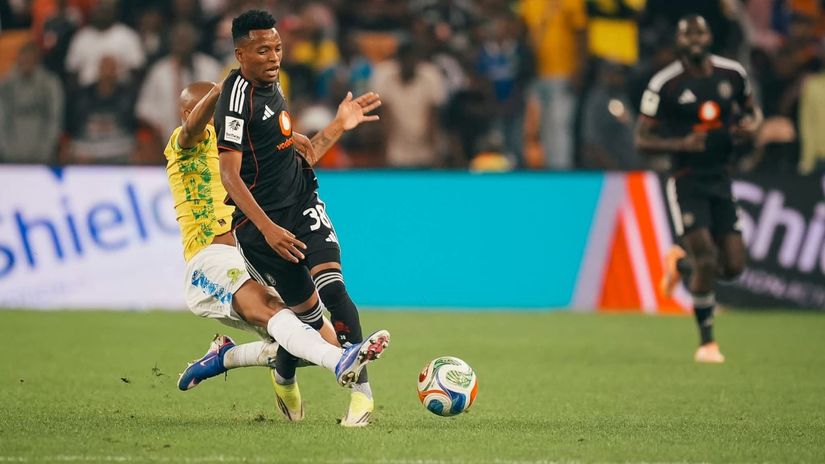
Mamelodi Sundowns secured a 2-1 victory over Orlando Pirates in a match defined by structural manipulation, half-space occupation, and calculated exploitation of fullback aggression.
The contest was not simply decided by moments of finishing quality from Bryan Leon, but by how Sundowns engineered spatial superiority against Pirates’ proactive 4-3-3.
Follow our WhatsApp channel for more news
Orlando Pirates began in a nominal 4-3-3. Sipho Chaine operated behind a central pairing of Seema Lebone and Nkosinathi Sibisi, with Sebelebele Kamogelo and Deon Hotto pushing aggressively from fullback.
Makhehlene Makhaula anchored midfield as the pivot, flanked by Patrick Masangwanyi and Nemtajela Masindi, who alternated between progression and creative support.
Relebohile Mofokeng and Oswin Appollis provided width, while Yanela Mbuthuma acted as the central striker threatening depth.
Sundowns lined up in a 4-2-3-1 on paper but consistently morphed into a 3-2-5 in possession.
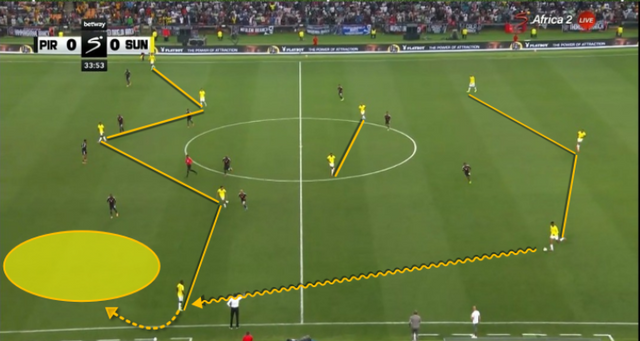
Ronwen Williams was protected by a back three of Khuliso Mudau, Khulumani Nadamane, and Grant Kekana.
Jayden Adams and Teboho Mokoena formed the double pivot.
Ahead of them, Nuno Santos and Tashreeq Mathews operated as narrow half-space attackers, Aubrey Modiba and Thapelo Morena held width, and Bryan Leon led the line.
Pirates pressed in a high 4-3-3 that often resembled a 4-4-2 out of possession.
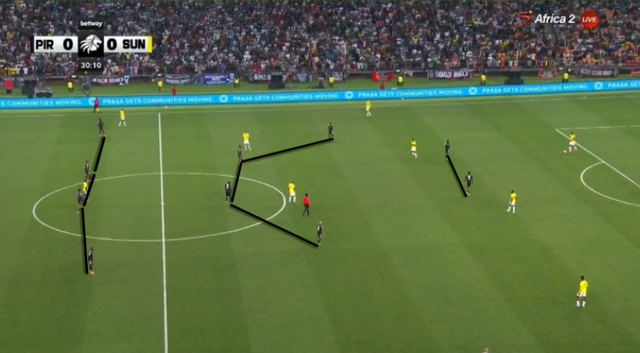
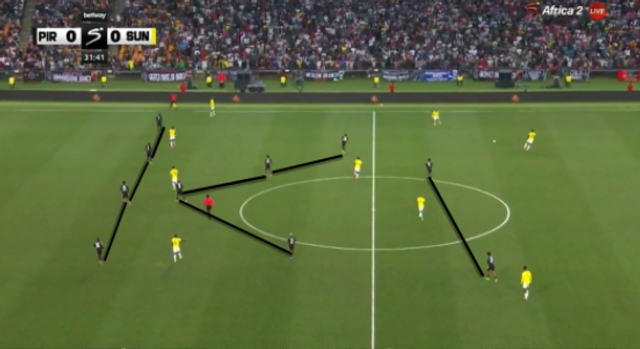
Their objective was to suffocate early build-up and isolate Sundowns wide. However, Sundowns deliberately lured this pressure.
Low build-up phases saw Nadamane circulate short passes before launching diagonals to Modiba on the far side.
This forced Pirates to sprint laterally and opened interior lanes. On the right, triangles between Mokoena, Mudau, and Morena created third-man combinations to bypass the first line.
The principle was simple: attract pressure centrally, release wide, attack the vacated corridor.
This was not random switching - it was structural bait.
Pirates’ attacking ambition came with risk. Both fullbacks consistently pushed high to overload wide areas, especially when Appollis dropped centrally delivering crosses toward Mbuthuma.
While this created offensive momentum, it exposed transition channels.
Sundowns repeatedly targeted the space behind Sebelebele on the right side of Pirates’ defence. Modiba stayed high on the opposite flank, while Mathews drifted into the left half-space to combine and destabilise the defensive line.
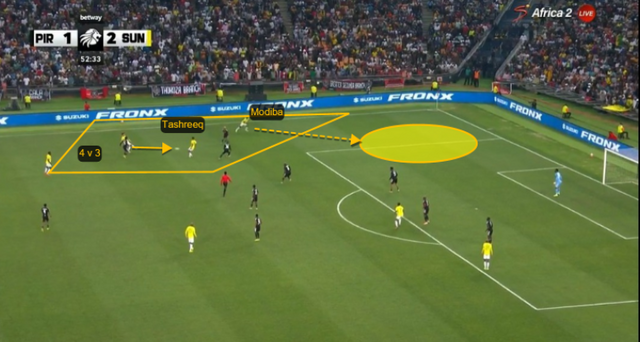
When possession was secured, quick vertical passes attacked these vacated lanes.
The opening goal illustrated this perfectly. Santos dropped into midfield to draw markers, then found Leon with a penetrative pass. Leon’s run split the centre-backs, and his finish gave Sundowns the lead in the 37th minute.
The movement - drop, draw, penetrate - was a recurring pattern.
A minute later, structural superiority became clinical punishment. Sundowns recycled possession leftward, isolating Modiba high and wide.
With Pirates compact centrally after being pulled deep, Modiba delivered a low cross to Leon, who peeled between the centre-backs for his second. Two goals in two minutes, both derived from manipulated spacing.
Sundowns’ 3-2-5 allowed five players to pin Pirates’ back line.
The wide attackers stretched horizontally, while Santos and Mathews occupied interior channels. This created dilemmas: step out and leave space behind, or hold shape and concede central access.
Modiba occasionally inverted into midfield before drifting back wide, while Mathews alternated between touchline width and inside penetration. These rotations destabilised Pirates’ defensive references.
Meanwhile, Pirates attempted their own positional fluidity. Mofokeng briefly rotated to the right, Appollis drifted centrally, and Masangwanyi made late runs beyond Mbuthuma.
The intention was to disrupt Sundowns’ marking structure, but Sundowns’ rest-defence remained composed.Pirates counter-pressed aggressively.
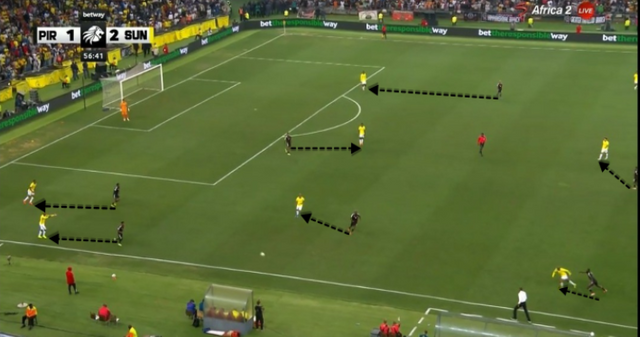
Upon losing possession, Masangwanyi and Mofokeng immediately collapsed toward the ball, attempting to trap Sundowns high. Their pressing intensity forced moments of instability and nearly paid off earlier, when Williams made a superb save following a deflection.
However, Sundowns’ rest-defence structure - three defenders plus a pivot - ensured numerical security behind the ball. Even when pressed, they retained short passing options and vertical outlets deep inside their box.
Pressing shape is only effective if it controls second balls. Sundowns frequently forced Pirates into rushed long deliveries, recovering loose clearances through compact central positioning.
Pirates struck immediately after the break. A deflection off Mokoena led to Masangwanyi scoring from outside the box after the ball struck the crossbar earlier on. At 2-1, momentum shifted.
Sundowns adjusted out of possession, transitioning into a 4-1-3-2 and later a 5-3-2/5-4-1 hybrid.
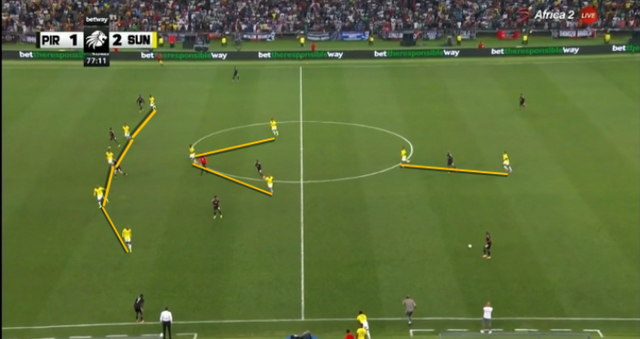
Morena dropped deeper to form a temporary back five, protecting the channels Pirates were targeting.
Pirates sought to stretch the block by switching play toward Hotto on the left and later intensifying right-sided combinations between Appollis and Mbuthuma. They pressed with greater aggression, forcing Sundowns to accelerate circulation.
Substitutions reinforced tactical intent. Marcelo Allende replaced Santos, adding ball retention and control.
Tshepang Moremi came on for Pirates, increasing vertical thrust in attacks. Yet as minutes progressed, Sundowns reduced tempo deliberately.
By the 82nd minute, Sundowns were circulating possession methodically, managing space rather than chasing territory. The defensive line implemented an offside trap within a compact 5-4-1, eliminating through-ball threats.
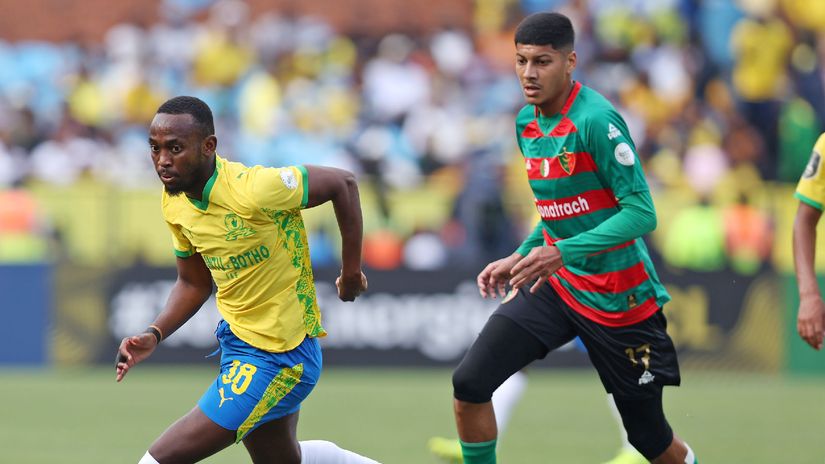
Late phases saw Sundowns prioritise compactness over expansion. Lines remained narrow, denying central penetration. Pirates were forced wide, where crossing lanes were contested aerially.
Importantly, Sundowns did not abandon transitional threat. Around the 75th minute, they targeted counterattacks when possession was regained, exploiting Pirates’ continued fullback aggression.
Rest-defence was not passive; it was anticipatory. Spacing behind the ball ensured that even when Pirates committed numbers forward, Sundowns could absorb and release.
This match was shaped by structural clarity. Pirates’ proactive fullback positioning created offensive width but exposed transitional channels. Sundowns’ 3-2-5 provided numerical superiority in build-up and consistent half-space occupation.
The decisive theme was repeated exploitation of one weakness: the space behind aggressive wide defenders. Both goals stemmed from manipulating that corridor through rotation, patience, and vertical timing.
Pirates’ counter-press and second-half aggression showed tactical bravery, but without structural security, momentum remained fragile.
Ultimately, Sundowns did not merely win through moments - they imposed spatial logic. Their build-up manipulation, half-space control, and game-state management demonstrated why structural discipline often outlasts intensity.