


.jpg)
African Olympic mystery - Ugandan athlete missing from training camp after not attending a Covid19 test
.jpg)



.png)
Reading Time: 3min | Fri. 16.07.21. | 15:00
Ugandan weightlifter Julius Ssekitoleko still absent
In a case raising questions over Japanese organizers’ oversight of Olympic participants amid local coronavirus concerns, local officials are searching for a Ugandan athlete who went missing in western Japan on Friday.
City officials said that the missing 20-year-old Julius Ssekitoleko was training as part of the nine-member Ugandan team in Izumisano, Osaka prefecture.
Officials also stated that the teammates realized the athlete was absent around noon Friday when his saliva test sample was not delivered and they found his hotel room empty.
The athlete was last seen in his room in the early hours of Friday - no training session for his teammates was held Friday morning.
Officials notified police for a broader search after failing to find him inside the hotel. Exactly when or how he got out of the hotel was unknown since there was no 24-hour monitoring.
"One member of the Ugandan delegation, which the city received as a host town, has gone missing and cannot be reached," the city near Osaka said in a statement.
"The city is making all efforts to search for the individual. We have reported the matter to police."
Ugandan sports officials said the athlete had recently found out he would not be able to compete at the Games because of a quota system.
Salim Musoke Ssenkungu, president of the Ugandan Weightlifting Federation, told AFP that Ssekitoleko had been training "very hard" for his first Olympic weightlifting competition but was told this week that he would not be allowed to compete and had to return home.
"If someone is there in Japan and is assuming he is going to compete but then gets bad news, of course he is going to be upset," Ssenkungu said.
.jpg)
The young athlete had recently won a bronze in the Africa Weightlifting Championships and was considered experienced despite his youth, he added.
"He's not from a rich family so it took a lot of interest and energy from him to be successful," Ssenkungu said.
Donald Rukare, president of the Uganda Olympic Committee, said officials had only just been informed about the disappearance. "We are also trying to find out (what happened). We are in contact with the team in Osaka," he told AFP.
Julius Ssekitoleko must have been in desperate situation if disappearing in a strange Japanese city - where he presumably does not speak the language - 500km from Tokyo was more preferable than going home. Hopefully he will be okay #Olympics #Tokyo2020 #weightlfting #Uganda https://t.co/Fgi9krOavj
— Duncan Mackay (@Duncan_ITG) July 16, 2021
The Ugandan team already went through quite a safety procedure since landing in Japan.
On their arrival on June 19 at Narita International Airport, a member of the team tested positive and was quarantined there, while the remaining eight members were allowed to travel more than 500 kilometers (300 miles) on a chartered bus to Izumisano, their pre-Olympics camp in the western prefecture of Osaka.
A second member of the East African team tested positive for the virus days later, which forced seven town officials and drivers who had close contact with the team to be moved to self-isolation. Both infected Ugandans had the delta variant of the virus, health officials stated.
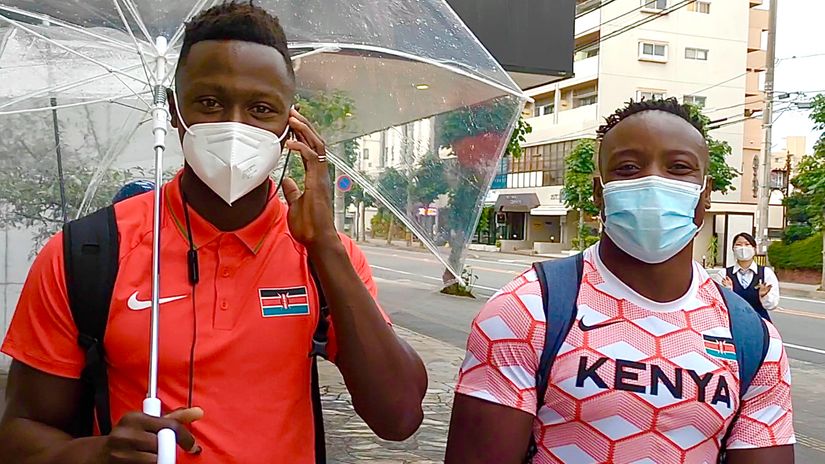
Since that occurrence, both team members have ended their quarantine and the team has been training normally since July 7.
Ugandan athletes case prompted the Japanese authorities to change isolation policy to require entire groups to quarantine in airport areas when any member tests positive and with that to step up border controls.
Violations of protocols have been reported even though Japanese officials have required the use of health and location apps and restricted activity in a “bubble” to fully isolate athletes from the Japanese public.
Olympic Minister Tamayo Marukawa pledged earlier that at a number of hotels monitors have not been seen operating. Reporters were told on Friday that Marukawa is asking organizers to strengthen measures and increase surveillance staff to make sure rules are followed.
The pandemic-delayed Olympics begin on July 23 despite mounting concern about Tokyo’s upsurge of infections.
.jpg)

.jpg)