



The role of science in Faith Kipyegon’s record-breaking attempt





.jpg)



Reading Time: 4min | Thu. 26.06.25. | 09:13
Mozzart Sport takes a look at some of the science-boosted elements engineered to give her a shot at rewriting the limits of female endurance
7.65 seconds.
That is the time triple Olympic 1,500m gold medalist Faith Kipyegon needs to shave from her world record time to become the first woman to run the mile in under 4 minutes.
Follow Our WhatsApp Channel For More News
Her current record stands at 4:07.64.
Kipyegon has spent months training for an exhibition on Thursday, 26 June in Paris, where she will take a shot at making history.
The event, dubbed Breaking4, is being staged by Nike.
To help her make history, an entire ecosystem of experts, from physiologists and biomechanists to shoe designers and data analysts, has been mobilized to fine-tune every possible element of her performance and trim every hundredth of a second from her time.
Mozzart Sport takes a look at some of the science-boosted elements engineered to give her a shot at rewriting the limits of female endurance.
Perfect place and time
The race will unfold at Stade Sébastien Charléty in Paris, a location chosen not just for its modern 20,000-seat stadium, but for the data-backed benefits it offers.
At just 115 feet above sea level, the city offers a high-oxygen environment, an advantage for Kipyegon, who trains at nearly 8,000 feet in Kaptagat.
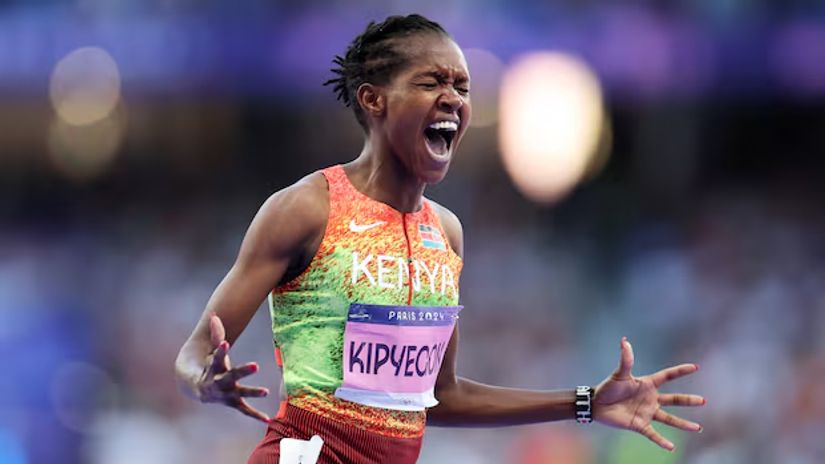
At such elevations, the human body responds by making more red blood cells, which enable it to carry more oxygen with every heartbeat.
Paris’s weather is another factor. With temperatures expected to hover around 68°F and humidity at 50 percent, the evening setting is meant to reduce wind and allow for optimal performance.
The same track hosted Kipyegon’s 1500m world record in 2023, offering a psychological boost.
Wavelight and Pacer Power
One of Kipyegon’s greatest advantages will come from the Wavelight pacing system.
This ring of 400 computer-controlled lights along the inner lane sets a pre-programmed pace, acting as a visual guide.

She will also be aided by human pacers, a method borrowed from Eliud Kipchoge’s sub-two-hour marathon.
These runners shield her from wind resistance, which can boost oxygen demands by 5 to 10 percent and help her lock into a rhythm, especially during the dreaded third lap, often referred to as “the loneliest minute in sports.”
In a 2023 study, Rodger Kram, an integrative physiology professor at the University of Colorado Boulder, predicted a sub-4-mile mile was possible for a runner like Kipyegon using a pacer four feet ahead and another four feet behind, reducing drag from both directions.
Custom spikes and speedwear
If her body is the engine, her gear is the aerodynamic shell.
Kipyegon will wear bespoke Nike spikes, each weighing just 85 grams, lighter than a deck of cards.
Built with new, translucent yarn and bolstered by a higher forefoot Air Zoom unit, the shoes are engineered for energy return and minimal drag.

“A shoe nearly 30 grams lighter could make her almost 0.3 percent faster, potentially saving about 0.7 seconds,” Kram explained.
Her race-day outfit is also tailored for speed.
The Nike-designed bodysuit, leggings, and armbands are embedded with thousands of tiny aero nodes to smooth airflow.
She will also wear a 3D-printed, ultralight bra molded from thermoplastic, all aimed at reducing surface drag, a strategy similar to the tech used in banned Speedo swimsuits of the past.
Legal performance-enhancers
There are several substances approved for competition by the World Anti-Doping Agency that Kipyegon could take before running to shave off a few more milliseconds.
Caffeine, beet-root juice, and baking soda have all been shown to boost an athlete’s performance. Kipyegon and her team declined to say which substances she might use, if any.
Though the attempt will not be eligible for official world record recognition due to assisted pacing and technology, the symbolism of the effort goes far beyond a time on the clock.
For Kipyegon, this is about pushing the boundaries of what women in sport can achieve, about owning the moment on her terms, much like Kipchoge did for men’s marathon running in 2019.

Should she succeed, Faith Kipyegon would become the first woman in history to run a mile in under four minutes, an achievement that would transform her from a champion to a legend of the impossible.